
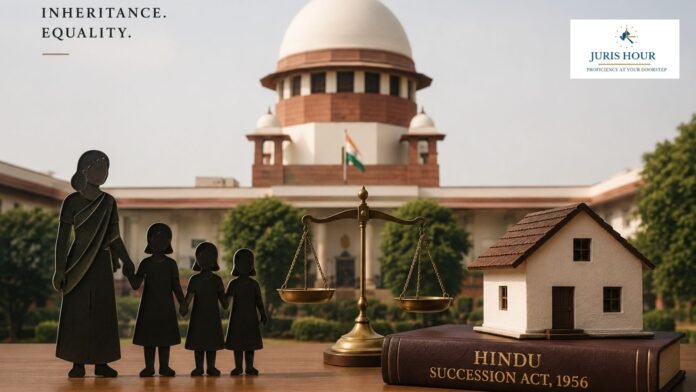
The Supreme Court has reaffirmed a significant principle governing inheritance under the Hindu Succession Act, 1956, holding that heirs inheriting property under Section 8 of the Act take it as tenants-in-common with definite shares and not as members of a Hindu coparcenary, consequently, a widow inheriting such property cannot claim the status of ‘karta’ to alienate the shares belonging to other heirs on grounds of legal necessity.
The bench of Justice Sanjay Karol and Justice Augustine George Masih dismissed an appeal filed by a widow challenging a Bombay High Court judgment that had restored a trial court decree in a decades-old family partition dispute involving agricultural lands and houses situated in Maharashtra. The litigation, which had continued for more than fifty years, arose between a stepmother and her four stepdaughters over the estate of a deceased Hindu male who died intestate.
The dispute centered on whether the widow could validly sell a portion of the inherited property on the ground of legal necessity for the marriage expenses of one of the daughters. The widow contended that she was managing the family property as its karta and therefore possessed authority to alienate part of the estate. While the First Appellate Court accepted this argument and upheld the sale, the High Court reversed that decision and restored the trial court’s decree in favour of the daughters.
Before the Supreme Court, the principal question was whether heirs succeeding under Section 8 of the Hindu Succession Act hold inherited property as joint tenants forming a Hindu coparcenary, or as tenants-in-common possessing separate and identifiable shares. The answer to this issue would determine whether the widow could exercise powers akin to a karta over the entire property.
Examining Sections 8, 10 and 19 of the Hindu Succession Act, the Court emphasized that when a Hindu male dies intestate, his Class I heirs inherit the property in equal shares and hold it as tenants-in-common. Section 19 specifically provides that where two or more heirs succeed together to the property of an intestate, they take the property “as tenants-in-common and not as joint tenants.”
The judgment contains an elaborate discussion on the distinction between joint tenancy and tenancy-in-common. The Court explained that in a joint tenancy, ownership is collective and governed by the rule of survivorship, meaning the interest of a deceased co-owner automatically passes to surviving co-owners. In contrast, tenancy-in-common recognizes separate and identifiable shares, and upon the death of a co-owner, that share devolves upon the owner’s legal heirs rather than surviving co-owners.
Tracing the legal position through a series of landmark precedents, the Court referred to decisions including Jogeswar Narain Deo v. Ram Chund Dutt, CWT v. Chander Sen, Yudhishter v. Ashok Kumar, and M. Arumugam v. Ammaniammal. The Bench reiterated that property inherited under Section 8 of the Hindu Succession Act becomes the individual property of the heir and does not acquire the character of Hindu Undivided Family property merely because it originated from an ancestor. Descendants do not obtain rights in such property by birth.
The Court observed that once succession opened on the death of the deceased owner, the widow and the four daughters each acquired a one-fifth share in the estate. Since each heir possessed a definite and separate share, the widow had authority only over her own one-fifth interest and could not deal with the remaining shares belonging to the daughters. The Bench held that the concept of karta-ship could not be invoked in such circumstances because the property had devolved through statutory succession and not through the traditional coparcenary system governed by survivorship.
Rejecting the widow’s defence based on legal necessity, the Court concluded that no question arose of her acting as karta to sell a part of the entire property for family purposes. Even if the sale was purportedly undertaken for the marriage of one of the daughters, such a transaction could not bind the separate shares of the other heirs.
Accordingly, the Supreme Court dismissed the appeal and upheld the High Court’s decision restoring the decree for partition. The Bench expressed hope that the conclusion of the litigation would finally bring an end to a family dispute that had persisted for more than half a century and enable the parties to move forward peacefully.
Case Details
Case Title: Darubai & Anr. Versus Kamalabai & Ors.
Citation: JURISHOUR-1506-SC-2026
Case No.: Special Leave Petition(Civil) No. 13232 of 2022
Date: 01/06/2026

