
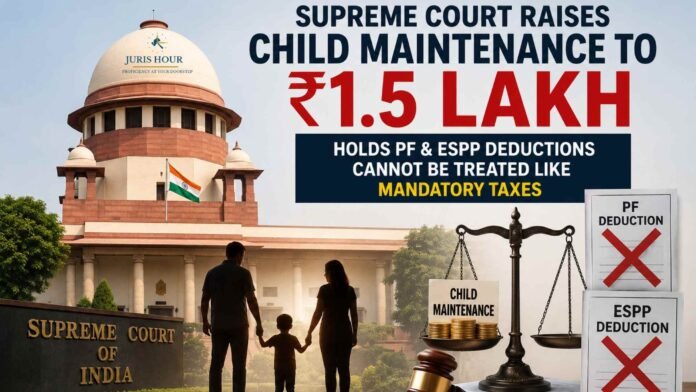
The Supreme Court has held that deductions towards Provident Fund (PF) and Employee Stock Purchase Plans (ESPPs) cannot be treated on the same footing as mandatory deductions such as income tax and professional tax while assessing the husband’s disposable income for maintenance.
The bench of Justice Sanjay Karol and Justice Nongmeikapam Kotiswar Singh has enhanced the monthly maintenance payable for two minor children to ₹1.50 lakh, or ₹75,000 per child, while also increasing the wife’s maintenance to ₹30,000 per month, taking into account her medical expenses and responsibility of caring for the children.
The dispute arose from matrimonial proceedings between the parties, whose marriage was solemnised in New Delhi on December 9, 2004. They have two sons, born in 2011 and 2014. The husband left the wife and children on June 21, 2018, following which the wife instituted divorce proceedings under Section 13(1)(ia) of the Hindu Marriage Act, 1955.
Buy Now: 50+ Supreme Court Judgments – July 2026
Along with the divorce petition, the wife sought interim maintenance under Sections 24 and 26 of the Hindu Marriage Act. She initially sought ₹2 lakh per month for herself and the two children, besides litigation expenses. She pointed out that she was bearing school fees and the EMI on the residential property. At that stage, the Family Court found that the wife had a net monthly income of approximately ₹91,000, whereas the husband’s net income was around ₹2.70 lakh. The Family Court consequently awarded ₹37,000 per child per month initially and enhanced it to ₹40,000 per child from January 1, 2021.
The Delhi High Court subsequently affirmed the maintenance order, observing that maintenance assessment involves a reasonable approximation rather than mathematical exactitude. It also took into account the wife’s monthly mortgage EMI of ₹48,888, school fees of approximately ₹23,000 per child and other expenses relating to tuition, sports and extracurricular activities.
As the children’s expenses increased, the wife sought enhancement of their maintenance in October 2022. She claimed that documented monthly expenses for the children had reached ₹1,66,847, while their combined school fees had increased to approximately ₹55,690 per month. She also alleged delays in the payment of maintenance by the husband.
The Family Court, by its order dated July 12, 2024, enhanced maintenance to ₹50,000 per child per month from April 2024, besides holding the husband liable for the enhanced school fees.
The wife thereafter approached the Delhi High Court seeking further enhancement. During the pendency of the proceedings, she was diagnosed with aggressive breast cancer on August 16, 2024. Taking note of her medical condition, the High Court directed the husband on December 10, 2024 to pay her ₹20,000 per month towards maintenance from December 1, 2024.
The proceedings also involved the husband’s alleged non-compliance with maintenance directions. On February 27, 2025, the Delhi High Court noted his admission regarding non-compliance and initiated suo motu contempt proceedings. The husband challenged the interim medical-maintenance direction before the Supreme Court, but his challenge was dismissed on May 6, 2025.
Despite this, arrears remained unpaid. The Delhi High Court subsequently characterised the conduct as aggravated contempt and directed the husband’s personal appearance.
On August 14, 2025, the Delhi High Court concluded that the amount awarded by the Family Court was inadequate. It enhanced the maintenance payable for the two children to ₹1.25 lakh per month from April 2024, observing that children are entitled to facilities comparable to those enjoyed by their parents.
The High Court also closed the contempt proceedings and, subsequently, by its clarification order dated September 2, 2025, granted the husband six months to clear the accumulated arrears while directing him to continue paying ₹1.25 lakh per month.
The wife approached the Supreme Court seeking, among other things, reconsideration of the quantum and clarification regarding the husband’s actual disposable income and the nature of deductions made from his salary.
A significant issue before the Supreme Court was the manner in which deductions from the husband’s salary should be considered for determining his capacity to pay maintenance.
The Delhi High Court had recorded the husband’s monthly income at approximately ₹4.50 lakh, including salary and average bonus. It had treated deductions of approximately ₹1,64,856 towards income tax, provident fund, professional tax and other components, leaving approximately ₹2.80 lakh per month.
The wife argued before the Supreme Court that several deductions relied upon by the husband were voluntary and could not be used to artificially reduce his income available for maintenance.
The Supreme Court accepted this submission in part. It specifically examined the treatment of Provident Fund and ESPP deductions.
The Court observed that PF contributions and ESPPs ultimately constitute benefits accruing to the husband himself. Unlike income tax and professional tax, which are mandatory statutory payments, PF and ESPP amounts are not permanent charges because the amounts ultimately accrue to the employee and may be withdrawn or otherwise benefit him in the future.
The Court therefore distinguished such deductions from mandatory taxes while assessing the husband’s financial capacity to pay maintenance.
The Supreme Court further took note of the wife’s medical condition. It observed that she was undergoing treatment for cancer while also looking after both children who were residing with her.
The Court noted that although the Delhi High Court had earlier directed payment of ₹20,000 per month towards her maintenance from December 2024, this amount had not been reflected in the High Court’s final order dated August 14, 2025. Considering her medical expenses, the Supreme Court found it appropriate to enhance her maintenance to ₹30,000 per month.
The Supreme Court ultimately held that the maintenance quantum fixed by the Delhi High Court required reconsideration.
The Court enhanced the monthly maintenance for the two children from ₹1.25 lakh to ₹1.50 lakh in total, i.e. ₹75,000 per child, with effect from January 1, 2025. The Court also clarified that the wife would not be precluded from seeking a further enhancement if circumstances change in the future.
Thus, the Supreme Court’s final directions resulted in:
| Component | Supreme Court Direction |
| Maintenance for Child 1 | ₹75,000/month |
| Maintenance for Child 2 | ₹75,000/month |
| Total child maintenance | ₹1,50,000/month |
| Wife’s maintenance | ₹30,000/month |
| Effective date for enhanced child maintenance | January 1, 2025 |
The Supreme Court also noted the undertaking given by the husband before the Delhi High Court regarding transfer of ownership of the vehicle to the wife. Since the undertaking had already been recorded, the Supreme Court found that no further substantive direction was necessary on that aspect.
However, it directed the husband to complete the necessary steps within three months from the date of the Supreme Court’s order. The civil appeals were accordingly disposed of.
Membership Required to Access Case Details & Order Copy
To view the complete Case Details and Download Order Copy, you must have an active membership. Please subscribe to continue.

