
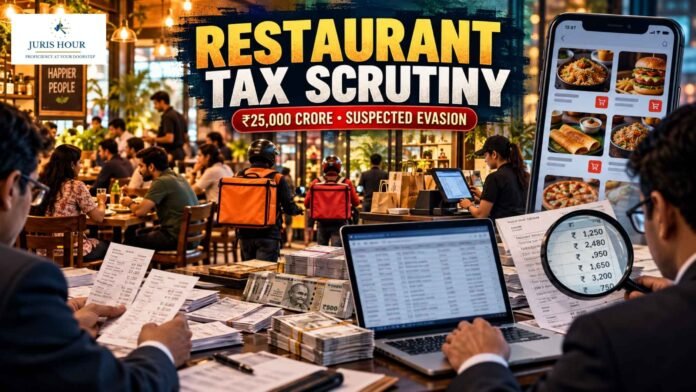
The Income Tax Department has reportedly identified suspected tax evasion exceeding ₹25,000 crore in the restaurant sector, with transaction records from food delivery platforms helping authorities trace establishments that received payments but did not file income tax returns.
According to the attached newspaper report, approximately 8,000 restaurants have been identified whose records show tax deducted at source (TDS) against their transactions, despite the absence of income tax returns. The findings suggest that digital payment trails are becoming a significant tool for detecting possible non-disclosure of restaurant earnings.
The authorities are examining data from Swiggy and Zomato as part of the exercise. The figures represent reported estimates of suspected evasion, rather than finally assessed tax demands against individual restaurants.
Buy Now: Legal & Taxation Combo – 4 Premium E-Magazines – September 2026
The analysis described in the clipping covers financial years 2021–22 to 2024–25. Information for the subsequent financial year was reportedly unavailable when the exercise was undertaken.
The report places the suspected evasion associated with the platform-based analysis at approximately ₹7,500 crore. Its accompanying chart shows restaurant sales through the platforms increasing from ₹1,450 crore in 2021–22 to ₹1,500 crore in 2022–23, ₹1,700 crore in 2023–24 and ₹2,700 crore in 2024–25.
These sales figures total approximately ₹7,350 crore over the four-year period. The clipping does not explain the precise calculation underlying the separately reported ₹7,500 crore evasion estimate or distinguish clearly between undisclosed receipts and the tax payable on those receipts.
For 2024–25, the establishments under scrutiny reportedly generated approximately ₹2,700 crore in platform-linked revenue, with around ₹25 crore deducted as TDS. Across the four years, the reported TDS collection was close to ₹75 crore.
The number of restaurants identified in the exercise reportedly increased by approximately 65% during the period.
Food delivery transactions provide authorities with a record of payments associated with particular restaurants. This enables the department to identify establishments with recorded business receipts and examine whether those receipts correspond with their tax filings.
However, online delivery represents only one part of many restaurants’ businesses. The clipping states that dine-in operations typically generate three to four times the revenue earned from food delivery.
Consequently, authorities reportedly believe that the platform records may indicate a larger volume of business when dine-in receipts are also considered. The broader estimate of suspected evasion appears to take account of this wider business activity, although the report does not provide a detailed methodology for arriving at the ₹25,000 crore figure.
The investigation described concerns the reporting and tax compliance of restaurants receiving payments through the platforms. The clipping does not allege tax evasion by Swiggy or Zomato themselves.
Authorities are reportedly considering a fresh drive to bring the identified restaurants and eateries into compliance and secure payment of taxes found to be due.
The proposed exercise would follow the department’s approach of using transaction data to identify discrepancies and contact taxpayers through targeted compliance campaigns.
Such campaigns seek to encourage businesses to address non-filing or possible under-reporting before further action is taken against persistent defaulters. The clipping does not specify a launch date for the proposed drive or identify the restaurants covered by the latest analysis.
The latest findings follow an earlier examination of nearly 1.8 lakh restaurants that reportedly indicated average under-reporting of income of approximately 30–35%.
In that exercise, tax authorities reportedly conducted surveys at around 70 establishments and contacted more than 60,000 restaurants, asking them to address the discrepancies and pay applicable taxes.
The clipping also refers to an earlier reported estimate of approximately ₹70,000 crore in under-reported receipts involving bills disappearing from cloud-based billing systems.
Another practice allegedly identified was the routing of customer payments through accounts belonging to waiters and other employees. Such arrangements could make it harder to reconcile the restaurant’s recorded receipts with its actual business collections.
According to the report, the earlier intervention produced some improvement in compliance, although substantial concerns remained.
The current exercise has reportedly helped authorities identify establishments across major cities, many with reported income in the range of ₹2 crore to ₹5 crore. Larger figures were observed in metropolitan centres and other major urban markets.
The findings highlight how food delivery records can expose gaps between visible commercial activity and tax return filing. They also indicate that scrutiny may extend beyond online orders to examine the wider receipts of restaurants flagged by the data.
The eventual tax liability of each establishment will depend on examination of its records and the outcome of the applicable proceedings. The amounts described in the report should therefore be understood as estimates associated with suspected non-compliance, rather than confirmed recoveries.
Read More: CBI Arrests CGST Superintendent Over ₹2 Lakh Bribe To Let Scrap Vehicles Pass

