
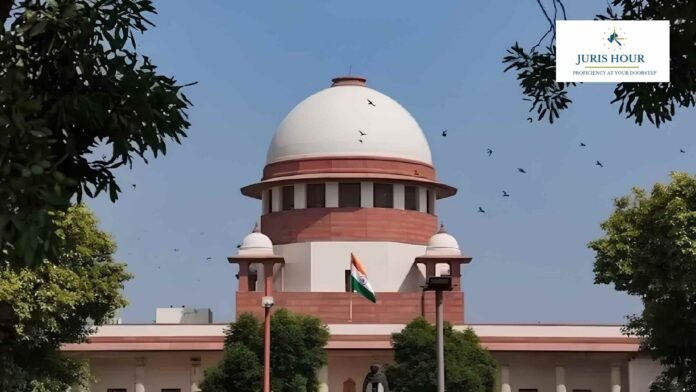
The Supreme Court has dismissed the State of Andhra Pradesh’s appeal seeking restoration of the conviction of four accused under Section 302 read with Section 34 of the Indian Penal Code (IPC), holding that material inconsistencies in the prosecution evidence prevented restoration of the murder conviction.
The bench of Justice Atul S. Chandurkar and Justice Ujjal Bhuyan expressly disapproved the Andhra Pradesh High Court’s reasoning for reducing the conviction to Section 304 Part II IPC, observing that the High Court had relied on “surmises and conjectures” rather than evidence.
The prosecution case arose from an attack on the intervening night of March 8-9, 2006. According to the prosecution, there was longstanding enmity between the victim, Atla Siva Govinda Reddy, and Ponthati Siva Rami Reddy and his family. The prosecution alleged that the victim had gone to his agricultural fields for watering crops when he was attacked by four accused persons armed with sickles and iron pipes. He sustained serious injuries and was subsequently taken for medical treatment.
Buy Now: 50+ Supreme Court Judgments – July 2026
The injured victim’s statement was recorded in the Government Hospital on the morning of March 9, 2006. The prosecution relied substantially upon this statement to establish the involvement of the accused. The victim, however, died shortly thereafter at about 7:30 a.m.
The Sessions Court accepted the prosecution case and convicted all four accused under Section 302 read with Section 34 IPC, sentencing each of them to life imprisonment along with a fine of ₹5,000.
The accused challenged their conviction before the Andhra Pradesh High Court. The High Court noticed several discrepancies in the prosecution evidence but also took note of the longstanding feud between the parties.
The High Court reasoned that if four armed persons had attacked the victim with an intention to kill him, they would ordinarily have remained at the scene until they were certain that the victim had died. Since the victim survived the attack long enough to be shifted to hospital and make a statement, the High Court concluded that the accused did not possess the intention to kill him, though they were aware that the injuries could result in death. On that reasoning, the conviction was altered from Section 302 to Section 304 Part II IPC and the sentence reduced to six years’ rigorous imprisonment.
The State approached the Supreme Court seeking restoration of the original murder conviction.
The Supreme Court closely examined the evidence of the prosecution witnesses and found significant inconsistencies concerning the location of the attack and the circumstances in which the injured victim was taken for treatment.
PW1, projected as an eyewitness, did not support the prosecution case and was declared hostile. He stated that he heard the victim’s cries, reached the spot and found him lying on the ground. According to him, the victim was first carried to a graveyard and thereafter taken towards his residence. The prosecution did not examine Chinna Koulai, who, according to PW1, had subsequently arrived at the spot.
PW2 also did not support the prosecution case in chief examination and was declared hostile, although he stated during cross-examination that he had gone to the graveyard after hearing cries and had helped PW1 take the victim towards his residence.
In contrast, PW3, the victim’s brother, gave a materially different version. He claimed that he reached the graveyard after being informed about the attack and saw the accused fleeing with sickles and iron rods. He further stated that the injured victim was taken from the graveyard to the Government Hospital in a jeep.
The Court noted that this version was inconsistent with the accounts of PW1 and PW2, who did not refer to PW3 being present at the spot or to any jeep being used to transport the victim. The evidence therefore created doubt regarding both the actual place of occurrence and the presence of the accused immediately after the alleged assault. There was also conflicting evidence on whether the victim was first taken to his residence or directly to the hospital.
The Supreme Court also scrutinised the statement allegedly made by the injured victim shortly before his death.
The medical officer, PW8, stated that the victim was conscious, coherent and mentally fit to give his statement. He stated that the statement was recorded at about 6:45 a.m. and that he had signed it. However, during cross-examination, the doctor accepted that a patient suffering severe injuries could require tranquilizers and that a person suffering a head injury might not remain continuously conscious. He also acknowledged a correction concerning the time mentioned in the statement.
The post-mortem evidence showed that the victim had suffered 22 injuries, including four injuries caused by a sharp-edged weapon and several others caused by a blunt object such as an iron rod. The post-mortem doctor accepted that such injuries could result in loss of consciousness, memory loss and slurred speech.
The investigating officer’s evidence also disclosed discrepancies concerning the timing of the medical intimation. The original time recorded in Exhibit P6 was stated to be 6:50 a.m., which was subsequently corrected to 5:50 a.m. The Supreme Court held that this overwriting created further doubt about when the medical intimation was actually received by the police.
The Court attached particular significance to the detailed nature of the victim’s statement. The statement ran to approximately a page and a half and provided a detailed account of the previous enmity as well as the alleged assault.
The Supreme Court observed that, considering the victim had sustained 22 injuries, many of them grievous, such a detailed narration by a seriously injured person raised serious doubt. The Court also noted that the possibility of the victim being affected by tranquilizers could not be ruled out.
The Court further noted deficiencies in the investigation. The investigating officer could not explain the absence of bloodstains on the clothes of PW1, PW2 or other witnesses who claimed to have transported the victim. He also admitted that he had not investigated who actually brought the victim from the scene to the Government Hospital. Several omissions emerged from his cross-examination.
After considering the entire evidentiary record, the Supreme Court concluded that the prosecution case contained material inconsistencies. These inconsistencies were sufficient to prevent the Court from restoring the conviction under Section 302 read with Section 34 IPC.
Importantly, however, the Court did not endorse the High Court’s reasoning. It held that the High Court’s observations regarding the alleged absence of an intention to kill were not supported by evidence. The High Court had itself acknowledged that no witness had spoken to the version on which it based its reasoning.
The Supreme Court therefore drew a distinction between rejecting the State’s request to restore the murder convictionand approving the High Court’s reasoning for reducing the conviction. The former was justified by the evidentiary deficiencies; the latter was expressly disapproved.
The Supreme Court specifically disapproved the High Court’s observation that an intention to kill could be inferred from the accused remaining at the scene until the victim died, or that persons intending to kill would ordinarily ensure that their victim had died before leaving.
The Supreme Court observed that the High Court had itself recorded that no witness had deposed on those lines. It therefore held that there was no basis for the High Court to make such comments. According to the Supreme Court, those observations were “purely” based on surmises and conjectures and could not furnish the evidentiary foundation for modifying the conviction.
The Court nevertheless held that the evidence available on record was insufficient to restore the Section 302 conviction. Since the accused had already undergone the six-year sentence imposed by the High Court and had not challenged their modified conviction under Section 304 Part II IPC, the Court considered that the matter should be brought to an end.
The Supreme Court ultimately dismissed the State’s criminal appeal. Thus, the conviction under Section 304 Part II IPC and the sentence imposed by the High Court remained undisturbed, while the Supreme Court made it clear that the High Court’s reasoning based on assumptions about how persons intending to kill would behave was legally unsustainable.
Membership Required to Access Case Details & Order Copy
To view the complete Case Details and Download Order Copy, you must have an active membership. Please subscribe to continue.

