
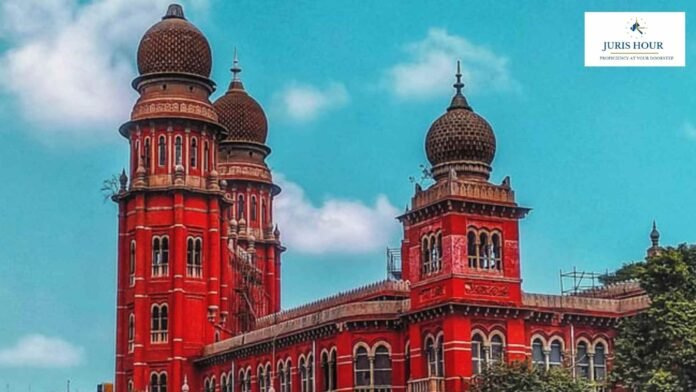
The Madras High Court has granted an interim stay on an order directing that GST liabilities relating to restaurant services be discharged only through cash payment, observing that the petitioner’s contentions regarding the relevant GST notifications appeared not to have been addressed in the impugned order.
The bench of Justice Senthilkumar Ramamoorthy passed the interim order against the State Tax Officer (ST)-7, now designated as R.S.-5, Coimbatore.
The writ petition challenged an order dated May 7, 2026, which had concluded that liabilities relating to restaurant services were required to be discharged only in cash.
Buy Now: 130 GST Judgments – E-Magazine July 2026
The central issue before the High Court was whether the applicable GST notifications require a taxpayer providing restaurant services to discharge the corresponding tax liability exclusively through cash, thereby restricting the utilisation of available input tax credit.
The petitioner relied upon Notification No. 11/2017-Central Tax and Notification No. 46/2017-Central Tax and contended that neither notification mandates that the liability relating to restaurant services must necessarily be discharged only through cash. The petitioner’s counsel specifically submitted that the notifications did not impose such a cash-payment requirement.
The dispute therefore concerns the interpretation and effect of the notifications governing GST on restaurant services, particularly whether they can be construed as imposing an exclusive cash-payment mechanism.
Appearing for the State Tax Department, Special Government Pleader (Tax) G. Dhana Madhri accepted notice on behalf of the respondent. However, she sought time from the Court to obtain instructions in the matter.
At the interim stage, the High Court did not finally determine the legality of the department’s interpretation. Instead, the Court examined whether the petitioner had established a prima facie case warranting protection until the matter could be considered further.
A significant factor in the High Court’s decision was its observation that the petitioner’s contentions appeared, prima facie, not to have been addressed in the impugned order.
The Court consequently directed an interim stay of the order dated May 7, 2026, as well as the proceedings pursuant to that order, until the next date of hearing.
The interim protection means that, for the present, the challenged order cannot be acted upon while the writ petition remains pending. Importantly, the High Court has not yet given a final ruling on whether restaurant-service GST liability can or cannot be required to be paid exclusively in cash.
The Court has listed the writ petition for further hearing on September 11, 2026.
Membership Required to Access Case Details & Order Copy
To view the complete Case Details and Download Order Copy, you must have an active membership. Please subscribe to continue.
Read More: Offshore Equipment Supplies Not Taxable in India Without Fixed-Place PE: ITAT

