
BEFORE THE INCOME TAX DEPARTMENT
Reply to Notice Issued Under Section 133(6) of the Income-tax Act, 1961
To
The Assessing Officer
[Ward/Circle Details]
Income Tax Department
[Address]
Subject: Reply to Notice under Section 133(6) of the Income-tax Act, 1961
PAN: [__________]
Assessment Year: [__________]
Notice Reference No.: [__________]
Date of Notice: [__________]
Respected Sir/Madam,
With reference to the above-mentioned notice issued under Section 133(6) of the Income-tax Act, 1961, seeking information/details/documents from the undersigned, I/we hereby submit the following reply for your kind consideration.
At the outset, it is respectfully submitted that the assessee is regularly assessed to income tax and has been complying with all statutory requirements under the Income-tax Act.
The information/documents sought in the notice are being furnished hereunder:
1. Information Sought and Reply
| Sr. No. | Query Raised in Notice | Reply / Submission |
| 1 | [Mention query] | [Detailed reply] |
| 2 | [Mention query] | [Detailed reply] |
| 3 | [Mention query] | [Detailed reply] |
2. Documents Enclosed
The following documents are enclosed in support of the submissions:
- Copy of PAN Card
- Copy of Aadhaar Card
- Bank Statements for the relevant period
- Books of Accounts/Ledger Copies
- Copies of Invoices/Bills
- Copy of ITR Acknowledgement
- Confirmation Letters/Affidavits
- Any other supporting documents
3. Specific Submission (Illustrative)
It is respectfully submitted that the transactions reflected in the bank account are duly recorded in the regular books of accounts and fully disclosed in the return of income filed for the relevant assessment year.
The source of deposits/credits is fully explained and supported by documentary evidence enclosed herewith. Therefore, no adverse inference may kindly be drawn against the assessee.
Further, the information furnished by the assessee may kindly be considered objectively and in accordance with law before initiating any further proceedings.
4. Request for Opportunity of Hearing
In case any further clarification or explanation is required, the assessee may kindly be granted an opportunity of being heard, including through video conference hearing under the faceless assessment regime, before passing any adverse order.
5. Prayer
In view of the facts and submissions stated above, it is respectfully prayed that the reply and documents furnished herewith may kindly be taken on record and the proceedings may kindly be concluded accordingly.
Thanking You,
Yours Faithfully,
For [Name of Assessee/Company]
Authorized Signatory
Name: __________
Designation: __________
Date: __________
Place: __________
Important Points While Drafting Reply to Notice u/s 133(6)
- Reply within the time mentioned in the notice.
- Attach documentary evidence for every explanation.
- Reply point-wise to each query raised.
- Avoid vague explanations.
- Mention PAN, DIN, notice number and assessment year correctly.
- Preserve acknowledgement of online submission.
- If information is not available, clearly state reasons.
- If additional time is required, file adjournment request before due date.
- Under faceless proceedings, specifically request personal hearing/video conference wherever necessary.
- Ensure consistency between bank entries, books of account and ITR disclosures.
Short Format for Routine Compliance Reply
Subject: Submission in Response to Notice u/s 133(6)
Respected Sir/Madam,
With reference to the notice issued under Section 133(6) of the Income-tax Act, 1961, the requisite information/documents are enclosed herewith for your kind consideration.
All transactions referred to in the notice are genuine, duly recorded in books of account, and reflected in the return of income.
The following documents are enclosed:
- [Document Name]
- [Document Name]
- [Document Name]
It is requested to kindly take the same on record.
Thanking You,
Yours Faithfully,
[Name & Signature]
Common Documents Asked in Notice u/s 133(6)
- Bank statements
- Source of cash deposits
- Loan confirmations
- Share capital details
- GST returns
- Purchase/sales invoices
- Ledger accounts
- Property transaction details
- TDS details
- KYC documents
- Investment proofs
- Cash book and books of account
Section 133(6) notices are generally issued for gathering information, verification of transactions, or inquiry before assessment/reassessment proceedings. Therefore, replies should be factual, document-backed, and carefully drafted to avoid unnecessary litigation.
What is Section 133(6) of the Income-tax Act?
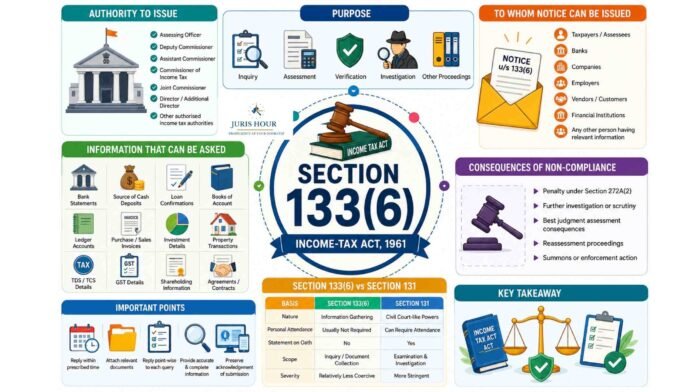
Section 133(6) of the Income-tax Act, 1961 empowers Income Tax authorities to call for information, documents, or statements from any person for the purposes of an inquiry, assessment, verification, investigation, or other proceedings under the Act.
It is one of the most widely used provisions by the Income Tax Department for collecting information from taxpayers, banks, companies, financial institutions, employers, customers, vendors, and even third parties connected with a taxpayer.
Purpose of Section 133(6)
The provision is mainly used to:
- Verify transactions disclosed by taxpayers
- Seek bank account details and financial records
- Confirm purchases, sales, loans, or investments
- Cross-check information available through AIS/TIS/SFT
- Conduct preliminary inquiry before reassessment proceedings
- Investigate suspicious or high-value transactions
- Gather information from third parties
The power under Section 133(6) is investigative and informational in nature.
Who Can Issue Notice Under Section 133(6)?
The following Income Tax authorities can issue notice under Section 133(6):
- Assessing Officer (AO)
- Deputy Commissioner
- Assistant Commissioner
- Commissioner of Income Tax
- Joint Commissioner
- Director/Additional Director of Income Tax
- Other authorised income tax authorities
In certain cases where no proceeding is pending, lower authorities may require prior approval from higher authorities before issuing such notice.
To Whom Can Notice Be Issued?
A notice under Section 133(6) may be issued to:
- Taxpayers/Assessees
- Banks
- Companies
- Employers
- Vendors or Customers
- Stock Brokers
- Financial Institutions
- Property Registrars
- Any person who may possess relevant information
Thus, even a person against whom no assessment proceedings are pending may receive such notice.
What Information Can Be Asked?
The department may seek:
- Bank statements
- Source of cash deposits
- Loan confirmations
- Books of account
- Ledger accounts
- GST details
- Purchase and sales invoices
- Property transaction details
- Investment details
- Details of foreign remittances
- TDS/TCS details
- Shareholding information
- Copies of agreements or contracts
The information sought must generally be relevant for inquiry under the Income-tax Act.
Whether Proceedings Must Be Pending?
Originally, there was significant litigation on whether information could be sought when no assessment proceeding was pending.
However, courts have held that Section 133(6) also permits collection of information for inquiry purposes even before initiation of assessment proceedings, especially after amendments widening departmental powers.
The provision is therefore frequently used for data collection and verification exercises.
Consequences of Non-Compliance
Failure to comply with a notice under Section 133(6) may lead to:
- Penalty under Section 272A(2)
- Further investigation or scrutiny
- Best judgment assessment consequences in some situations
- Reassessment proceedings
- Summons or enforcement action
Therefore, notices should not be ignored.
Important Judicial Principles
Courts have repeatedly held that:
- Information sought must have nexus with inquiry purposes
- Authorities cannot make fishing or roving inquiries without basis
- Principles of natural justice should be followed
- Replies and evidence submitted by taxpayers must be objectively considered
At the same time, courts generally grant wide powers to the department for collecting information relevant to tax administration.
Practical Situations Where Section 133(6) Notices are Commonly Issued
1. Cash Deposit Verification
After large cash deposits in bank accounts.
2. Property Transactions
To verify source of investment in immovable property.
3. High-Value Transactions
Based on AIS/SFT reporting.
4. GST–Income Tax Mismatch
Where turnover reported in GST differs from ITR.
5. Bogus Purchase/Suspicious Transactions
To verify suppliers or accommodation entry allegations.
6. TDS/TCS Verification
Mismatch between Form 26AS/AIS and books of account.
Key Difference Between Section 133(6) and Summons Under Section 131
| Particulars | Section 133(6) | Section 131 |
| Nature | Information gathering | Civil court-like powers |
| Personal attendance | Usually not required | Can require attendance |
| Statement on oath | No | Yes |
| Scope | Inquiry/document collection | Examination and investigation |
| Severity | Relatively less coercive | More stringent |
Important Practical Advice
- Always reply within the prescribed time.
- Submit point-wise replies.
- Attach documentary evidence.
- Preserve acknowledgement of filing.
- Seek adjournment if additional time is required.
- Avoid inconsistent explanations.
- If the notice is vague or excessive, legal objections may be raised professionally.
Section 133(6) notices are generally the first stage of verification by the Income Tax Department. A carefully drafted and evidence-backed reply can often prevent escalation into reassessment or penalty proceedings.

