
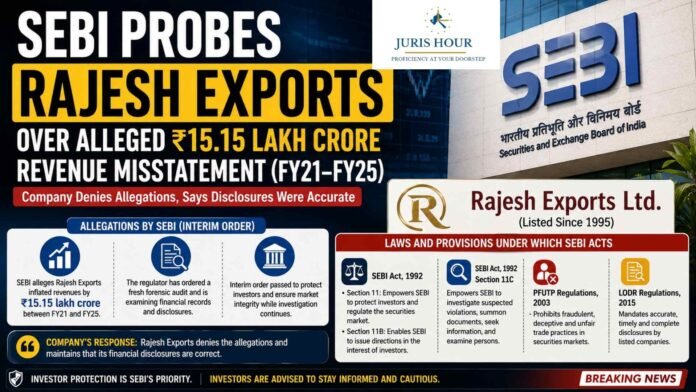
Rajesh Exports Ltd., one of India’s best-known gold refining and jewellery manufacturing companies and a listed entity since 1995, has come under regulatory scrutiny after the Securities and Exchange Board of India (SEBI) issued an interim order alleging large-scale financial misrepresentation between FY 2020-21 and FY 2024-25.
According to SEBI’s preliminary findings, the company allegedly misrepresented revenues aggregating approximately ₹15.15 lakh crore during the five-year period. The regulator has described the alleged discrepancies as unprecedented in scale and has initiated further regulatory action, including a forensic examination of the company’s financial records. operational scale and financial position. stated that despite repeated requests, sufficient supporting documentation was not provided to independently verify the reported figures. , disclosures, and certain fund movements involving promoter-linked entities. These findings remain subject to further investigation and adjudication. regulatory process and intends to submit additional clarifications. financial disclosures are correct.
What Laws Empower SEBI to Act in Cases of Alleged Financial Misstatement?
SEBI’s action against Rajesh Exports is presently based on prima facie findings recorded in an interim ex-parte order. The allegations remain subject to further investigation, responses from the company and its officials, and subsequent proceedings. However, the case provides an important illustration of the legal framework available to the market regulator when it suspects financial misrepresentation or disclosure violations.
SEBI’s Statutory Powers Under the SEBI Act, 1992
The Securities and Exchange Board of India derives its authority primarily from the SEBI Act, 1992.
Section 11 of the SEBI Act empowers SEBI to protect the interests of investors and regulate the securities market. The provision authorizes the regulator to take measures necessary to safeguard market integrity and ensure fair disclosures by listed companies.
Section 11B empowers SEBI to issue directions to listed entities, promoters, directors, intermediaries and other market participants where it considers such action necessary in the interests of investors or the securities market.
Where urgent intervention is considered necessary, SEBI may also issue interim directions pending completion of an investigation.
Investigative Powers Under Section 11C
When SEBI suspects violations of securities laws, it may initiate an investigation under Section 11C of the SEBI Act.
This provision enables investigating authorities to:
- Call for books of accounts and records;
- Seek information and explanations from companies and individuals;
- Examine directors, officers and other concerned persons;
- Inspect documents relevant to the investigation.
Failure to cooperate with an investigation may itself become a significant regulatory concern.
Prohibition of Fraudulent and Unfair Trade Practices
One of the key legal provisions examined in cases involving alleged financial misstatements is the SEBI (Prohibition of Fraudulent and Unfair Trade Practices Relating to Securities Market) Regulations, 2003, commonly known as the PFUTP Regulations.
These regulations prohibit:
- Fraud in connection with securities transactions;
- Dissemination of false or misleading information;
- Acts likely to induce investors to trade on an incorrect understanding of a company’s financial position;
- Manipulative or deceptive practices affecting the securities market.
If a listed company is found to have published inaccurate financial information that materially influences investor decisions, SEBI may examine whether the conduct attracts provisions of the PFUTP Regulations.
Disclosure Obligations Under the LODR Regulations
Listed companies are also governed by the SEBI (Listing Obligations and Disclosure Requirements) Regulations, 2015 (LODR Regulations).
The LODR framework requires listed entities to ensure that disclosures made to stock exchanges are accurate, timely, complete and not misleading.
The regulations impose responsibilities relating to:
- Financial statement disclosures;
- Corporate governance practices;
- Related-party transactions;
- Material event disclosures;
- Transparency towards shareholders and investors.
Any alleged failure to provide complete and accurate information to investors may attract scrutiny under the LODR Regulations.
Role of Forensic Audits
In complex accounting matters, SEBI may direct a forensic audit to independently examine transactions, accounting treatments, fund flows, disclosures and supporting documentation.
A forensic audit does not determine guilt. Instead, it assists the regulator in verifying facts and assessing whether securities laws have been violated.
In the Rajesh Exports matter, SEBI has directed a fresh forensic examination as part of its ongoing proceedings.
Can SEBI Impose Immediate Restrictions?
Yes. In appropriate cases, SEBI may pass interim ex-parte orders before the conclusion of a full investigation if it believes immediate action is necessary to protect investors or preserve the integrity of the securities market.
Such interim orders are not final findings of guilt. The affected parties are generally given an opportunity to present their case during subsequent proceedings before any final determination is made.
What Happens Next?
After issuing an interim order, SEBI typically continues its investigation, examines additional evidence, considers responses submitted by the noticees, and may conduct hearings before arriving at a final conclusion.
Depending on the outcome, SEBI may:
- Confirm, modify or revoke interim directions;
- Impose monetary penalties where authorized by law;
- Issue market-access restrictions;
- Direct corrective disclosures;
- Refer matters to other statutory authorities where necessary.
As of now, the allegations against Rajesh Exports remain under regulatory examination, and the company has publicly disputed SEBI’s findings, maintaining that its financial disclosures were accurate.
Read More: RBI Keeps Repo Rate at 5.25%: Impact on Loans, EMIs and Savings

