
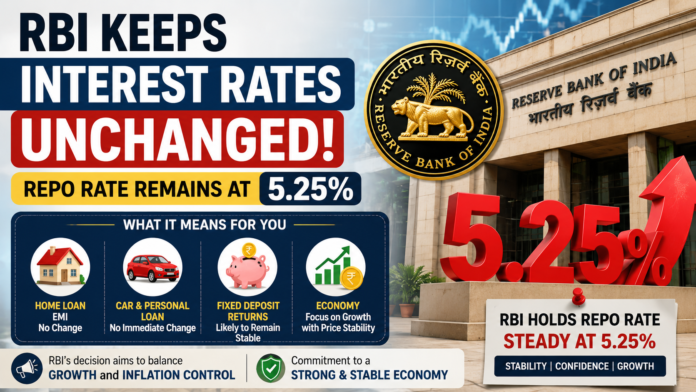
The Reserve Bank of India (RBI) has kept the benchmark repo rate unchanged at 5.25% following the latest meeting of the Monetary Policy Committee (MPC). The decision comes at a time when the Indian economy is navigating global geopolitical uncertainties, volatile crude oil prices, inflation concerns, and currency pressures. The six-member MPC reportedly voted unanimously to maintain the status quo while retaining a cautious approach toward inflation and growth management.
For home loan borrowers, businesses, investors, and consumers, the decision signals continuity in the interest rate environment. While borrowers may not receive immediate relief in the form of lower EMIs, they are also protected from any sudden increase in borrowing costs.
What Is the Repo Rate?
The repo rate is the interest rate at which commercial banks borrow money from the RBI against government securities.
It is one of the most important monetary policy tools available to the central bank. Whenever the RBI changes the repo rate, the impact eventually flows through to lending rates, deposit rates, home loans, vehicle loans, business loans, and overall economic activity.
A reduction in the repo rate generally makes borrowing cheaper and encourages spending and investment. Conversely, an increase in the repo rate raises borrowing costs and helps control inflation by reducing excess demand in the economy.
What Is Monetary Policy?
Monetary policy refers to the actions taken by the RBI to regulate the supply of money and the cost of credit in the economy. Its primary objective is to maintain price stability while supporting economic growth.
In India, monetary policy is formulated by the Monetary Policy Committee, a six-member body comprising three RBI officials and three external members appointed by the Government of India. The committee meets periodically to assess inflation, economic growth, liquidity conditions, global developments, and financial stability before deciding the policy rate.
The RBI’s inflation-targeting framework requires it to maintain consumer price inflation around 4%, with a tolerance band of 2% on either side.
Why Did the RBI Keep the Repo Rate Unchanged?
The central bank’s decision reflects a balancing act between supporting growth and containing inflationary pressures.
According to the RBI’s assessment, inflation remains broadly manageable, but several risks continue to warrant caution. Rising global crude oil prices, geopolitical tensions in West Asia, currency volatility, and uncertainty in global markets have increased the possibility of imported inflation. At the same time, India’s domestic economic indicators continue to display resilience.
The RBI has therefore chosen a “wait-and-watch” approach, allowing policymakers to assess the impact of existing monetary measures before making further changes to interest rates.
Impact on Home Loan Borrowers
One of the most immediate consequences of the policy decision is stability in home loan interest rates.
Borrowers with floating-rate home loans linked to external benchmarks are unlikely to witness any immediate change in their EMIs. Since the repo rate remains unchanged, lending institutions are not expected to revise benchmark-linked loan rates solely on account of the latest policy review.
For prospective homebuyers, the decision provides greater predictability in financial planning and housing affordability.
Impact on Businesses
Businesses closely monitor monetary policy because interest rates influence borrowing costs and investment decisions.
An unchanged repo rate provides certainty to companies planning capital expenditure, expansion projects, and financing activities. Stable borrowing costs can encourage businesses to proceed with investment plans without worrying about sudden increases in interest expenses.
Sectors such as real estate, automobiles, infrastructure, manufacturing, and consumer durables are particularly sensitive to changes in interest rates and therefore benefit from policy stability.
Impact on Depositors and Investors
For depositors, the RBI’s decision means that fixed deposit rates are unlikely to experience any immediate policy-driven movement.
Investors, meanwhile, closely watch RBI announcements because monetary policy influences bond yields, equity valuations, liquidity conditions, and overall market sentiment.
A stable interest rate environment generally supports financial market stability by reducing uncertainty regarding future borrowing costs and economic conditions.
Why Monetary Policy Matters to Every Citizen
Although monetary policy may appear technical, it affects almost every aspect of daily life.
When the RBI changes interest rates, the consequences can be felt in:
- Home loan EMIs;
- Vehicle loan repayments;
- Personal loan costs;
- Business financing expenses;
- Fixed deposit returns;
- Consumer spending;
- Inflation and purchasing power.
A carefully calibrated monetary policy helps ensure that inflation remains under control while allowing businesses and households access to affordable credit.
Challenges Before the RBI
The RBI’s latest decision comes against a backdrop of several domestic and international challenges.
Global energy prices remain vulnerable to geopolitical developments. A weaker rupee can increase the cost of imports and contribute to inflationary pressures. Weather-related risks, including monsoon performance, also remain important for food inflation in India. At the same time, policymakers must ensure that economic growth momentum is not adversely affected by excessively tight monetary conditions.
These factors explain why the central bank has opted for caution despite maintaining confidence in India’s economic resilience.
Conclusion
The RBI‘s decision to keep the repo rate unchanged at 5.25% reflects a measured approach aimed at preserving macroeconomic stability. By maintaining the current rate, the Monetary Policy Committee seeks to strike a balance between supporting economic growth and guarding against inflationary risks arising from global uncertainties.
For borrowers, the decision offers stability in loan repayments. For businesses, it provides a predictable financing environment. For investors and consumers, it signals the RBI’s commitment to maintaining economic stability while remaining vigilant to emerging risks.
Read More: ITR Filing 2026: Which Income Tax Return Form Is Right for You?

