
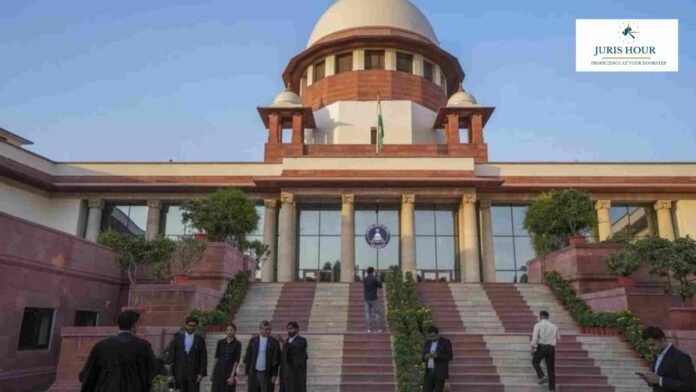
The Supreme Court has acquitted a man convicted for murder and offences under the SC/ST (Prevention of Atrocities) Act after finding that the prosecution failed to establish the very occurrence of the incident through reliable evidence.
The bench of Justice N.V. Anjaria and Justice Prashant Kumar Mishra held that major contradictions in eyewitness testimonies, inconsistencies in medical evidence, and failure to examine independent witnesses made the conviction unsustainable.
The appellant had earlier been convicted under Sections 302 and 323 of the IPC and Sections 3(2)(v) and 3(1)(x) of the SC/ST Act. He was sentenced to life imprisonment by the trial court, and the Telangana High Court had affirmed the conviction.
According to the prosecution, the incident took place on 12 May 2013 after a dispute arising from an earlier elopement involving the deceased and the accused’s sister. The prosecution alleged that the deceased had returned to the village despite a village Panchayat deciding that he should stay away. It was claimed that when the deceased passed near the accused’s house, an altercation took place and the accused assaulted him with a stone, causing fatal injuries.
The prosecution further alleged that the deceased’s mother rushed to the spot after being informed by another witness and was also abused with caste-based slurs. The deceased later succumbed to injuries while being shifted to a hospital in Hyderabad.
However, the Supreme Court found that the prosecution’s case collapsed primarily because one of the key eyewitnesses turned hostile and contradicted the prosecution story. The witness denied informing the deceased’s mother about the incident and stated that he had simply returned home after the deceased asked him to leave. He also stated that his earlier statement to police was false.
The Court also noted that other witnesses did not support the prosecution’s claim regarding the alleged Panchayat meeting, which was projected as the motive behind the crime. Witnesses examined by the prosecution specifically denied conducting any Panchayat concerning the elopement incident.
A major factor that weighed with the Supreme Court was the contradiction in the medical evidence. The Bench observed that the postmortem report contained serious inconsistencies regarding the date and time of the autopsy. The doctor who conducted the postmortem failed to provide a satisfactory explanation for these discrepancies. The Court held that the evidentiary value of the medical evidence stood “diminished to nil.”
The Court reiterated the settled legal principle that a postmortem report by itself is not substantive evidence and must be corroborated by reliable oral testimony. Referring to earlier precedents, the Bench explained that medical evidence merely has an advisory character and cannot independently establish guilt when foundational facts remain doubtful.
Importantly, the Supreme Court also elaborated on the evidentiary value of hostile witnesses. The Court held that while testimony of a hostile witness can be relied upon to convict an accused if corroborated by other evidence, the same testimony can equally be used to discredit the prosecution case and support acquittal where it inspires confidence.
The Bench further observed that the alleged incident had occurred on a busy public road near quarry areas where trucks and vehicles moved continuously, yet the prosecution failed to examine any independent witness from the locality. This omission assumed significance because the prosecution evidence itself had become doubtful.
The Court ultimately concluded that the prosecution had failed to prove not only the motive but even the occurrence of the incident itself. It held that the trial court and High Court committed a “concurrent error” in convicting the appellant on the basis of weak and contradictory evidence.
Allowing the appeal, the Supreme Court set aside the conviction and directed that the appellant be released forthwith unless required in any other case.
Case Details
Case Title: Talari Naresh Versus The State Of Telangana
Citation: JURISHOUR-1250-SC-2026
Case No.: SLP(Crl.) No.13614 OF 2025
Date: 13/05/2026

