
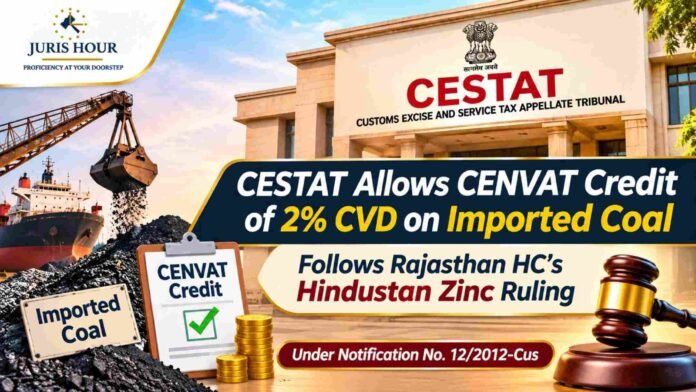
The Ahmedabad Bench of Customs, Excise and Service Tax Appellate Tribunal (CESTAT) has allowed CENVAT credit of additional customs duty (CVD) paid at the concessional rate of 2% on imported coal, holding that the issue is squarely covered by the Rajasthan High Court’s ruling in Hindustan Zinc Ltd.
The bench of Somesh Arora (Judicial Member) and Satendra Vikram Singh (Technical Member)has allowed an appeal filed by Carbon Edge Industries Limited, holding that the company was entitled to CENVAT credit of additional customs duty paid on imported coal.
Buy Now: Direct tax (Income Tax) Judgments E-Magazine October 2026
The appellant/assessee imported coal and paid additional customs duty (Countervailing Duty or CVD) at the concessional rate of 2% under Section 3 of the Customs Tariff Act, 1975, read with Notification No. 12/2012-Cus dated March 17, 2012, as amended.
After payment of the additional customs duty, the company availed CENVAT credit of the duty paid in terms of Rule 3(1)(vii) of the CENVAT Credit Rules, 2004.
However, the Department denied the credit on the ground that the additional customs duty paid by the company was not equivalent to the duties specified under clauses (i), (ii), (iii), (iv), (v), (vi) and (via) of Rule 3(1) of the CENVAT Credit Rules, 2004.
The Department’s objection essentially questioned whether CVD paid at a concessional rate of 2% under the Customs Notification could qualify for CENVAT credit when restrictions were applicable to certain categories of domestic excise duty.
Aggrieved by the denial of credit, the assessee challenged the adjudication order dated June 29, 2020, passed by the Commissioner of CGST, Kutch (Gandhidham), before CESTAT.
Before the Tribunal, the consultant appearing for the appellant submitted that the issue was no longer res integra and had already been conclusively decided by the Rajasthan High Court in Union of India v. Hindustan Zinc Ltd. & Ors.
The Rajasthan High Court, vide judgment dated October 5, 2026, in D.B. Central Excise Appeal Nos. 4/2022, 6/2022, 7/2022 and 8/2022, had examined the precise question concerning the admissibility of CENVAT credit of CVD paid at concessional rates under Notification No. 12/2012-Cus dated March 17, 2012.
The appellant further argued that the Department had not established that the credit availed by the company exceeded the duty of excise specified under the relevant clauses of Rule 3(1) of the CENVAT Credit Rules, 2004.
Accordingly, the appellant requested the Tribunal to set aside the impugned order and grant consequential relief.
On the other hand, the Departmental Representative reiterated the findings recorded by the lower authorities.
While examining the issue, CESTAT noted that the Rajasthan High Court had already considered an identical dispute in Union of India v. Hindustan Zinc Ltd. & Ors., reported at 2026 (10) TMI 1306.
The High Court had examined the distinction between Rule 3(1)(i) and Rule 3(1)(vii) of the CENVAT Credit Rules, 2004.
It observed that Rule 3(1)(i) deals with credit of specified duties of excise, whereas Rule 3(1)(vii) permits credit of additional duty leviable under Section 3 of the Customs Tariff Act, equivalent to the duties specified under the relevant clauses.
The High Court noted that the authorities had incorrectly imported the conditions applicable under Rule 3(1)(i) into Rule 3(1)(vii).
In the case of Hindustan Zinc, the assessee had paid additional customs duty by availing the benefit of Notification No. 12/2012-Cus and had not paid the specified domestic excise duty or availed the benefit of the relevant Central Excise notifications.
The High Court found that the distinction between these provisions had not been properly appreciated by the Revenue authorities.
The Tribunal also took note of the clarification emerging from Circular No. 41/2013-Cus dated October 21, 2013.
The circular addressed the issue of whether an importer could simultaneously avail exemption from Basic Customs Duty under a Free Trade Agreement and pay concessional CVD at 2% under Notification No. 12/2012-Cus.
The clarification recognised that the concessional 2% CVD was a general applied rate on imported steam coal and bituminous coal, irrespective of the excise duty applicable to comparable domestically manufactured coal.
The relevant clarification also recognised that importers could simultaneously avail the applicable BCD exemption under the relevant FTA notification and concessional CVD at 2% under Notification No. 12/2012-Cus.
The Rajasthan High Court further considered the minutes of the Regional Advisory Committee meeting of the Hyderabad Zone held on February 9, 2015.
The Committee, comprising departmental officers and industry representatives, had specifically considered the issue of CENVAT credit on imported coal.
The clarification recorded in the minutes recognised that CENVAT credit of 2% CVD paid on imported coal under Notification No. 12/2012-Cus appeared to be admissible, as the notification was not excluded from the purview of Rule 3 of the CENVAT Credit Rules, 2004.
The Rajasthan High Court also considered the judgment of the Calcutta High Court in Shyam Steel Industries Ltd., which had examined the eligibility of CENVAT credit in respect of 1%/2% concessional additional customs duty paid on imported coal.
The Calcutta High Court considered the meaning of the expression “equivalent” used in Rule 3(1) of the CENVAT Credit Rules, 2004.
It observed that the expression “equivalent” cannot be interpreted to mean exactly identical. The term allows a reasonable degree of flexibility and adjustment.
The High Court also took note of earlier Tribunal decisions recognising the admissibility of CENVAT credit of concessional CVD paid under Notification No. 12/2012-Cus.
The Rajasthan High Court concluded that the assessee was entitled to CENVAT credit of 1%/2% additional customs duty paid on imported coal under Notification No. 12/2012-Cus dated March 17, 2012, as amended.
It answered the question of law in favour of the assessee and against the Revenue and dismissed the appeals filed by the Department.
CESTAT Ahmedabad observed that the issue involved in Carbon Edge Industries Limited’s appeal was identical to the issue already decided by the High Court.
The Tribunal found that the Rajasthan High Court had specifically examined whether CVD paid at concessional rates under Notification No. 12/2012-Cus was eligible for CENVAT credit and had answered the question in favour of the assessee.
Consequently, the Tribunal held that the issue was no longer res integra.
CESTAT allowed the appeal filed and granted consequential relief, if any, in accordance with law.
Membership Required to Access Case Details & Order Copy
To view the complete Case Details and Download Order Copy, you must have an active membership. Please subscribe to continue.
Read More: Mere Investigation Wing Report and Suspicion Can’t Establish Bogus LTCG: ITAT

