
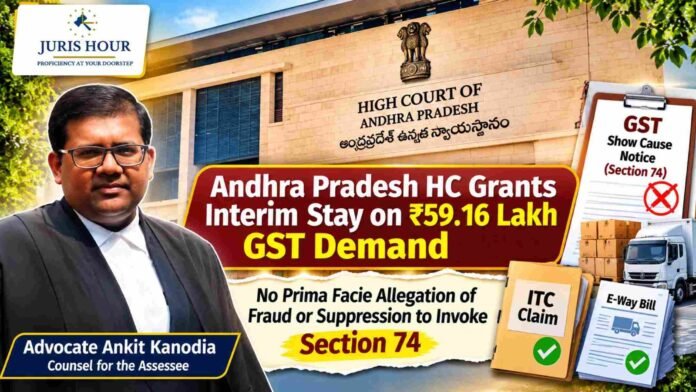
The Andhra Pradesh High Court has granted interim protection to a GST-registered taxpayer facing a demand of ₹59.16 lakh involving alleged wrongful availment of Input Tax Credit (ITC), observing that the impugned show cause notice did not prima facie spell out any allegation of fraud, wilful misstatement or suppression of facts with an intent to evade tax, as required for invoking Section 74 of the CGST Act.
The Court also took note of the documentary evidence furnished by the taxpayer, including tax invoices, gate entry registers, raw material registers, bank statements and corresponding GSTR-2A/2B records, supporting the taxpayer’s claim that the goods had actually been received.
Buy Now: 210+ GST Judgments E-Magazine – October 2026
Importantly, the Court rejected, at the interim stage, the department’s contention that the absence of FASTag data was sufficient to question the movement of goods, particularly when the Ministry of Road Transport and Highways had clarified that cash payments at National Highway toll plazas continued to be permitted through hybrid lanes.
Accordingly, the Division Bench stayed all further proceedings pursuant to the impugned show cause notice dated August 21, 2026.
The petitioner/assessee was a registered dealer under the GST law engaged in the manufacture and supply of precious-metal products, including palladium in unwrought form and carbon blacks.
During the relevant period, the petitioner purchased palladium carbon from M/s Tirupati Enterprises, Park Town, Chennai, Tamil Nadu. The supplier was registered under the GST Act in Tamil Nadu.
The goods were covered by valid tax invoices and transported from Chennai to the petitioner’s factory at Visakhapatnam through M/s Annapoorna Roadways, Pondicherry. The transportation was arranged and paid for by the supplier, with consignment notes issued in respect of the movement.
According to the petitioner, the goods were duly received at its factory. The corresponding vehicle numbers and e-way bill details were also recorded in the factory’s gate entry register.
On the basis of the tax invoices and receipt of goods, the petitioner availed Input Tax Credit of IGST in its GST returns for the relevant tax periods in accordance with Section 16 of the CGST Act.
The petitioner also relied upon the fact that the invoices were reflected in Form GSTR-2B through the supplier’s return filings.
The controversy arose when the Principal Commissioner of CGST and Central Excise, Chennai North Commissionerate, issued a letter dated September 26, 2025, directing various Commissionerates across the country to investigate four firms, including the petitioner’s supplier.
The investigation was initiated on the allegation that these firms were non-existent at their declared places of business and had allegedly passed on fake or irregular ITC without actual supply of goods to their respective recipients.
A list of recipients was also forwarded to the concerned Commissionerates for taking necessary action to safeguard revenue.
Pursuant to the investigation, the department proceeded against the petitioner on the allegation that the e-way bills available on the common portal reflected “no movement of goods”.
Following the investigation, the first respondent issued Form GST DRC-01A dated July 13, 2026, intimating the petitioner to pay a tax liability of ₹59,16,496, relating to the tax periods February 2021 and May 2021, along with applicable interest and penalty.
The principal allegation was that the e-way bills did not establish the actual movement of goods.
The petitioner submitted a detailed reply dated August 13, 2026, contesting the allegations and producing documentary evidence to establish the genuineness of the transactions and actual receipt of the goods.
The documents furnished included Copies of tax invoices issued by the supplier, Factory gate entry registers recording receipt of goods, Raw material registers, Bank statements evidencing payments, Corresponding GSTR-2A and GSTR-2B records, and Vehicle numbers and e-way bill details relating to transportation.
Despite these explanations and supporting documents, the department was not satisfied with the petitioner’s response.
Consequently, a show cause notice in Form GST DRC-01 dated August 21, 2026, was issued under Section 74 of the CGST Act.
Challenging the jurisdiction and validity of the notice, the petitioner approached the Andhra Pradesh High Court.
Sri Ankit Kanodia, learned counsel representing Sri Anil Kumar Bezawada, appearing for the petitioner, contended that the department had wrongly invoked Section 74 of the CGST Act.
The primary contention was that the show cause notice did not contain any specific allegation of fraud, wilful misstatement or suppression of facts with an intention to evade payment of tax.
It was argued that the petitioner had furnished sufficient documentary evidence demonstrating the genuineness of the purchases and actual receipt of goods.
The counsel emphasised that the transactions were supported by valid tax invoices, the payments were made through banking channels, and the supplier had also reflected the corresponding invoices in its GST returns.
The petitioner further contended that merely because the department subsequently discovered irregularities concerning the supplier, the recipient could not automatically be treated as having availed fraudulent ITC.
Another important argument concerned limitation.
The petitioner’s counsel submitted that the department could not invoke the extended period under Section 74 merely on the basis of an alleged absence of clear evidence regarding the movement of goods, particularly when the normal limitation period under Section 73 had already expired.
Reliance was also placed on the Supreme Court’s decision in M/s Tata Steel Ltd. v. Union of India, reported in (2026) SCC OnLine SC 1702.
On these grounds, the petitioner sought a stay of further proceedings pursuant to the impugned show cause notice.
Opposing the petition, Smt. Shanthi Chandra, learned Senior Standing Counsel appearing for the department, argued that the petitioner had deliberately violated the provisions of the CGST Act by availing ineligible ITC despite not actually receiving the goods from the supplier.
The department further submitted that the supplier’s GST registration had been cancelled retrospectively.
According to the Revenue, the alleged wrongful availment of ITC came to light only after a detailed investigation conducted by the department.
It was also contended that the investigation revealed wilful suppression of facts by the petitioner, apart from contravention of statutory provisions.
The department additionally questioned the petitioner’s ability to establish the actual movement of vehicles through toll plazas by producing FASTag data.
After considering the rival submissions, the Division Bench examined the documents placed on record by the petitioner.
The Court noted that it was not in dispute that the petitioner had purchased the goods under valid invoices.
It further recorded that the petitioner had furnished copies of invoices, gate entry registers, raw material registers, bank statements and corresponding GSTR-2A/2B records to substantiate its claim of having received the goods and availed ITC from its suppliers.
The Court also observed that the petitioner had provided details concerning the movement of goods, including vehicle numbers and corresponding e-way bills.
These records assumed significance because the department’s principal objection was that the e-way bills reflected no movement of goods.
The Court, therefore, considered the documentary material placed by the petitioner while examining whether the department’s allegations justified the proceedings initiated under Section 74.
One of the significant aspects of the proceedings concerned the department’s objection regarding the absence of FASTag data to establish the movement of vehicles.
The Revenue argued that the petitioner had failed to demonstrate vehicle movement through toll plazas by producing FASTag records.
However, the High Court was not persuaded by this contention at the interim stage.
The Court referred to the Ministry of Road Transport and Highways, Government of India’s press release dated December 31, 2020.
The said clarification specifically stated that although FASTag fitment had been mandated for vehicles with effect from January 1, 2021, hybrid lanes at National Highway fee plazas would continue to remain operational, permitting payment of toll charges through both FASTag and cash.
In view of this clarification, the Court observed that the department’s contention regarding the absence of FASTag data prima facie merited no consideration.
This observation is particularly relevant in cases involving inter-State transportation of goods, where the department relies on toll plaza records to question the actual movement of vehicles.
The Court’s reasoning indicates that the absence of FASTag records, by itself, cannot conclusively establish that goods were never transported, particularly when cash payments at toll plazas were also permitted.
The most significant observation of the High Court concerned the invocation of Section 74 of the CGST Act.
After examining the impugned show cause notice dated August 21, 2026, the Court expressed the prima facie opinion that a plain reading of the notice did not disclose any allegation of fraud, wilful misstatement or suppression of facts with an intent to evade tax.
This observation assumes importance because Section 74 deals with determination of tax not paid, short-paid, erroneously refunded or input tax credit wrongly availed or utilised by reason of fraud, wilful misstatement or suppression of facts to evade tax.
The Court considered the absence of such allegations in the notice while examining the legality of the proceedings initiated against the petitioner.
Thus, the mere allegation that the supplier was non-existent or had allegedly passed on irregular ITC was not, at the interim stage, sufficient to overcome the concerns raised regarding the applicability of Section 74.
The Court, however, did not finally adjudicate the validity of the ITC claim or the jurisdictional objections. It expressly observed that the matter required further consideration.
Considering the submissions advanced by both sides and the material available on record, the Division Bench held that the petitioner’s interests required protection pending adjudication of the writ petition.
The Court ordered an interim stay of all further proceedings pursuant to the impugned show cause notice dated August 21, 2026, issued by the first respondent.
The Court also directed the respondents to file their counter affidavit and ordered that the matter be listed after eight weeks.
Significance of the Order
The interim order highlights several important aspects of GST litigation involving allegations of fake ITC and transactions with suppliers subsequently found to be non-existent.
First, proceedings under Section 74 require specific statutory allegations. The Court’s prima facie observation highlights that the department must demonstrate the applicability of the ingredients of fraud, wilful misstatement or suppression of facts to evade tax. A notice cannot simply rely upon an allegation of wrongful ITC without addressing the statutory requirements of the provision.
Second, subsequent investigation against a supplier does not automatically settle the recipient’s case. The recipient’s documents, including invoices, payment records, transportation details and evidence of receipt of goods, remain relevant while examining the ITC claim.
Third, documentary evidence of receipt of goods assumes importance. Gate entry registers, raw material registers, bank statements and GST return records can collectively support a taxpayer’s explanation regarding the underlying transaction.
Fourth, absence of FASTag data cannot automatically establish non-movement of goods. The Court specifically considered the MoRTH clarification permitting cash toll payments through hybrid lanes, thereby questioning the department’s reliance on the absence of FASTag records.
Finally, the distinction between Sections 73 and 74 remains important. The extended limitation and consequences associated with Section 74 cannot be invoked without satisfying the statutory conditions prescribed for that provision.
Advocate Ankit Kanodia represented the assessee.
Membership Required to Access Case Details & Order Copy
To view the complete Case Details and Download Order Copy, you must have an active membership. Please subscribe to continue.

