
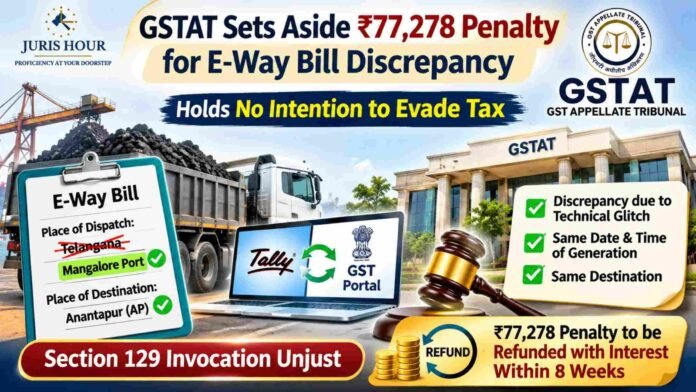
The Goods and Services Tax Appellate Tribunal (GSTAT), State Bench Bengaluru, has set aside a penalty of ₹77,278 imposed under Section 129 of the Central Goods and Services Tax Act, 2017, after finding that a discrepancy in the place of dispatch mentioned in the e-way bill occurred due to a technical glitch in the software integration with Tally.
The Tribunal held that although the taxpayer ought to have exercised greater care while generating the e-way bill on the common portal, there was no material indicating an intention to evade tax. It observed that the date and time of generation of the e-way bill in Tally software and on the GST portal were identical, and the destination mentioned in both documents was also the same.
Setting aside the appellate order, the Tribunal directed the Department to refund the penalty amount of ₹77,278 along with statutory interest within eight weeks from the date of the order.
Buy Now: 210+ GST Judgments E-Magazine – October 2026
The appellant/assessee was engaged in the business of trading in coal and allied products, procuring goods from both domestic markets and through imports. Since coal is a bulky commodity and transportation costs significantly influence commercial transactions, the company frequently undertook direct dispatch arrangements on a bill-to-ship-to basis.
In the present case, the company sold imported coal lying at Mangalore Port to a buyer located in Anantapur, Andhra Pradesh. The goods were arranged to be transported directly from Mangalore Port to the buyer’s destination.
The consignment comprised 29.580 metric tonnes of coal and was transported through vehicle bearing registration number KL11BS0622. The movement was accompanied by an e-invoice and an e-way bill.
However, the discrepancy between the actual place of dispatch and the place of dispatch reflected in the e-way bill resulted in detention proceedings.
Department Detains Coal Consignment Under Section 129
On June 1, 2022, at approximately 2:30 PM, the Commercial Tax Officer (Enforcement)-3, Kamarajar West Zone, Mangaluru, intercepted the vehicle at Golithottu.
During verification, the officer noticed that the e-way bill accompanying the consignment reflected the movement of goods from Telangana to Andhra Pradesh, whereas the driver disclosed that the actual transportation had commenced from Mangalore Port.
The Department took the view that the coal was being transported from Mangalore without the requisite supporting documents reflecting the actual movement.
Consequently, proceedings were initiated under Section 129 of the CGST Act, alleging contravention of the e-way bill requirements under Rule 138 of the CGST Rules.
The company was directed to pay a penalty of ₹77,278 for release of the detained goods. The appellant paid the amount and obtained release of the consignment.
The company challenged the detention order before the Joint Commissioner of Commercial Taxes (Appeals), Mangaluru.
However, the Appellate Authority, through its order dated July 20, 2023, dismissed the appeal and upheld the penalty imposed by the proper officer.
The Appellate Authority relied upon decisions of the Kerala High Court in Podaran Foods India Private Limited v. State of Kerala and Ouseph K.M. v. State of Kerala, as well as the Madhya Pradesh High Court’s decision in Gati Kinetsu Express Private Limited v. Commissioner of Commercial Taxes.
It also took the view that proof of mens rea or intention to evade tax was not necessary for initiating proceedings under Section 129 of the CGST Act.
Aggrieved by the decision, the appellant approached the GST Appellate Tribunal.
Before the Tribunal, the appellant submitted that a valid e-invoice and e-way bill containing the consignment particulars had been generated before commencement of transportation.
It was contended that the discrepancy arose due to a technical issue in the software integration with Tally, resulting in incorrect auto-population of the place of dispatch on the GST portal.
The appellant argued that the goods were identifiable and traceable and that the discrepancy was limited to the place of dispatch.
Accordingly, a technical error in the e-way bill could not automatically be treated as transportation without documents or as evidence of an intention to evade tax.
The appellant relied upon the Allahabad High Court’s decision in Saumya v. Union of India, reported in 2025 (7) TMI 1069.
An important aspect of the proceedings concerned the appellant’s request to introduce additional documentary evidence before the Tribunal.
The appellant sought to place on record the following documents:
- Gate Pass issued by JSW Mangalore Coal Terminal Private Limited dated June 1, 2022, recording vehicle number KL11BS0622 and quantity of 29.580 MT.
- Consignment Note No. 139795 dated June 1, 2022, issued by Vaishnavi Transport Corporation.
- Invoice No. KA/TR/04846 dated June 1, 2022, issued by Balaji Malts Private Limited, Maddur.
- Weighment slip dated June 3, 2022, issued by Hari Om Pipe Industries Private Limited, recording 29.520 MT at Anantapur.
The appellant contended that these documents formed a documentary chain establishing the actual physical movement of the goods and were necessary for proper adjudication.
The company relied upon Rule 45 of the GST Appellate Tribunal (Procedure) Rules, 2025, which empowers the Tribunal to admit additional evidence in appropriate circumstances.
The Department opposed the application, arguing that the appellant had failed to establish why these documents were not produced before the adjudicating or appellate authorities.
The Tribunal examined Rule 45 of the GSTAT (Procedure) Rules, 2025, alongside Rule 112 of the CGST Rules.
It observed that Rule 45 permits the Tribunal to admit additional evidence where such evidence is necessary to enable it to pass an order or where sufficient cause exists. Rule 45(4) also empowers the Tribunal to call for documents considered necessary in the interests of justice.
However, under Rule 112(1) of the CGST Rules, additional evidence cannot ordinarily be introduced unless the prescribed circumstances for its admission are established.
The Tribunal noted that the appellant had not provided any satisfactory explanation for failing to produce the documents before the Appellate Authority.
It further observed that the consignment note issued by Vaishnavi Transport Corporation and the tax invoice issued by Balaji Malts Private Limited were already in the appellant’s name. Therefore, the contention that the documents could only be obtained from third parties was not acceptable.
Accordingly, the Tribunal rejected the application for additional evidence.
Importantly, despite rejecting the additional evidence, the Tribunal proceeded to examine the main dispute on the basis of the existing records.
The principal question before the Tribunal was whether a discrepancy in the place of dispatch mentioned in the e-way bill, allegedly arising from a technical glitch, could justify detention and penalty under Section 129 of the CGST Act.
The Tribunal examined the e-invoice, the e-way bill generated through the GST portal and the e-way bill generated through Tally software.
It made the following important observations:
1. Identical date and time of generation
The e-way bill generated through Tally software and the one generated on the GST portal were both generated on June 1, 2022, at 10:36 AM.
2. Same vehicle particulars
The vehicle number mentioned in the e-invoice and the e-way bill matched.
3. Same destination
The place of destination was identical in both e-way bills, namely, Anantapur, Andhra Pradesh.
4. Difference only in the place of dispatch
The e-way bill generated through Tally reflected the place of dispatch as Mangalore Port, whereas the e-way bill generated on the GST portal reflected Hyderabad, Telangana.
The Tribunal considered these circumstances significant while examining whether the discrepancy indicated an intention to evade tax.
It accepted the appellant’s explanation that the discrepancy had occurred due to a technical glitch in the software integration.
The Tribunal also examined the judicial precedents relied upon by the Department and the appellant.
A significant consideration was the Supreme Court’s decision in Assistant Commissioner (ST) v. Satyam Shivam Papers Private Limited, reported in 2022 (57) GSTL 97.
The Tribunal observed that the Supreme Court had upheld the requirement of establishing material indicating an intention to evade tax before invoking Section 129 in the circumstances considered in that case.
The Supreme Court had approved the reasoning that merely because the time mentioned in an e-way bill had expired, the proper officer could not automatically conclude that there was an intention to evade tax without supporting material.
The Tribunal also considered the Karnataka High Court’s decision in BVM Trans Solutions Private Limited v. Commercial Tax Officer, reported in (2025) 37 Centax 391.
In that decision, the Karnataka High Court did not subscribe to the view adopted by the Madhya Pradesh High Court in Gati Kinetsu Express Private Limited and held that failure to fill in Part B of the e-way bill would not, by itself, justify invocation of Section 129 in the absence of an intention to evade tax.
The Tribunal noted that the decision in Gati Kinetsu Express predated the Supreme Court’s decision in Satyam Shivam Papers and could not be applied without considering the subsequent legal position.
The Tribunal also relied upon two important judicial precedents concerning discrepancies in transportation documents.
Saumya v. Union of India – Allahabad High Court
In this case, the consignment was detained because the goods were loaded from Nagpur instead of Chandrapur, Maharashtra, as reflected in the accompanying documents.
The High Court observed that there were no discrepancies concerning the quantity, quality or other particulars of the goods mentioned in the e-way bill and tax invoice.
The penalty was set aside, as a wrong declaration of the place of loading, without more, could not justify imposition of penalty.
The GSTAT found that this decision supported the appellant’s case.
K.S. Traders v. Deputy Commercial Tax Officer (Int), Madurai – Madras High Court
The Madurai Bench of the Madras High Court, in W.P. (MD) No. 23310/2025, decided on August 26, 2025, considered a case where the tax invoice mentioned Shencottah as the place of dispatch, whereas the e-way bill reflected Tuticorin.
The Court held that a minor discrepancy in the address or place of dispatch in the tax invoice and e-way bill did not justify imposition of penalty under Section 129.
The Tribunal observed that this decision also supported the appellant’s contention.
After considering the factual circumstances and the judicial precedents, the Tribunal accepted the appellant’s explanation that the discrepancy had occurred due to a technical glitch.
The Tribunal observed that the appellant ought to have been more careful while generating the e-way bill on the common portal. However, apart from negligence, the Department had not established any intention to evade tax.
The Tribunal particularly emphasised that the e-way bills generated through Tally and the GST portal had the same date and time. The place of destination was identical in both documents. The discrepancy related to the place of dispatch. The explanation of a technical glitch was acceptable in the facts of the case. There was no material establishing an intention to evade tax.
The Tribunal consequently held that invocation of Section 129 was unjust and incorrect in the facts and circumstances of the case.
Membership Required to Access Case Details & Order Copy
To view the complete Case Details and Download Order Copy, you must have an active membership. Please subscribe to continue.
Read More: Temple Hair Collection Under Lump-Sum Tender as Exempt Supply of Goods, Not Services: AAR

