
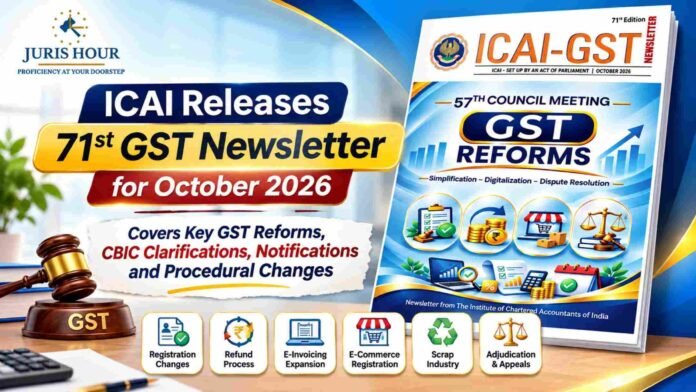
The Institute of Chartered Accountants of India (ICAI), through its GST & Indirect Taxes Committee, has released the 71st Edition of the ICAI-GST Newsletter for October 2026, providing a comprehensive compilation of important GST developments, statutory amendments, CBIC circulars, notifications and procedural changes.
The ICAI’s October 2026 GST Newsletter highlights sweeping changes following the 57th GST Council Meeting, including simplified GST registration, system-based cancellation and revocation, faster refund processing, revised ITC provisions, retrospective omission of Rule 96(10), and new GST obligations for scrap dealers effective November 1, 2026.
The October edition assumes particular significance in view of the recommendations made during the 57th GST Council Meeting held on October 8, 2026. While the earlier phase of GST reforms focused substantially on rate rationalisation, the latest developments place greater emphasis on procedural simplification, trade facilitation, technology-driven compliance, improved refund mechanisms and strengthening the quality of adjudication.
Buy Now: All 200+ GSTAT Judgements Till November 2026 | Comprehensive E-Magazine
The newsletter, presented by ICAI President CA. Prasanna Kumar D and Chairman of the GST & Indirect Taxes Committee CA. Umesh Sharma, also highlights ICAI’s contribution towards GST policy formulation and its engagement with the Government and GST Network.
According to the President’s communication, India’s gross GST collections increased by 22.9% year-on-year to ₹2,31,290 crore in October 2026, compared with ₹1,88,125 crore in October 2025. The collection represented the highest monthly figure since April 2026 and the fastest growth since September 2022.
The newsletter covers several important developments that are likely to have a direct impact on taxpayers, chartered accountants, tax practitioners, businesses and GST officers.
1. CBIC Issues Detailed Guidelines for Processing GST Registration Applications
One of the significant developments covered in the newsletter is the issuance of detailed guidelines for processing GST registration applications.
The guidelines aim to standardise documentation requirements, reduce unnecessary queries and prevent arbitrary rejection of registration applications.
The CBIC has clarified the documentation requirements relating to the constitution of business, promoters, partners, authorised signatories and the Principal Place of Business (PPoB).
Applicants are required to furnish appropriate supporting documents depending upon their business constitution. For instance, partnership firms must furnish partnership deeds, while societies, trusts and other entities must submit the relevant registration certificates or proof of constitution.
The guidelines also prescribe requirements for photographs of promoters and authorised signatories. Photographs must be recent, coloured and show the full front face. Group photographs and photographs extracted from identity documents are not acceptable.
Special documentation requirements for different premises
The guidelines provide specific documentation requirements for different categories of business premises.
| Nature of premises | Documents required |
| Property owned by family members or partners | Appropriate consent, rented, leased or shared-premises documentation |
| Property inherited from deceased ancestor | Affidavit, death certificate and relevant property document |
| Rented premises without rent agreement | Prescribed undertaking and electricity or water bill evidencing possession |
| Co-working space | Membership agreement specifying duration and allocated workspace, along with property documents |
| Jointly owned property | Consent letter or NOC from other co-owners |
| SEZ premises | Valid Letter of Approval or Permission from the Development Commissioner |
An important clarification is that an Udyam/MSME certificate is neither required nor acceptable as proof of the Principal Place of Business or Additional Place of Business.
The CBIC has also clarified that telecommunication towers and bank ATMs are not required to be declared as a Principal Place of Business or Additional Place of Business.
Officers cannot raise arbitrary registration queries
The guidelines specifically discourage officers from raising presumptive queries or demanding documents that are not prescribed.
Officers should not insist upon the residential address of an applicant, managing director or authorised signatory situated in another city or State. They should also not reject applications merely because the business activity is considered unsuitable for residential premises.
Further, electricity bills and property tax receipts are to be verified for the name and address of the premises. Officers should not scrutinise the amount of the electricity bill or insist that a residential electricity connection cannot be used for business purposes.
Where deficiencies are identified, the applicant must be given an opportunity to rectify them through FORM GST REG-03 instead of facing outright rejection.
The circular also reiterates that bank account details may be furnished after registration but must be provided within 30 days of registration or before furnishing outward supply details in GSTR-1/IFF, whichever is earlier.
Relevant Circular: Circular No. 257/03/2026-GST dated October 26, 2026.
2. CBIC Prescribes Detailed Guidelines for GST Demand, Adjudication and Appeal Proceedings
Another major development is the issuance of comprehensive guidelines governing demand, adjudication and appellate proceedings under GST.
The guidelines seek to improve the quality of show-cause notices, ensure reasoned adjudication orders, strengthen procedural fairness and reduce avoidable litigation.
Show-cause notices must contain specific allegations and evidence
The CBIC has emphasised that a show-cause notice must clearly identify the relevant facts, allegations, applicable statutory provisions, supporting evidence and computation of the proposed demand.
A properly drafted notice should contain:
- Details of the taxpayer, GSTIN and relevant tax periods.
- Background and factual basis of the proceedings.
- Examination of documents and evidence.
- Relevant statutory provisions and alleged contraventions.
- Individual roles of different noticees, wherever applicable.
- Clear statement of charges.
- Financial-year-wise computation of the proposed demand.
The notice must provide sufficient particulars to enable the taxpayer to understand the allegations and submit an effective reply.
The guidelines also emphasise that the allegations should not be presented as established conclusions at the show-cause notice stage. Neutral expressions should be used so that the proceedings do not appear predetermined.
Fraud allegations must be supported by evidence
The circular specifically addresses the invocation of extended limitation provisions on grounds of fraud, wilful misstatement or suppression of facts.
The proper officer must establish the requisite intention to evade tax and support the allegation with evidence.
Merely invoking fraud or suppression without establishing the necessary factual foundation would not satisfy the prescribed requirements.
The circular further clarifies that issuing a second show-cause notice on the same facts and grounds for a subsequent period, by invoking fraud or suppression, is generally not legally valid unless fresh and independent grounds exist.
Separate quantification under Sections 73 and 74
Where demands are proposed under both Sections 73 and 74, the show-cause notice must clearly identify the factual and legal basis for invoking each provision.
The demands must be separately quantified.
For FY 2024-25 onwards, where Section 74A applies, fraudulent and non-fraudulent demands must be distinctly identified along with their respective grounds and quantification.
No parallel proceedings on the same subject matter
The CBIC has reiterated that proceedings concerning the same subject matter should not be initiated simultaneously by CGST and SGST/UTGST authorities in contravention of Section 6 of the CGST Act.
Appropriate coordination between the authorities is necessary to prevent multiplicity of proceedings.
Adjudication orders must be speaking orders
The circular places considerable emphasis on reasoned adjudication orders.
Adjudicating authorities must independently examine the taxpayer’s submissions, evidence and legal arguments.
A generic observation such as “reply has been considered” would not be sufficient. The authority must explain whether the taxpayer’s submissions have been accepted, partially accepted or rejected and provide reasons for the conclusion.
The adjudication order must also:
- Examine the evidence relied upon in the show-cause notice.
- Address the taxpayer’s defence and supporting documents.
- Discuss relevant judicial precedents cited by both sides.
- Record issue-wise findings.
- Quantify tax, interest and penalty separately.
- Explain the legal basis for imposing penalties.
- Clearly specify the demand confirmed or dropped.
An important feature is the express requirement that AI-generated information used during adjudication must be independently verified for accuracy under appropriate human oversight. The issuing authority remains responsible for the correctness of the order.
Rectification under Section 161 cannot become a review
The circular clarifies that rectification under Section 161 is restricted to errors apparent on the face of the record.
It cannot be used to review the merits of an order, reappreciate evidence or correct errors requiring detailed reasoning. Such matters must be addressed through the appropriate appellate mechanism.
Relevant Circular: Circular No. 258/04/2026-GST dated October 26, 2026.
3. CBIC Clarifies Calculation and Refund of Pre-Deposit for GST Appeals
The CBIC has issued important clarifications regarding pre-deposit requirements under Sections 107 and 112 of the CGST Act.
The circular addresses several practical issues concerning the calculation of pre-deposit, refund of amounts deposited and treatment of pre-deposits following appellate relief.
The principal clarifications are as follows:
| Issue | Clarification |
| Calculation of 10% pre-deposit | Calculated on disputed tax, excluding the admitted liability |
| Admitted tax | Must be paid in full |
| Appeal before GST Appellate Tribunal | Pre-deposit calculated on the remaining disputed tax liability confirmed by the Appellate Authority |
| Refund after appellate relief | Refund can be claimed through FORM GST RFD-01 |
| Departmental appeal | Refund cannot be withheld merely because the Department intends to appeal |
| Interest on refund | Actual payment dates at the respective appellate stages must be considered |
| Remand by Tribunal | Pre-deposit is refundable within the prescribed time, subject to adjustment of the demand upheld in a partial remand |
Importantly, the circular clarifies that where an appellate order grants relief, it need not expressly direct refund of the pre-deposit.
The taxpayer can file a refund application under Serial No. 7 of FORM GST RFD-01, namely, “On account of order”.
Further, the Department cannot withhold the refund merely because it intends to challenge the favourable appellate order. Refund remains payable unless the appellate order is stayed by the Tribunal or a Court.
Relevant Circular: Circular No. 259/05/2026-GST dated October 26, 2026.
4. Important Clarifications on Input Service Distributor (ISD) Mechanism
The CBIC has issued detailed clarifications concerning the distribution of input tax credit through the Input Service Distributor mechanism.
The circular addresses multiple ISD registrations, distribution of credit, eligibility of ITC, timing of distribution and consequences of incorrect distribution.
Multiple ISD registrations permitted
The CBIC has clarified that there is no restriction on obtaining more than one ISD registration within a State or Union Territory for separate business verticals or separately registered places of business.
Each such registration is treated as a distinct person under Section 25 of the CGST Act.
Recipient must satisfy ITC eligibility conditions
The ISD is required to distribute credit in accordance with Section 20.
However, the recipients of the credit, and not the ISD, must satisfy the eligibility conditions under Sections 16 and 17 of the CGST Act.
Where the ISD distributes credit in contravention of Section 20, it may be liable to a penalty under Section 122(1)(ix), amounting to ₹10,000 or the amount of credit distributed irregularly, whichever is higher.
Where excess credit is distributed, the excess amount is recoverable from the recipients along with applicable interest.
Distribution of credit in the same month
Under Rule 39(1)(a), credit available for distribution during a particular month must be distributed in that month and reported in GSTR-6.
The circular clarifies that invoices appearing in GSTR-6A are treated as available for distribution once the ISD determines that the credit is prima facie eligible.
Clarification on Rule 54(1A)
The circular also clarifies the treatment of credit transferred through invoices or credit notes issued by a regular registered person to an ISD under Rule 54(1A).
Such transactions are merely a credit-transfer mechanism.
Accordingly, the value of such invoices does not constitute outward supply turnover of the issuer and is excluded from the relevant turnover calculations under Section 2(112) and Rule 89.
Further, the transferred credit does not qualify as Net ITC of the issuer for the refund formula.
Relevant Circular: Circular No. 260/06/2026-GST dated October 26, 2026.
5. Clarification on 50% ITC Mechanism for Banks and NBFCs under Section 17(4)
The CBIC has clarified various aspects concerning the optional 50% ITC mechanism available to banking companies, financial institutions and NBFCs under Section 17(4) of the CGST Act.
The clarification addresses the applicability of the provision to different registrations of the same entity and the reporting of ITC in GSTR-3B.
Registrations that are not engaged in accepting deposits or extending loans and advances, such as registrations exclusively engaged in bullion trading, are neither eligible nor required to opt for Section 17(4).
Where an eligible registration opts for the provision, all other registrations of the same entity that are also engaged in accepting deposits or extending loans and advances must follow Section 17(4).
Reporting of ITC
The circular prescribes the manner of reporting ITC under the 50% mechanism.
Taxpayers must ascertain eligible credit, reverse non-business-related and blocked credit permanently, avail eligible credit in accordance with the second proviso to Section 17(4), and reverse the remaining applicable portion.
It also addresses situations involving the Invoice Management System (IMS).
Where an invoice is presently ineligible because the conditions under Section 16 are not satisfied but may become eligible later, it must be kept pending in IMS.
Once the conditions are satisfied, the invoice may be accepted and the credit availed subject to the 50% mechanism.
The CBIC has also advised tax authorities not to take an adverse view of different methodologies followed in earlier periods, provided the total ITC availed is consistent with the principles clarified in the circular.
Relevant Circular: Circular No. 261/07/2026-GST dated October 26, 2026.
6. Major Relief on ITC for Demo Vehicles Purchased by Authorised Motor Vehicle Dealers
In an important clarification concerning motor vehicle dealers, the CBIC has withdrawn paragraph 4.6 of Circular No. 231/25/2024-GST dated September 10, 2024.
The earlier clarification had stated that where an authorised dealer merely acted as an agent or service provider to the manufacturer, ITC on demo vehicles purchased for test drives was blocked under Section 17(5)(a)(A).
The reasoning was that the dealer was not making the supply of motor vehicles on its own account and was merely providing marketing or facilitation services.
The CBIC has now reconsidered the position.
It has recognised two business models:
- Dealer-agency model, where the manufacturer sells vehicles directly to customers and the dealer maintains demo vehicles.
- Traditional dealership model, where the dealer purchases and sells vehicles on its own account and designates certain vehicles as demo vehicles.
In both cases, demo vehicles serve the same commercial purpose of allowing prospective customers to experience a test drive before purchasing a vehicle.
The Board has also interpreted the expression “such motor vehicles” used in Section 17(5)(a)(A) to indicate that ITC is not restricted only to the particular vehicle subsequently sold but may extend to vehicles used for further supply of similar motor vehicles.
Accordingly, the CBIC has clarified that ITC on demo vehicles is not blocked under Section 17(5)(a) for dealers operating under the dealer-agency model.
This clarification is particularly relevant for authorised motor vehicle dealers that had previously faced ITC restrictions on demo vehicles.
Relevant Circular: Circular No. 262/08/2026-GST dated October 26, 2026.
7. CBIC Clarifies GST Treatment of Export Proceeds Received Through Alternative Payment Mechanisms
The CBIC has issued important clarifications concerning the receipt and realisation of export proceeds for determining whether a transaction qualifies as an export of services under the IGST Act.
The circular addresses alternative payment mechanisms, settlement of receivables and payables, stockbroking services and reinsurance brokers.
The major clarifications include:
Receipt of export proceeds in INR: Receipt of export proceeds in repatriable INR accounts, including Special Non-Resident Rupee (SNRR) accounts and INR Nostro accounts, is recognised for satisfying the relevant condition under Section 2(6)(iv) of the IGST Act.
Stockbroking services: Payments received by Indian stockbrokers from overseas clients through repatriable INR accounts, including SNRR and NRE accounts, are considered acceptable. Payments through NRO accounts must be routed through repatriable INR accounts.
Set-off of receivables and payables: Where export receivables are adjusted against import payables in accordance with RBI directions, the relevant condition for export of services is considered fulfilled.
This clarification is significant in light of the FEMA (Export and Import of Goods and Services) Regulations, 2026, effective October 1, 2026.
Reinsurance brokers: Commission received through the net retention mechanism, in accordance with FEMA regulations, is treated as satisfying the relevant export-of-services condition.
The circular also clarifies that recovery of export refunds under Rule 96B should not be made to the extent the export realisation requirement has been written off by the authorised dealer bank.
Relevant Circular: Circular No. 263/09/2026-GST dated October 26, 2026.
8. Omission of Rule 96(10) Given Retrospective Effect from October 23, 2017
One of the most significant developments for exporters concerns the retrospective treatment of the omission of Rule 96(10) of the CGST Rules.
Rule 96(10) had restricted refund of IGST paid on exports where specified concessional or exemption benefits had been availed on inputs.
The provision was omitted with effect from October 8, 2024.
However, in Goodluck India Limited v. Union of India, the Supreme Court held that in the absence of a saving clause, the omission would also apply to pending proceedings.
Following the judgment, the CBIC has clarified that:
- The omission of Rule 96(10) is effective retrospectively from October 23, 2017.
- Pending proceedings concerning Rule 96(10) must be dealt with in accordance with the Supreme Court’s judgment.
- Similar treatment applies, mutatis mutandis, to the omission of Rules 89(4A) and 89(4B) of the CGST Rules.
The clarification is particularly relevant for exporters whose refund claims or proceedings were affected by the erstwhile restrictions.
Relevant Circular: Circular No. 264/10/2026-GST dated October 26, 2026.
9. GST Classification and Rate Clarifications for Various Goods
The CBIC has also issued several clarifications to address classification disputes and bring uniformity in the GST treatment of specified goods.
The important clarifications include:
| Goods | Clarification |
| Sublimation paper | Classified under Heading 4809, attracting 18% GST |
| Toys under Heading 9503 | Relevant 5% and 18% rate entries cover the broader categories of toys falling under the heading |
| Old and used motor vehicles | ITC restriction under the margin scheme is limited to tax paid on procurement of the vehicles themselves |
| Seaweed extract-based bio-stimulants | Classified under Heading 3101, subject to the prescribed registration |
| Psyllium seeds (Isabgol/Isabgul) | Specific exemption entry inserted |
| Retreaded tractor tyres | Specific entry introduced under the 2.5% CGST schedule |
ITC on other expenses under the margin scheme
An important clarification concerns dealers dealing in old and used motor vehicles under the margin scheme.
The restriction on ITC under the relevant notifications is limited to the tax paid on procurement of the old and used motor vehicles themselves.
Accordingly, dealers may claim ITC on other eligible inputs and input services used in their business, such as spare parts, repair and maintenance services, technology services, rent and marketing expenses, subject to the applicable provisions.
Relevant Circulars: Circular Nos. 265/11/2026-GST and related clarifications dated October 28, 2026.
10. CBIC Clarifies GST Applicability on Various Services
The newsletter also covers a series of important clarifications on the taxability of specific services.
R&D services versus consultancy services
Entry 44A of Notification No. 12/2017-CT(R) provides exemption for specified research and development services.
The CBIC has clarified that a certificate issued by the head of the concerned Government entity, research association, university, college or other notified institution, certifying that the activity is in the nature of R&D and not consultancy, may suffice for claiming the exemption.
Import of services by Indian establishments of foreign shipping companies
Import of services by an Indian establishment of a foreign shipping company from a related person or another establishment outside India, without consideration, has been exempted with effect from November 1, 2026.
Further, the GST Council has recommended regularisation of the past period from July 1, 2017 to October 31, 2026 on an “as is where is” basis.
Statutory recoveries in motor vehicle leasing
The CBIC has clarified that expenses such as registration charges, road tax, insurance premiums, FASTag charges and other incidental expenses recovered by lessors from lessees form part of the value of the composite supply of leasing services.
Such recoveries attract GST at the rate applicable to the leasing service.
TRAI not covered under the definition of Government
The Telecom Regulatory Authority of India (TRAI), despite being a statutory regulatory authority, does not qualify as “Government” under Section 2(53) of the CGST Act.
Notional interest under Fund Transfer Pricing mechanism
Notional interest recorded by banks under their Fund Transfer Pricing mechanism in relation to internal loans or advances between branches is covered within the definition of interest for the purpose of exemption under Notification No. 12/2017-CT(R).
Services provided by NBFCs to banks under co-lending arrangements
The CBIC has clarified that lending-related services provided by NBFCs to banks under co-lending arrangements constitute taxable services under GST.
The value of such services shall be the value specified in the contractual agreement between the NBFC and the bank.
Relevant Circular: Circular No. 266/12/2026-GST dated October 28, 2026.
11. Important Amendments under Finance Act, 2026 Effective from November 1, 2026
The Central Government has appointed November 1, 2026, as the effective date for Sections 153 to 155 of the Finance Act, 2026.
These amendments bring important changes to post-supply discounts, credit notes and refund provisions.
| Provision | Amendment |
| Section 15(3)(b) | Earlier pre-supply agreement and specific invoice-linkage conditions removed |
| Section 34(1) | Express provision added for issuing credit notes for post-supply discounts under Section 15(3)(b) |
| Section 54(6) | 90% provisional refund framework extended to eligible inverted-duty structure cases |
| Section 54(14) | Minimum ₹1,000 refund restriction removed for exports of goods with payment of tax |
These amendments are intended to facilitate greater flexibility in post-supply discount arrangements and improve the refund framework.
12. E-Invoicing Extended to RCM Supplies from Unregistered Persons and Import of Services
An important compliance-related amendment has been made to the e-invoicing framework through Notification No. 04/2026-Central Tax dated October 26, 2026.
The scope of e-invoicing has been expanded to include:
- Supplies received from unregistered persons where the recipient is liable to pay tax under reverse charge.
- Import of services.
The amendment is scheduled to become effective from January 1, 2027.
This is an important development for businesses undertaking significant reverse-charge transactions, as it expands the scope of e-invoicing-related compliance.
13. Major Amendments to CGST Rules, 2017: New Registration Mechanism for E-Commerce Sellers
Notification No. 05/2026-Central Tax dated October 26, 2026, has notified the CGST (Amendment) Rules, 2026, with most changes becoming effective from November 1, 2026, unless otherwise specified.
One of the significant changes is the insertion of Rule 14B, which facilitates GST registration through e-commerce operator warehouses.
Under the new provision, a person registered in a home State may obtain registration under the same PAN in another State even where the person has no physical presence there, by declaring the e-commerce operator’s warehouse as the Principal Place of Business.
The facility is subject to prescribed conditions, including:
- The supply of goods must be made through an e-commerce operator liable to collect TCS under Section 52.
- The seller must hold a valid regular GST registration in the home State.
- Monthly output tax liability on supplies to registered persons, excluding persons having the same PAN, must not exceed ₹2.5 lakh.
- The e-commerce operator must provide consent within seven working days.
- Aadhaar authentication is mandatory.
- Only one registration per State per PAN is permitted under the provision.
The rules also prescribe the consequences of withdrawal of consent by the e-commerce operator and failure to comply with registration-related requirements.
This development is expected to facilitate inter-State business operations for eligible small sellers operating through e-commerce platforms.
14. System-Based GST Registration Cancellation and Revocation
The amendments introduce significant changes to the process of cancellation and revocation of GST registration.
System-based cancellation
The amended Rule 20 provides for system-based cancellation of registration on the taxpayer’s request.
In specified cases, the cancellation order will be generated electronically in FORM GST REG-38 without requiring officer intervention.
The rules also prescribe separate procedures for taxpayers who have furnished all returns and discharged their liabilities and those who are required to furnish GSTR-10.
New Rule 23A: System-based revocation
A new Rule 23A has been inserted to provide for system-based revocation of cancellation of registration.
Eligible registered persons whose registration has been deemed cancelled electronically under Rule 22(5) may apply for revocation in FORM GST REG-21 within 180 days from the date of cancellation.
However, the application cannot be filed where prescribed compliance requirements remain unfulfilled, including furnishing pending returns and bank account details under Rule 10A.
Following revocation, pending returns for the period between cancellation and revocation must be furnished within 30 days from the date of the revocation order.
Where the prescribed compliance is completed, revocation is deemed approved and the order in FORM GST REG-22 is communicated electronically.
Cancellation grounds rationalised
The amended Rule 21 focuses on objective and system-verifiable defaults.
The specified grounds include:
- Failure by composition taxpayers to furnish annual returns beyond three months from the due date.
- Failure by monthly return filers to furnish returns for six continuous months.
- Failure by quarterly return filers to furnish returns for two continuous tax periods.
- Violation of prescribed conditions under Rule 10A.
Further changes concerning suspension and cancellation under Rules 21A and 22 and the system-based revocation mechanism under Rule 23A are scheduled to take effect from April 1, 2027.
15. Major Changes in GST Refund Processing: Deemed Acknowledgement Within 10 Days
The amendments to the GST refund mechanism are particularly important for exporters and taxpayers claiming refund of accumulated ITC.
The revised rules aim to reduce procedural delays and introduce a technology-driven refund processing mechanism.
The major changes include:
Reduction in processing timeline: The period for issuing acknowledgement or deficiency memo under Rule 90 has been reduced from 15 days to 10 days.
Deemed acknowledgement: Under the newly inserted Rule 90(3A), if the proper officer does not issue FORM GST RFD-02 or FORM GST RFD-03 within 10 days, the refund application shall be deemed acknowledged.
System-generated provisional refund order: Under Rule 91(2), FORM GST RFD-04 will be generated on the portal within three working days of acknowledgement, based on system-based risk evaluation.
Electronic payment: Refund payment orders in FORM GST RFD-05 will be made available through the portal.
Adjustment of outstanding dues: The revised Rule 92(1B) provides for adjustment of refund amounts against outstanding demands, with the balance amount being refundable to the applicant.
ITC on input services and capital goods included in refund calculations
Another important development is the expansion of the Net ITC concept for refund calculations.
Eligible input services and proportionate capital goods ITC are now included in the refund computation under the prescribed amendments.
For inverted duty structure refunds, eligible input services will be those on which ITC has been availed on or after November 1, 2026.
Capital goods ITC will be considered proportionately over 60 months from April 1, 2027.
The revised Rule 89(5) also provides an amended formula for calculating the maximum refund under the inverted duty structure.
These changes are particularly relevant for businesses that have accumulated substantial credit on input services and capital goods.
16. New Procedure under Rule 86A: Formal Orders and Opportunity to Object
The amendments to Rule 86A, effective April 1, 2027, introduce a more structured procedure for restricting debit of the electronic credit ledger.
The power to disallow debit of the electronic credit ledger will vest in the “proper officer”.
A formal order-based mechanism has been introduced, requiring the officer to follow the prescribed procedure.
The key features are:
- Restriction order to be issued in FORM GST DRC-26.
- Taxpayer may submit objections in FORM GST DRC-27.
- The officer must provide an opportunity of hearing.
- The decision after hearing must be issued in FORM GST DRC-28.
- Part A of the order allows the debit, while Part B rejects the objection.
The order will remain in force for one year from its issuance or until the officer allows the debit, whichever is earlier.
This amendment introduces a prescribed mechanism for taxpayers to challenge restrictions imposed on their electronic credit ledger.
17. New GST Obligations for Scrap Dealers: TDS and RCM on Specified Waste and Scrap
One of the most important changes for the scrap industry concerns the introduction of specific GST-related obligations for transactions involving used cooking oil, plastic scrap, tyre scrap, metal scrap and electronic waste.
The amendments are effective from November 1, 2026.
Specified scrap goods excluded from registration exemption
Notification No. 06/2026-Central Tax dated October 27, 2026, amends Notification No. 5/2017-Central Tax.
The earlier exemption from obtaining GST registration for persons exclusively making supplies on which the entire tax is payable under reverse charge will no longer be available to persons dealing in specified categories of goods.
The specified goods are:
| Goods | Customs Tariff Heading |
| Used cooking oil | 1518 |
| Waste and scrap of plastics | 3915 |
| Waste and scrap of tyres | 4004 |
| Metal scrap | Chapters 72 to 81 |
| Electrical and electronic waste and scrap | 8549 |
TDS obligations on specified scrap transactions
Notification No. 07/2026-Central Tax dated October 27, 2026, amends the provisions concerning TDS under Section 51.
Registered persons receiving specified goods from another registered person are required to deduct TDS in accordance with the amended notification.
The amendment covers used cooking oil, plastic scrap, tyre scrap, metal scrap and e-waste.
Reverse charge on purchases from unregistered suppliers
Notification No. 04/2026-Central Tax (Rate) dated October 27, 2026, further amends the reverse-charge notification under Section 9(3).
Specified supplies made by unregistered persons to registered persons have been brought within the reverse-charge mechanism.
The specified categories include:
- Used cooking oil.
- Waste and scrap of plastics.
- Waste and scrap of tyres.
- Electrical and electronic waste and scrap.
These changes are particularly relevant for scrap dealers, recyclers, manufacturers and businesses purchasing such materials from unregistered suppliers.
18. Important Changes in GST Rates and Exemptions for Goods and Services
The October newsletter also highlights several changes to GST rate notifications and exemption entries.
The significant changes include:
| Particulars | Amendment |
| Psyllium seeds (Isobgul/Isobgol) | Specific exemption entry inserted |
| Seaweed extract-based bio-stimulants | Clarified under the fertiliser entry attracting 5% GST |
| Retreaded tractor tyres | New entry under the 5% GST schedule |
| Other retreaded rubber tyres | Continued under the 18% GST schedule |
| Toys under Heading 9503 | Clarification on the scope of the 5% and 18% entries |
| Nominated Agency | Definition aligned with Appendix 4B of the DGFT Handbook of Procedures |
Changes in hotel, restaurant and transport services
Notification No. 06/2026-Central Tax (Rate) dated October 27, 2026, also amends the rate notification concerning specified services.
The newsletter provides a detailed table covering hotel accommodation, restaurant services, food supplied in trains or at railway platforms, outdoor catering, transportation of passengers through electric vehicles and delivery services.
For specified services, a 2.5% Central Tax rate is prescribed subject to ITC restrictions, while certain eligible suppliers have the option to pay tax at a higher rate of 9% without the corresponding ITC restrictions.
The notification also introduces amendments to the definitions of Goods Transport Agency and Electrically Operated Vehicle.
Exemptions for specified services
The amendments to Notification No. 12/2017-Central Tax (Rate) include several additional or revised exemption entries.
These cover:
- Helicopter passenger transport on a seat-sharing basis in specified North-Eastern States and other notified regions.
- Services by the Seamen’s Provident Fund Organisation to eligible persons.
- Specified rights relating to toll collection.
- Curing of coffee supplied to coffee cultivators.
- Specified storage and warehousing services relating to agricultural produce.
The newsletter also records amendments concerning the definition of seeds and the scope of certain exemptions.
19. GST Treatment of Renting of Passenger Vehicles and Delivery Services
The newsletter also covers changes concerning the reverse-charge mechanism applicable to renting of motor vehicles.
Notification No. 08/2026-Central Tax (Rate) dated October 27, 2026, increases the Central Tax rate in the relevant reverse-charge entry from 6% to 9% for renting of motor vehicles designed to carry passengers, where the cost of fuel is included in the consideration and the service is supplied to a body corporate.
Further, Notification No. 09/2026-Central Tax (Rate) amends the provisions concerning delivery services covered under Section 9(5).
The amendment clarifies the coverage of delivery services supplied through electronic commerce operators, subject to the prescribed exception for suppliers liable for registration under Section 22(1).
These changes are effective from November 1, 2026.
20. Special GST Procedure for Toll-Operate-Transfer Concessionaires
Notification No. 10/2026-Central Tax (Rate) dated October 27, 2026, prescribes a special procedure for payment of tax by concessionaires operating under the Toll-Operate-Transfer model.
A concessionaire providing operation and maintenance services to the concessioning authority during the concession period is required to pay Central Tax on the amount charged or debited from the escrow account towards operation and maintenance expenses.
The tax liability is to be discharged in the tax period in which the relevant expenditure is charged or debited from the escrow account.
The notification also defines the terms “Concession Agreement” and “Concessioning Authority” for this purpose.
The prescribed procedure is effective from November 1, 2026.
Key GST Changes at a Glance
The 71st Edition of the ICAI GST Newsletter reflects a broad shift towards simplified compliance, system-driven processes and improved procedural safeguards.
| Area | Major development | Effective date |
| GST registration | Standardised registration documentation and restrictions on unwarranted queries | October 2026 |
| Demand and adjudication | Detailed guidelines for SCNs and reasoned orders | October 2026 |
| Appeal pre-deposit | Clarification on calculation and refund | October 2026 |
| ISD | Clarifications on distribution of ITC | October 2026 |
| Demo vehicles | ITC relief for dealer-agency model | October 2026 |
| Rule 96(10) | Retrospective omission from October 23, 2017 | As clarified |
| E-invoicing | RCM supplies from unregistered persons and import of services | January 1, 2027 |
| Rule 14B | Registration through e-commerce warehouses | November 1, 2026 |
| Refund processing | 10-day acknowledgement and system-based processing | November 1, 2026 |
| Scrap industry | TDS and RCM changes for specified scrap | November 1, 2026 |
| Rule 86A | Formal restriction and objection mechanism | April 1, 2027 |
| System-based cancellation and revocation | Revised suspension, cancellation and revocation framework | April 1, 2027 for specified provisions |
Conclusion
The 71st Edition of the ICAI GST Newsletter for October 2026 captures an important phase in the evolution of India’s GST framework.
The developments following the 57th GST Council Meeting demonstrate a clear emphasis on reducing procedural difficulties, improving taxpayer experience and strengthening the quality of tax administration.
The guidelines on GST registration and adjudication are particularly important because they seek to address recurring difficulties faced by taxpayers, including arbitrary registration queries, inadequately drafted show-cause notices, non-speaking orders and unnecessary parallel proceedings.
Similarly, the introduction of system-based refund processing, deemed acknowledgement, revised ITC provisions and formal procedures under Rule 86A indicates a greater reliance on technology while retaining procedural safeguards.
The changes relating to e-commerce sellers, scrap dealers, exporters, motor vehicle dealers, banks and NBFCs also demonstrate the wide-ranging impact of the latest amendments.
For businesses and tax professionals, the immediate requirement is to review their existing GST compliance processes, identify the amendments applicable to their operations and ensure that the prescribed changes are implemented within the relevant timelines.
The ICAI newsletter is therefore an important reference document for understanding the latest GST developments and their practical implications for taxpayers and professionals.
Membership Required to Access Notification Details & Copy
To view the complete Notification Details and Download Copy, you must have an active membership. Please subscribe to continue.
Read More: Dual Approval U/s 151 of Income Tax Act Invalidates Reassessment Proceedings: ITAT

