
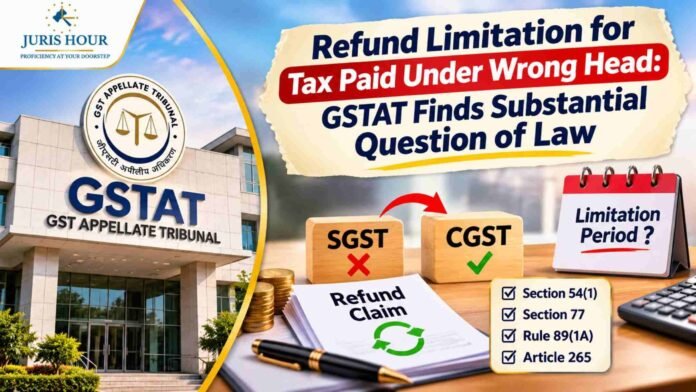
The Goods and Services Tax Appellate Tribunal (GSTAT), Chennai Bench, has held that an appeal involving the interpretation of Sections 54(1) and 77 of the Central Goods and Services Tax Act, 2017, Section 19 of the Integrated Goods and Services Tax Act, 2017, and Rule 89(1A) of the CGST Rules, 2017, raises a question of law within the meaning of Section 109(8) of the CGST Act.
The bench of A P Ravi (Judicial Member) and Duvvuri Krishna Srinivas (Technical Member) identifies substantial questions of law concerning the relevant date for claiming a refund where ITC was reversed under the wrong tax head and the same liability was subsequently discharged under the correct head.
Buy Now: 210+ GST Judgments E-Magazine – October 2026
The central controversy relates to the determination of the relevant date for computing the limitation period where an amount of input tax credit was reversed under the SGST head instead of the CGST head, and the corresponding liability was subsequently discharged under the correct CGST head.
The Tribunal concluded that resolving this controversy requires interpretation of statutory provisions and cannot be decided merely by verifying returns or other documents. Accordingly, it directed that the appeal be heard by a Division Bench comprising one Judicial Member and one Technical Member.
The dispute arose from the reversal of input tax credit under the incorrect tax head.
As recorded in the Tribunal’s order, the appellant had reversed the CGST credit under the SGST head on 16 March 2019. Subsequently, the same amount was paid under the correct CGST head on 8 December 2023.
Thereafter, the appellant filed a refund application on 27 December 2023, seeking a refund of the amount that had effectively been paid twice in respect of the same liability.
However, the refund claim was rejected solely on the ground of limitation.
The rejection gave rise to a significant legal controversy concerning the interpretation of the term “date of payment of tax” under Section 54(1), read with Explanation 2 thereto, particularly clause (h).
The issue is whether the limitation period should commence from the date on which the amount was initially debited under the incorrect SGST head or from the date on which the liability was actually discharged under the correct CGST head.
In its written submissions dated 15 November 2026 and 16 November 2026, the appellant contended that the matter involved an important question of law requiring interpretation of the relevant provisions of the CGST Act and Rules.
The appellant relied upon a conjoint reading of the following provisions: Section 54(1) of the CGST Act, 2017; Section 77 of the CGST Act, 2017; Rule 89(1A) of the CGST Rules, 2017; and CBIC Circular No. 162/18/2021-GST dated 25 September 2021.
The appellant’s principal contention was that the relevant date for computing the limitation period should be 8 December 2023, being the date on which the amount was discharged under the correct CGST head.
Accordingly, since the refund application was filed on 27 December 2023, the appellant maintained that the claim was well within the prescribed limitation period.
The appellant also argued that retaining an amount that had effectively been paid twice towards the same tax liability would offend Article 265 of the Constitution of India, which mandates that no tax shall be levied or collected except by authority of law.
The Department, in its written submissions dated 13 November 2026, also acknowledged that the appeal involved a question of law.
However, the Revenue disputed the appellant’s interpretation of the relevant provisions.
The Department contended that the debit under the SGST head on 16 March 2019 constituted the relevant date of payment for determining the limitation period.
According to the Department, even after excluding the period from 1 March 2020 to 28 February 2022 pursuant to Notification No. 13/2022-Central Tax dated 5 July 2022, the refund application was still beyond the prescribed two-year limitation period.
The Department further argued that Section 77 of the CGST Act is specifically concerned with situations where a supply is initially treated as an intra-State supply and tax is paid accordingly, but is subsequently held to be an inter-State supply, or vice versa.
Accordingly, the Revenue contended that the provisions of Section 77 could not be extended by analogy to an error involving payment under the CGST and SGST heads in respect of the same intra-State liability.
The Tribunal clarified that these rival submissions were being recorded only for deciding the constitution of the Bench and that the merits of the rival contentions would be considered at the final hearing.
After considering the written submissions of both parties and examining the grounds of appeal, the Tribunal identified three substantial legal questions requiring adjudication.
1. What Is the Relevant Date for Computing Refund Limitation When Tax Is Paid Under the Wrong Head?
The first question concerns the interpretation of Section 54(1), read with clause (h) of Explanation 2 thereto.
The Tribunal will have to examine whether the date of payment of tax should be considered as:
- 16 March 2019, when the amount of input tax credit was reversed under the SGST head; or
- 8 December 2023, when the liability was discharged under the correct CGST head.
The Tribunal will also examine whether the debit of input tax credit under an incorrect tax head constitutes “payment of tax” within the meaning of the relevant provision.
This question is significant because the determination of the relevant date directly affects the computation of the two-year limitation period prescribed under Section 54(1).
2. Whether Section 77 of the CGST Act Can Be Applied to an Error Between CGST and SGST Heads?
The second question concerns the scope and applicability of Section 77 of the CGST Act, Section 19 of the IGST Act and Rule 89(1A) of the CGST Rules, read with CBIC Circular No. 162/18/2021-GST dated 25 September 2021.
These provisions deal with situations involving payment of tax under the wrong classification of intra-State or inter-State supplies.
The Tribunal will examine whether these provisions govern, or can be applied by analogy to, a situation where an amount relating to the same intra-State liability is reversed or paid under the SGST head instead of the CGST head.
The distinction is important because the factual circumstances in the present dispute concern an error between CGST and SGST heads rather than a conventional case of an intra-State supply subsequently treated as an inter-State supply or vice versa.
3. Whether Retention of an Amount Paid Twice Violates Article 265 of the Constitution?
The third question concerns the computation of the limitation period, including the effect of Notification No. 13/2022-Central Tax dated 5 July 2022.
The Tribunal will also have to consider the constitutional implications of retaining an amount that has effectively been paid twice towards the same liability.
The appellant has invoked Article 265 of the Constitution, arguing that the retention of such an amount would be contrary to the constitutional requirement that tax can be collected only under the authority of law.
The answer to this question will depend upon the interpretation of the applicable refund provisions and the manner in which the limitation period is computed.
GSTAT’s Findings: Dispute Requires Interpretation of Statutory Provisions
The Tribunal observed that none of the identified questions could be answered merely by verifying returns or examining documentary evidence.
Instead, each question requires an authoritative determination concerning the meaning, scope and interrelationship of the relevant provisions of the CGST Act, IGST Act and CGST Rules.
Importantly, the Tribunal noted that the answer to these legal questions would be decisive because the refund claim had been rejected solely on the ground of limitation.
The Bench also took note of the fact that both the appellant and the respondent had acknowledged the existence of a question of law.
However, the Tribunal independently examined the grounds of appeal and written submissions and concluded that adjudication of the appeal necessarily required interpretation of Section 54(1), including Explanation 2, Section 77 of the CGST Act, Section 19 of the IGST Act and Rule 89(1A) of the CGST Rules.
Appeal Directed to Be Heard by Division Bench Under Section 109(8)
In view of the above findings, the GSTAT Chennai Bench held that the appeal involves a question of law within the meaning of Section 109(8) of the CGST Act, 2017.
Consequently, the appeal is required to be heard and decided by a Division Bench comprising:
- One Judicial Member; and
- One Technical Member.
The Tribunal expressly clarified that its order was confined to determining the existence of a question of law for the purpose of constituting the appropriate Bench.
It further clarified that nothing stated in the order should be construed as an expression of opinion on the merits of the appeal. All contentions raised by both parties have been left open for consideration at the final hearing.
The matter has accordingly been directed to be listed before the Division Bench on 19 January 2027 for hearing on merits.
Membership Required to Access Case Details & Order Copy
To view the complete Case Details and Download Order Copy, you must have an active membership. Please subscribe to continue.
Read More: GST Appeals Can’t Be Entertained Beyond 4 Months: GSTAT

