
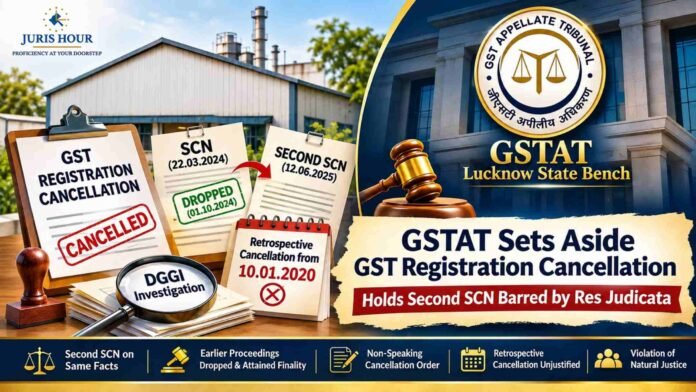
The Goods and Services Tax Appellate Tribunal (GSTAT), Lucknow State Bench has held that the department cannot reopen registration cancellation proceedings on the same foundational facts after earlier proceedings were dropped and attained finality.
The bench of Narendra Kumar (Judicial Member) and Alok Chopra (Technical Member) has observed that the second Show Cause Notice (SCN) was barred by the principles of res judicata and constructive res judicata, as it was substantially founded on the same allegations and investigative material that had already been considered in earlier proceedings.
Buy Now: 210+ GST Judgments E-Magazine – October 2026
The appellant/assessee a proprietorship concern engaged in the business of FMCG products, waste paper, gitti trading and food grains, was issued a Show Cause Notice dated March 22, 2024, proposing cancellation of its GST registration under Section 29(2)(e) of the CGST Act, 2017.
The allegations originated from a letter issued by the Directorate General of GST Intelligence (DGGI) dated March 19, 2024. The investigation reportedly raised several allegations concerning the taxpayer’s transactions and ITC availment.
The allegations included huge mismatches between inward and outward supplies, outward supplies without corresponding inward supplies, transactions involving suppliers allegedly found to be non-existent, involvement of a firm allegedly using fake transporter bilty books, and allegations concerning certain inward suppliers found to be non-existent upon verification.
The taxpayer challenged the proceedings before the Allahabad High Court. In Writ Tax No. 85 of 2024, the High Court, by an order dated September 4, 2024, directed the Department to provide all documents referred to in the Show Cause Notice and thereafter pass a reasoned and speaking order after considering the taxpayer’s reply.
Pursuant to the High Court’s directions, the DGGI letter was provided to the taxpayer, who submitted a detailed reply on September 18, 2024.
After considering the Show Cause Notice, the taxpayer’s reply and the DGGI investigation material, the adjudicating authority passed a reasoned order dated October 1, 2024, dropping the cancellation proceedings.
Importantly, the Department did not challenge this order, and it attained finality.
Despite the earlier proceedings having been dropped, the Department issued another Show Cause Notice dated June 12, 2025, proposing cancellation of the GST registration under Rule 21(b) and Rule 21(e) of the CGST Rules, 2017.
The second notice relied upon the DGGI communications dated March 19, 2024, and December 20, 2024.
The Department alleged that the taxpayer had contravened the provisions of Rule 21(b), relating to issuance of invoices without supply of goods or services, and Rule 21(e), concerning availment of ITC in violation of the provisions of the Act or Rules.
The taxpayer submitted that the second notice was substantially based on the same foundational facts and investigation material that had formed the basis of the first proceedings.
It was further argued that the subsequent DGGI communication merely provided additional details and elaboration of allegations already considered during the earlier adjudication. Such an expansion of the existing investigation material could not constitute a legitimate basis for reopening proceedings that had already been concluded.
The taxpayer also contended that the second SCN was an attempt to achieve indirectly what the Department had failed to achieve in the earlier proceedings.
Following the second Show Cause Notice, the proper officer passed an order dated July 9, 2025, cancelling the GST registration of Baba Industries with retrospective effect from January 10, 2020.
The taxpayer alleged that the cancellation order was non-speaking and did not contain any independent reasoning or findings explaining why the registration was required to be cancelled.
It was also contended that the taxpayer’s reply had not been properly considered and that the order was passed mechanically without examining the factual and legal position.
Aggrieved by the cancellation, the taxpayer approached the Allahabad High Court in Writ Tax No. 713 of 2025. The High Court, by an order dated August 4, 2025, relegated the taxpayer to the statutory appellate remedy.
Thereafter, the First Appellate Authority, through Order-in-Appeal No. 514/CGST/APPL/LKO/2025 dated December 3, 2025, rejected the appeal and upheld the cancellation.
Consequently, the assessee approached the GST Appellate Tribunal, Lucknow.
One of the principal questions before the Tribunal was whether the Department could issue a second Show Cause Notice on substantially the same facts and allegations after the earlier proceedings had already been dropped through a reasoned adjudication order.
The Tribunal examined the principles of res judicata and constructive res judicata, including their applicability to quasi-judicial proceedings under tax laws.
Referring to Section 11 of the Code of Civil Procedure, 1908, the Tribunal observed that the doctrine is founded on the principle that litigation must attain finality and that a party should not be subjected to repeated proceedings concerning the same matter.
The Tribunal identified the essential requirements for applying the doctrine, including the issue in the subsequent proceedings must be directly and substantially the same as the issue decided earlier. The proceedings must involve the same parties or parties claiming under them. The parties must have litigated under the same legal capacity. The earlier authority must have had jurisdiction over the subject matter. The matter must have been finally decided on its merits.
The Tribunal also referred to the decision of the Supreme Court in S.B.I. v. Ram Lal Bhaskar, reported in (2011) 10 SCC 249, while discussing the broader principle that finality in litigation should be respected.
The Tribunal specifically considered whether the doctrine of res judicata could apply to proceedings under tax laws.
It referred to the decision in Radhasoami Satsang v. Commissioner of Income Tax, (1992) 1 SCC 659, wherein the Supreme Court recognised that although each assessment year is ordinarily a separate unit, a fundamental aspect permeating through different years, which has been decided earlier, should not ordinarily be reopened without a material change in circumstances.
The Tribunal also discussed the decision in Bharat Sanchar Nigam Ltd. v. Union of India, (2006) 3 SCC 1, concerning the applicability of the doctrine in taxation matters.
The Tribunal observed that although tax proceedings may involve separate statutory periods and causes of action, the Department cannot arbitrarily depart from an earlier concluded position when the foundational facts remain unchanged.
It emphasised that where the same cause of action and foundational facts have already been adjudicated, the Department cannot repeatedly initiate proceedings merely by presenting the same allegations in a different form.
After examining the two Show Cause Notices and the corresponding DGGI communications, the Tribunal found substantial similarity between the allegations forming the basis of both proceedings.
The first Show Cause Notice dated March 22, 2024, was based on the DGGI letter dated March 19, 2024.
The subsequent Show Cause Notice dated June 12, 2025, relied upon the same investigation and the subsequent DGGI communication dated December 20, 2024.
The Tribunal noted that the second DGGI communication was essentially an expanded and more detailed presentation of the allegations already forming part of the earlier investigation.
In particular, the Tribunal observed that the second communication did not disclose any genuinely new foundational facts that could justify reopening the earlier proceedings.
The Tribunal also noted that the first adjudicating authority had already considered the allegations and dropped the proceedings through its order dated October 1, 2024.
That order had not been challenged by the Department and had attained finality.
Accordingly, the Tribunal concluded that the subsequent proceedings amounted to an impermissible attempt to reopen an issue that had already been adjudicated.
The Tribunal made an important observation regarding the nature of the subsequent DGGI communication.
It noted that the second DGGI letter dated December 20, 2024, provided a more detailed explanation of the allegations concerning mismatches between inward and outward supplies, outward supplies without corresponding inward supplies, alleged non-existent suppliers, alleged use of fake transporter bilty books, and allegations concerning non-existent inward suppliers.
However, these allegations were substantially the same as those forming the basis of the first Show Cause Notice.
The Tribunal observed that merely providing further particulars or elaborating upon earlier allegations would not automatically create a fresh cause of action.
The Department was required to establish the existence of genuinely new facts or independent grounds capable of supporting fresh proceedings.
The Tribunal also referred to the principle that a subsequent Show Cause Notice should not be issued on the same facts and grounds as an earlier notice, particularly where the earlier proceedings had already been concluded.
Apart from the issue of res judicata, the Tribunal also examined the legality of the cancellation order dated July 9, 2025.
It found that the cancellation order did not properly record the reasons for cancelling the registration.
The order failed to demonstrate independent application of mind by the proper officer and did not adequately address the taxpayer’s submissions.
The Tribunal emphasised that cancellation of GST registration cannot be treated as a mechanical consequence of issuing a Show Cause Notice or receiving an adverse investigation report.
The proper officer is required to independently examine the allegations, consider the taxpayer’s reply and record reasons supporting the decision.
An adjudicating authority cannot simply rely upon the conclusions or recommendations of an investigating agency without independently examining the material available on record.
The Tribunal also referred to the Supreme Court’s decision in Oryx Fisheries Pvt. Ltd. v. Union of India, (2010) 13 SCC 427, which emphasised the importance of fairness and proper application of mind in quasi-judicial proceedings.
It observed that the right to submit a reply and receive a reasoned adjudication is an essential component of the principles of natural justice.
Another important aspect examined by the Tribunal was the retrospective cancellation of the GST registration with effect from January 10, 2020.
The Tribunal observed that retrospective cancellation of registration can have serious financial and commercial consequences for a taxpayer.
Such cancellation may affect the taxpayer’s business operations, transactions with other registered persons and the financial position of parties forming part of the supply chain.
The Tribunal noted that retrospective cancellation cannot be ordered mechanically or without proper justification.
The proper officer must examine the facts and circumstances and record reasons supporting the retrospective effect of cancellation.
The Tribunal referred to the principles laid down by the Delhi High Court in Riddhi Siddhi Enterprises v. Commissioner of Goods and Services Tax (CGST), W.P.(C) No. 8061 of 2024, concerning the requirement that retrospective cancellation must be supported by reasons and cannot be exercised arbitrarily.
It also considered other High Court decisions dealing with non-speaking cancellation orders and the requirement to provide a meaningful opportunity of hearing.
The Tribunal found that the retrospective cancellation in the present case was unjustified and disproportionate.
An important feature of the ruling is that the Tribunal did not consider it appropriate to remand the matter to the adjudicating authority for fresh consideration.
It observed that the foundational Show Cause Notice dated March 22, 2024, had already resulted in a reasoned order dated October 1, 2024, dropping the proceedings.
Since the Department had not challenged that order, it had attained finality.
The Tribunal held that the second Show Cause Notice dated June 12, 2025, was barred by the principles of res judicata and constructive res judicata.
Consequently, the jurisdictional foundation of the subsequent cancellation proceedings itself was legally unsustainable.
The Tribunal observed that once the second Show Cause Notice was found to be barred by res judicata, there was no justification for remanding the matter for another round of adjudication.
After considering the facts, submissions and applicable legal principles, the GST Appellate Tribunal allowed the appeal filed by Baba Industries.
The Tribunal set aside the order-in-Appeal passed by the First Appellate Authority. Order for cancellation of registration bearing Reference cancelling the taxpayer’s registration retrospectively from January 10, 2020.
The Tribunal held that the second Show Cause Notice and the consequential cancellation proceedings were legally unsustainable.
Membership Required to Access Case Details & Order Copy
To view the complete Case Details and Download Order Copy, you must have an active membership. Please subscribe to continue.

