
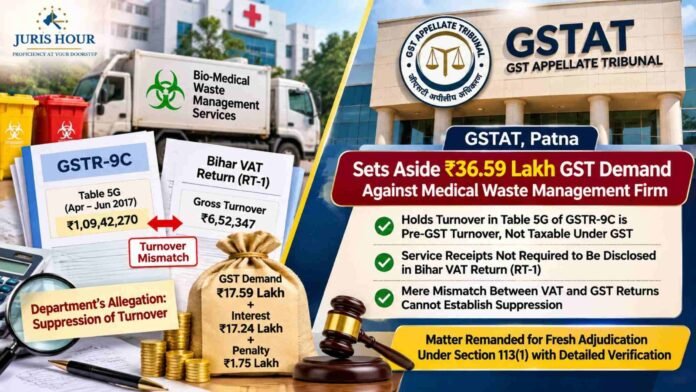
The Goods and Services Tax Appellate Tribunal (GSTAT), Patna, has set aside the Order-in-Appeal confirming a GST demand against the assessee arising from an alleged mismatch between turnover reported in GSTR-9C and the Bihar VAT return and held that a mere difference between figures reported under two different tax regimes cannot, by itself, establish suppression of taxable turnover under GST.
The bench of Manoj Kumar Sinha (Judicial Member) and Sanjay Kumar Mawandia (Technical Member) set aside the original adjudication order and the appellate order. It also set aside the tax demand of ₹17,59,576, interest of ₹17,24,192 and penalty of ₹1,75,958, directing the adjudicating authority to undertake a fresh verification in accordance with the Tribunal’s findings.
Buy Now: 210+ GST Judgments E-Magazine – October 2026
The appellant/assessee is engaged in providing bio-medical waste management services and also undertakes the sale of goods, including plastic waste.
The dispute originated from the financial year 2017-18, which covered both the pre-GST period (April 1, 2017, to June 30, 2017) and the GST period (July 1, 2017, to March 31, 2018).
The Department noticed a difference between the turnover reported in Table 5G of Form GSTR-9C and the gross turnover reflected in the Bihar VAT return (Form RT-1).
According to the Department, the appellant had disclosed turnover of ₹1,09,42,270 in Table 5G of GSTR-9C for April to June 2017, whereas its Bihar VAT return reflected gross turnover of only ₹6,52,347.
Consequently, the Department treated the difference of ₹1,02,89,923 as suppressed turnover and initiated proceedings under Section 73 of the CGST/BGST Act.
The adjudicating authority passed an ex-parte order dated December 29, 2023, confirming the demand. The first appellate authority subsequently upheld the demand through Order-in-Appeal dated August 29, 2025.
Aggrieved by the decision, the taxpayer approached the GST Appellate Tribunal.
The demand confirmed by the lower authorities comprised the following amounts:
| Particulars | CGST | SGST | Total |
| Tax | ₹8,79,788 | ₹8,79,788 | ₹17,59,576 |
| Interest | ₹8,62,096 | ₹8,62,096 | ₹17,24,192 |
| Penalty | ₹87,979 | ₹87,979 | ₹1,75,958 |
| Total | ₹18,29,863 | ₹18,29,863 | ₹36,59,726 |
The appellant also deposited the mandatory pre-deposit of ₹1,75,958 under Section 112(8)(b) of the CGST Act for filing the appeal before the Tribunal.
The appellant submitted that the entire demand arose from an incorrect comparison of turnover reported under different taxation laws.
It was explained that GST came into effect from July 1, 2017, and therefore the turnover for April to June 2017 was required to be treated separately under the erstwhile VAT and Service Tax laws.
The appellant furnished the following break-up of its PAN-India turnover for FY 2017-18:
| Period | Services | Sale of Goods | Total |
| FY 2017-18 | ₹49,61,85,942 | ₹10,31,25,213 | ₹59,93,11,155 |
| April–June 2017 (Pre-GST) | ₹12,20,31,885 | ₹2,30,76,061 | ₹14,51,07,946 |
| July 2017–March 2018 (GST) | ₹37,41,54,079 | ₹8,00,49,167 | ₹45,42,03,246 |
For Bihar, the appellant explained that the turnover for April to June 2017 consisted of:
| Particulars | Amount |
| Bio-medical waste management charges | ₹1,02,98,422 |
| Sale of goods, including plastic waste | ₹6,43,573 |
| Registration fees (non-operating) | ₹51,500 |
| Total as per books | ₹1,09,93,495 |
The appellant contended that bio-medical waste management services were exempt from Service Tax under Entry 2B of Notification No. 25/2012-ST dated June 20, 2012.
The service turnover was disclosed in Form ST-3, whereas the sale of goods was reported in the Bihar VAT return in Form RT-1.
Accordingly, the appellant argued that the Department had wrongly treated service receipts as suppressed turnover merely because they were not reflected in the VAT return.
One of the principal questions before the Tribunal was whether the amount reflected in Table 5G of GSTR-9C could be treated as taxable turnover under GST.
The Tribunal examined the prescribed format of Form GSTR-9C, notified under Notification No. 49/2018-Central Tax.
It observed that Part II of GSTR-9C reconciles the turnover declared in the audited financial statements with the turnover reported in the annual GST return.
Serial No. 5G specifically provides for reporting turnover relating to April 2017 to June 2017.
The Tribunal noted that this amount is required to be deducted from the audited annual turnover because the financial statements cover the entire financial year, whereas GST became applicable only from July 1, 2017.
Accordingly, the Tribunal held that:
“A figure in Table 5G is, by the design of the form, turnover the taxpayer declares as not belonging to the GST period.”
The Tribunal further observed that the show cause notice itself acknowledged that the amount of ₹1,09,42,270 had been reduced from the total turnover and that tax on the turnover relating to July 2017 to March 2018 had been accepted.
Despite this, the Department treated the same pre-GST figure as GST turnover without producing any material to establish that the relevant supplies had actually taken place on or after July 1, 2017.
The Tribunal held that a mere arithmetical difference between two returns governed by different laws cannot establish GST liability.
It clarified that although a discrepancy in GSTR-9C may justify an enquiry under Section 73, such discrepancy cannot independently sustain a tax demand.
The proper officer must establish through material evidence that a taxable supply took place without payment of tax.
Another important issue considered by the Tribunal was whether the appellant was legally required to disclose its service receipts in Form RT-1 under the Bihar VAT Act.
The Department had proceeded on the premise that even exempt service turnover ought to have been disclosed in the VAT return.
However, the Tribunal rejected this approach.
It examined Section 24(1) of the Bihar VAT Act and observed that the VAT return was required to cover transactions involving sales, purchases, receipts and dispatch of goods.
Since the Bihar VAT Act dealt with taxation of goods and did not extend to services, service receipts were governed by Chapter V of the Finance Act, 1994, and were required to be reported through Form ST-3.
The Tribunal observed that there was nothing on record to establish any legal requirement to disclose service receipts in Form RT-1, whether as exempt turnover or otherwise.
It further noted that the appellant had consistently reported only goods-related transactions in its VAT returns over several years without any prior departmental objection.
The Tribunal accordingly held that:
“Omitting service turnover from form RT-1 does not, by itself, establish suppression.”
The Tribunal also found that the first appellate authority had erroneously proceeded on the assumption that the ST-3 return covered April to September 2017.
It noted that Notification No. 18/2017-ST dated June 22, 2017, required the final Service Tax return for the quarter ending June 30, 2017, to be filed by August 15, 2017.
The appellant had filed its ST-3 return on August 15, 2017, in accordance with the prescribed requirement.
Therefore, the period printed on the pre-amended format of the return could not, by itself, be a valid ground to reject the appellant’s explanation.
The Tribunal examined the transitional provisions under Section 142(11)(a) and (b) of the CGST Act.
It observed that GST came into force on July 1, 2017, and the levy under Section 9 applies to supplies as defined under Section 7 of the Act.
Transactions pertaining to the period before July 1, 2017, remain within the domain of the erstwhile taxation laws, subject to the applicable transitional provisions.
The Tribunal specifically observed that Section 142(11)(a) and (b) provides that no tax is payable under the GST Act on goods or services to the extent tax was leviable under the State VAT law or Chapter V of the Finance Act, 1994.
Importantly, the Tribunal clarified that even if transactions relating to the pre-GST period remained undeclared or under-declared under the erstwhile VAT or Service Tax regime, GST could not automatically be demanded on such transactions.
Any resulting tax liability or enquiry would have to be pursued by the authorities empowered under the respective earlier laws.
Thus, the Department could not use the GST proceedings to impose tax on transactions merely because a discrepancy was noticed in the returns relating to the pre-GST period.
The Tribunal also addressed the question of the burden of proof in proceedings under Section 73.
It held that the burden to establish the taxable event lies upon the Revenue.
The mere failure of a taxpayer to file a reply to the show cause notice does not shift this burden.
The Tribunal observed that even an ex-parte order must be supported by cogent reasons and material available on record, rather than an inference drawn merely from the taxpayer’s silence.
At the same time, the Tribunal recognised that certain details, including invoice dates, dates of service provision and allocation of turnover to Bihar, were particularly within the knowledge of the appellant.
Therefore, the appellant was directed to produce the relevant supporting records before the adjudicating authority.
It also clarified that if the appellant claims exemption under Entry 75 of Notification No. 12/2017-Central Tax (Rate) for any supply made on or after July 1, 2017, it must establish compliance with the conditions prescribed under that entry.
While examining the sustainability of the orders passed by the lower authorities, the Tribunal identified significant deficiencies in the manner in which the demand had been confirmed.
First, the appellate authority failed to properly examine the service turnover of ₹1,02,98,422, which substantially accounted for the alleged mismatch.
Second, it incorrectly held that service receipts were required to be disclosed in Form RT-1 under the Bihar VAT Act.
Third, the Department had failed to establish how the alleged suppressed turnover translated into a tax demand of ₹17,59,576.
The Tribunal specifically noted that the tax demand on turnover of ₹1,02,89,923 resulted in an effective tax rate of approximately 17.1%, which was entirely unknown to the GST rate schedule.
The Tribunal therefore observed that the impugned order lacked legal sustainability.
However, it did not grant outright relief to the appellant because the appellant had failed to submit its reply before the original adjudicating authority despite repeated opportunities.
Further, the transaction-wise turnover statements and CA certificate dated October 26, 2026, had been produced for the first time before the Tribunal and had not been examined by the lower authorities.
The Tribunal observed that although the demand and the appellate order suffered from serious legal and factual deficiencies, the factual reconciliation still required verification.
The respondent Department had also sought verification of the transaction-wise records during the course of the hearing.
Considering these circumstances, the Tribunal invoked Section 113(1) of the CGST/BGST Act and remanded the matter to the original adjudicating authority for fresh adjudication.
The Tribunal directed the appellant to produce all relevant documents, including:
- Relevant books of accounts and financial records.
- Transaction-wise turnover statements.
- Invoices and supporting documents.
- Details of the dates on which services were provided.
- Form ST-3 and Bihar VAT Return RT-1.
- GSTR-9 and GSTR-9C.
- CA certificates and other reconciliation statements.
Importantly, the Tribunal directed that verification must remain confined to the legal findings recorded in its order and that the remand proceedings must not become a fresh roving enquiry.
The adjudicating authority was further directed to pass a fresh, reasoned order after granting an adequate opportunity of personal hearing to the appellant.
The Tribunal clarified that interest and penalty are consequential to the determination of tax liability.
Since the underlying tax demand was being set aside for fresh adjudication, the interest of ₹17,24,192 and penalty of ₹1,75,958 were also set aside.
Membership Required to Access Case Details & Order Copy
To view the complete Case Details and Download Order Copy, you must have an active membership. Please subscribe to continue.

