
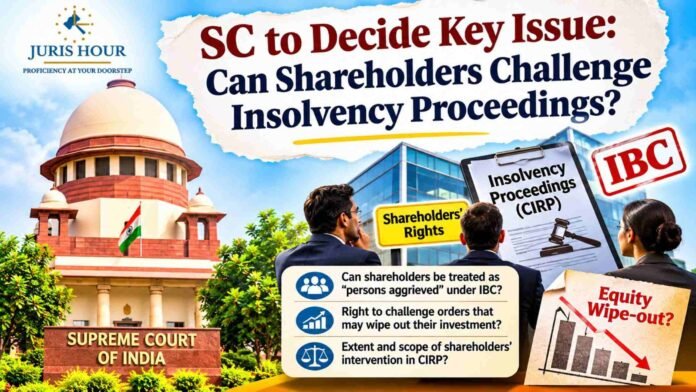
The Supreme Court is set to clarify the extent of shareholders’ rights to challenge insolvency proceedings, particularly where the commencement of corporate insolvency resolution proceedings (CIRP) directly threatens their financial interests and may result in the complete erosion of their equity investment.
The issue assumes significance for majority and minority shareholders who, despite holding substantial stakes in companies, may find themselves without an effective opportunity to challenge insolvency-related orders passed by the National Company Law Tribunal (NCLT).
The Supreme Court reserved its judgment on October 8, 2026, after hearing a challenge concerning the rejection of a shareholder’s plea to be treated as a “person aggrieved” under the insolvency framework. The decision could determine whether shareholders have a limited right to question insolvency proceedings when their legal or financial interests are directly affected.
Buy Now: 210+ GST Judgments E-Magazine – October 2026
Supreme Court Examines Shareholders’ Right to Challenge Insolvency Proceedings
The matter arose from proceedings involving Clarion Health Food LLP, which holds a 63.64% shareholding in Goli Vada Pav Pvt. Ltd., a company operating in the fast-food sector.
Clarion challenged the rejection of its claim that it should be recognised as a person aggrieved and consequently permitted to challenge the insolvency proceedings concerning the company.
It contended that, being a majority shareholder with a direct financial interest in the company’s affairs, it should have the right to question insolvency proceedings that could potentially wipe out its entire equity investment.
The shareholder further argued that it was not informed in its capacity as a shareholder when Goli Vada Pav was admitted into insolvency proceedings. As a result, it was allegedly deprived of an opportunity to raise objections before the National Company Law Tribunal at the stage when the insolvency process commenced.
A Bench comprising Justice Ujjal Bhuyan and Justice Atul S. Chandurkar heard the matter and reserved its judgment on October 8.
The central question before the Supreme Court is whether shareholders whose investments are directly threatened by insolvency proceedings can be denied the opportunity to challenge the proceedings merely because they are not creditors or do not control the resolution process.
Why Shareholders’ Rights Under the IBC Are Significant
The Insolvency and Bankruptcy Code, 2016 (IBC) primarily places creditors at the centre of the corporate insolvency resolution process. The statutory framework gives financial and operational creditors a central role in the resolution mechanism, while shareholders generally occupy a lower position in the order of priority.
Under the insolvency framework, shareholders ordinarily have limited control over the resolution process and cannot dictate decisions taken by creditors or the Committee of Creditors (CoC).
However, the commencement of CIRP and approval of a resolution plan can have a direct and substantial impact on shareholders. In certain cases, the existing equity may be completely extinguished, leaving shareholders with no economic value in the company.
The question, therefore, is whether shareholders should have a limited opportunity to challenge insolvency orders when such proceedings directly affect their rights and investments.
Legal experts believe that a ruling in favour of shareholders could provide them with an opportunity to approach the adjudicating authorities against admission orders or other insolvency decisions that directly threaten their interests.
Rahul Dev, Partner at Argus Partners, observed that shareholders should have a limited opportunity to be heard where insolvency proceedings directly affect their rights, even though they do not exercise control over the resolution process or decisions of creditors.
He further indicated that recognition of such a right could allow shareholders to challenge admission orders that may ultimately result in the loss of their investments.
NCLAT Rejects Shareholders’ Challenge to ₹1,611 Crore Resolution Plan
The issue has gained importance following recent decisions of insolvency tribunals restricting shareholders’ attempts to intervene in corporate insolvency proceedings.
On November 6, 2026, the National Company Law Appellate Tribunal (NCLAT) dismissed appeals filed by minority shareholders of Gstaad Hotels challenging a resolution plan involving approximately ₹1,611 crore.
The approved resolution plan wiped out the company’s existing equity and transferred 100% of its shares to the successful resolution applicant.
The minority shareholders argued that the resolution plan did not adequately account for the value available to equity holders.
However, the NCLAT held that shareholders cannot challenge a resolution plan merely because they hold shares in the corporate debtor or are financially affected by the consequences of the resolution plan.
The decision highlights the distinction between having an economic interest in a company and possessing a legally recognised right to challenge insolvency-related decisions.
NCLT Rejects Shareholders’ Attempt to Intervene in Mahamaya Exports Insolvency
A similar issue arose in the insolvency proceedings of Mahamaya Exports, where the NCLT, on October 9, 2026, rejected attempts by shareholders to intervene in insolvency proceedings initiated by Indian Bank.
The shareholders collectively held approximately 44% of the company and had sought to settle the bank’s outstanding dues on its behalf.
Their intervention was aimed at preventing the insolvency process from proceeding against the company.
The rejection of their attempt further illustrates the limited scope available to shareholders seeking to intervene in insolvency proceedings, even where they have substantial financial interests in the corporate debtor.
Shareholding Alone May Not Be Sufficient to Challenge Resolution Plans
Legal experts point out that the distinction between financial prejudice and a legally enforceable right to appeal is particularly important under the IBC.
Gaurav Singh Gaur, Associate Partner at King Stubb & Kasiva, observed that recent tribunal decisions indicate an effort to restrict the extent to which shareholders can intervene in insolvency proceedings.
According to him, merely holding shares in a company or being financially affected by a resolution plan does not automatically confer a right to challenge the entire insolvency process.
He explained that shareholders should have a limited opportunity to raise concerns, particularly where their equity investment is being completely wiped out. However, such an opportunity should not extend to allowing shareholders to vote on a resolution plan or interfere with the commercial decisions of the Committee of Creditors.
The distinction is important because the IBC gives primacy to the commercial wisdom of the CoC, and shareholder interests cannot automatically override the statutory resolution framework.
What the Supreme Court’s Decision Could Mean for Shareholders
The Supreme Court’s forthcoming judgment could have wider implications for corporate insolvency proceedings, particularly in cases involving companies where promoters, majority shareholders or minority investors face the possibility of losing their entire equity investment.
If the Supreme Court recognises a limited right of shareholders to challenge insolvency proceedings, it may provide an additional procedural safeguard in cases where insolvency orders directly affect their legal interests.
Such recognition, however, would not necessarily mean that shareholders could participate in every stage of CIRP, interfere with the CoC’s commercial decisions or challenge resolution plans merely because they disagree with the outcome.
The crucial question is likely to be the extent to which a shareholder can establish that an insolvency order directly affects their legally recognised rights, beyond the ordinary financial consequences of holding shares in a company undergoing insolvency.
The judgment is therefore expected to clarify the balance between protecting shareholders against potentially prejudicial insolvency proceedings and preserving the creditor-driven structure of the IBC.
For companies, investors and insolvency professionals, the ruling could provide important guidance on the circumstances in which shareholders may approach insolvency tribunals to challenge proceedings affecting their investments.
Read More: Refund Limitation Issue Involving Wrong CGST/SGST Head Requires Interpretation of Law: GSTAT

