
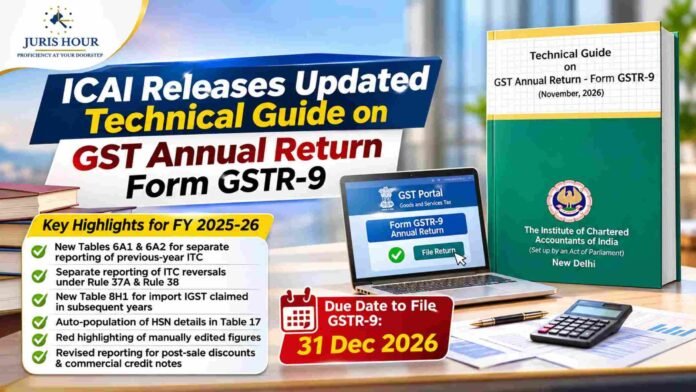
The Institute of Chartered Accountants of India (ICAI), through its GST & Indirect Taxes Committee, has released the November 2026 edition of its Technical Guide on GST Annual Return – Form GSTR-9, incorporating legislative amendments, procedural developments and GST portal changes up to October 2026.
The updated publication provides detailed, table-wise guidance for taxpayers, Chartered Accountants and GST practitioners preparing the annual return for Financial Year 2025-26. It explains the revised reporting requirements, treatment of input tax credit (ITC), reconciliation of inward and outward supplies, tax payments, amendments reported in subsequent financial years and other disclosures.
One of the most significant aspects of the revised guide is its focus on separating current-year transactions from previous-year ITC claimed during the reporting year. It also explains the newly introduced ITC reporting fields, separate disclosure of Rule 37A and Rule 38 reversals, import IGST credit claimed in subsequent years and auto-population of HSN-wise outward supply details.
Buy Now: All 200+ GSTAT Judgements Till November 2026 | Comprehensive E-Magazine
According to ICAI, the updated guide is intended to help taxpayers prepare accurate annual returns while identifying discrepancies before filing.
GSTR-9 Filing for FY 2025-26: Due Date and Applicability
The annual return is governed by Section 44 of the Central Goods and Services Tax Act, 2017, read with Rule 80 of the CGST Rules, 2017.
As explained in the ICAI guide, the following requirements apply for FY 2025-26:
| Particulars | Requirement |
| Applicable financial year | FY 2025-26 |
| Annual return | Form GSTR-9 |
| Statutory provision | Section 44(1) |
| Relevant rule | Rule 80 |
| Due date | 31 December 2026 |
| Turnover threshold | Aggregate turnover exceeding ₹2 crore |
| Exemption | Taxpayers having aggregate turnover up to ₹2 crore |
| Filing mode | Electronic filing on GST Portal |
The exemption for taxpayers having aggregate turnover up to ₹2 crore is based on Notification No. 15/2025-Central Tax. The turnover threshold is determined on an all-India, PAN-based basis.
Importantly, where the aggregate turnover under a PAN exceeds ₹2 crore, every GSTIN registered under that PAN is required to furnish GSTR-9, including inactive GST registrations.
The GST Portal enables GSTR-9 only after all applicable monthly or quarterly GSTR-1, GSTR-1A, IFF and GSTR-3B returns for the financial year have been filed.
ICAI has also highlighted two important statutory restrictions:
- Once filed, Form GSTR-9 cannot be revised.
- Under Section 44(2), an annual return cannot be furnished after three years from its statutory due date.
The guide notes that GSTR-9 and GSTR-9C for FY 2025-26 were enabled on the GST Portal from 8 October 2026, with 31 December 2026 as the filing deadline.
Technical Guide on GST Annual Return – Form GSTR-9.pdf
Technical Guide on GST Annual Return – Form GSTR-9.pdf
Major Changes in GSTR-9 for FY 2025-26
The November 2026 edition identifies several important changes in the annual return structure and the GST Portal. The most significant developments concern ITC bifurcation, reversal reporting, import credits and HSN-wise disclosures.
1. New Tables 6A1 and 6A2 for Separate Reporting of Previous-Year ITC
One of the major changes relates to the reporting of input tax credit availed during FY 2025-26 but pertaining to an earlier financial year.
Table 6A continues to capture the total ITC availed through Table 4A of GSTR-3B during the reporting year. However, this figure may include credit pertaining to previous financial years.
To provide a clearer reconciliation, two additional fields have been introduced:
- Table 6A1 – Prior Period ITC Exclusion: Captures ITC pertaining to previous financial years but claimed in GSTR-3B during FY 2025-26. Rule 37 and Rule 37A reclaims are excluded.
- Table 6A2 – Net Current Year ITC: Automatically calculates the net ITC pertaining to FY 2025-26 by deducting Table 6A1 from Table 6A.
The formula is:
Table6A2=Table6A-Table6A1
This distinction is particularly important because taxpayers can no longer treat the entire ITC availed during the year as credit pertaining to the same financial year.
2. Separate Reporting of ITC Reversals Under Rule 37A and Rule 38
ICAI has highlighted changes in Table 7 concerning the reporting of ITC reversals.
Two separate reporting fields have been introduced:
- Table 7A1: Reversal of ITC under Rule 37A on account of non-filing of GSTR-3B by the supplier.
- Table 7A2: Reversal of ITC under Rule 38 relating to banking companies and financial institutions.
Further, the annual return provides specific reporting for reversals under Rules 37, 37A, 38, 39, 42 and 43, as well as Section 17(5) of the CGST Act.
The earlier consolidated reporting approach under Table 7H has been discontinued in favour of more granular disclosure.
This change is significant for businesses having substantial ITC reversals, as the annual return now requires more precise identification of the statutory provision under which the credit has been reversed.
3. Rule 37 and Rule 37A Reclaims to Be Reported in Table 6H
The guide specifically clarifies the treatment of ITC reclaims.
Where ITC was reversed in an earlier financial year and subsequently reclaimed under Rule 37 or Rule 37A during FY 2025-26, the reclaimed credit is treated as ITC of the year in which it is reclaimed.
Accordingly, such credit is required to be reported in Table 6H and not in Table 6A1.
The guide also distinguishes ordinary ITC reclaims from reclaims under Rule 37 and Rule 37A, which is important for avoiding duplication in the annual return.
4. New Table 8H1 for IGST Paid on Imports but Claimed in Subsequent Years
Another important change concerns importers claiming input tax credit of IGST paid on imported goods.
A new field, Table 8H1, has been introduced to capture IGST paid on imports during FY 2025-26 but claimed as ITC in subsequent financial years.
The formula for Table 8I has also been modified:
Table8I=Table8G-(Table8H+Table8H1)
This change provides a more accurate reconciliation of import-related ITC and helps distinguish credit pertaining to the reporting year from credit actually claimed in a subsequent year.
Importers should accordingly reconcile their Bills of Entry, ICEGATE records, GSTR-2B and GSTR-3B before finalising the annual return.
5. Changes in Table 8A: Actual ITC Considered in Auto-Population
ICAI has also explained an important enhancement in the downloadable Excel file for Table 8A.
The Excel statement now includes an additional column titled:
“Actual ITC amount considered for 8A Summary computation”.
This column provides the tax-head-wise amount actually considered for populating Table 8A online, rather than merely reflecting the gross document value.
For example, where an original invoice reflects ITC of ₹100 and an amended invoice increases the credit to ₹120, the additional column reflects only the differential amount of ₹20.
In the case of credit and debit notes, the amount reflects the credit actually considered in GSTR-3B after adjusting the reduction declared by the taxpayer in the Invoice Management System (IMS).
This enhancement is expected to assist taxpayers in understanding differences between the underlying invoice records and the ITC figures appearing in Table 8A.
6. Table 8B Delinked from Table 6H
Table 8B, which captures ITC as per Table 6B, has been delinked from Table 6H.
It will now auto-populate exclusively from Table 6B.
The purpose of this change is to avoid reconciliation differences in Table 8D and ensure that the comparison is based on the relevant current-year ITC figures.
7. Revised Reporting of ITC Through Table 6M
Table 6M has been relabelled to specifically capture ITC availed through Forms GST ITC-01, ITC-02 and ITC-02A.
The revised instructions expressly exclude ITC availed through GSTR-3B, TRAN-1 and TRAN-2 from this reporting field.
This provides greater clarity regarding the treatment of special-form ITC and prevents unrelated credit entries from being clubbed into the same disclosure.
Technical Guide on GST Annual Return – Form GSTR-9.pdf
Technical Guide on GST Annual Return – Form GSTR-9.pdf
Technical Guide on GST Annual Return – Form GSTR-9.pdf
Major GST Portal Enhancements for FY 2025-26
Apart from changes in the return form, ICAI has identified certain GST Portal enhancements that taxpayers should consider while preparing GSTR-9.
1. Red Highlighting of Manually Edited Figures
The system-populated outward supply figures in GSTR-9 can be edited by taxpayers wherever required.
However, where a taxpayer manually modifies a system-populated figure, the corresponding row is now highlighted in red.
This feature enables taxpayers and professionals to identify figures that have been changed from the system-calculated values and undertake additional verification before filing.
2. Auto-Population of HSN Details in Table 17
For FY 2025-26, the HSN-wise summary of outward supplies in Table 17 is auto-populated from Table 12 of GSTR-1/GSTR-1A.
The GST Portal also provides a downloadable Excel file titled “Download Table 12 of GSTR-1/1A HSN Details”, containing an additional sheet in the format of Table 17.
Taxpayers can use this facility to prepare and verify their HSN-wise disclosures.
The guide further highlights that where the GST rate applicable to a particular HSN code changes during the financial year, the same HSN code may have to be reported separately under different tax rates.
This is particularly relevant for supplies made before and after 22 September 2025.
3. Revised HSN Reporting Requirements
The guide specifies the following HSN reporting requirements:
| Aggregate turnover | HSN reporting requirement |
| Above ₹5 crore | 6-digit HSN |
| Up to ₹5 crore | 4-digit HSN for B2B supplies |
Taxpayers should ensure that the HSN summary is reconciled with their outward supply records and the corresponding GSTR-1 disclosures.
Important Reporting Changes in Part V of GSTR-9
Part V deals with transactions pertaining to FY 2025-26 that are declared in returns of the subsequent financial year, within the specified period.
For FY 2025-26, this generally covers relevant transactions reported in GSTR-1, GSTR-1A, IFF or GSTR-3B for April 2026 to October 2026, furnished up to 30 November 2026.
The following disclosures assume particular importance:
| Table | Particulars |
| Table 10 | Upward amendments to supplies or tax liability |
| Table 11 | Downward amendments to supplies or tax liability |
| Table 12 | ITC pertaining to FY 2025-26 reversed in FY 2026-27 |
| Table 13 | ITC pertaining to FY 2025-26 availed in FY 2026-27 |
| Table 14 | Differential tax payable and paid on account of declarations in Tables 10 and 11 |
The reporting structure ensures that transactions relating to the previous financial year but disclosed in subsequent returns are not mixed with the original transactions of the reporting year.
Importantly, Tables 4, 5, 6 and 7 are required to capture transactions exclusively pertaining to FY 2025-26. The subsequent-year adjustments are required to be reported in their respective fields.
Technical Guide on GST Annual Return – Form GSTR-9.pdf
Technical Guide on GST Annual Return – Form GSTR-9.pdf
Key Legal and Regulatory Changes Affecting GSTR-9
The November 2026 guide also consolidates important legislative and procedural changes introduced during FY 2025-26. Taxpayers must consider these developments while preparing their annual return and reconciliation statement.
1. Clarification on Post-Sale Discounts and Commercial Credit Notes
ICAI has discussed Circular No. 251/08/2025-GST dated 12 September 2025, which clarifies the GST treatment of post-sale discounts and commercial credit notes.
The guide distinguishes between different commercial arrangements.
Financial or commercial credit notes without reduction of tax liability
Where a supplier issues a financial or commercial credit note without reducing the original taxable value or GST liability, the recipient is not required to reverse the ITC attributable to such discount.
This is because the original transaction value and corresponding tax liability remain unchanged.
Post-sale discounts by manufacturers to dealers
Where there is no agreement between the manufacturer and the end customer, the manufacturer-to-dealer sale and dealer-to-customer sale are treated as two independent transactions.
A discount given by the manufacturer merely to reduce the dealer’s purchase price and promote competitive sales does not, by itself, constitute consideration for a separate service.
However, where the manufacturer has an agreement with the end customer to supply goods at a discounted price and compensates the dealer through credit notes to facilitate that arrangement, the discount is treated differently.
Promotional activities by dealers
The guide further clarifies that ordinary promotional activities undertaken by a dealer to increase sales of goods owned by the dealer do not automatically constitute a separate supply of services.
However, where the dealer undertakes specific activities such as advertising campaigns, co-branding, customised services, special sales drives, exhibition arrangements or customer support under an agreement with separately defined consideration, GST may be payable on the independent supply of services.
This distinction is important for businesses reconciling commercial credit notes, discounts and ITC disclosures in their annual returns.
2. GST Rate Changes Effective from 22 September 2025
The guide highlights various rate and exemption notifications issued pursuant to the recommendations of the 56th GST Council meeting.
The important notifications include:
| Notification | Subject |
| Notification No. 09/2025-CT(R) | Revised GST rates on goods |
| Notification No. 10/2025-CT(R) | Exemptions on goods |
| Notification No. 11/2025-CT(R) | Rate changes relating to petroleum operations and coal bed methane |
| Notification No. 12/2025-CT(R) | Amendments concerning old and used motor vehicles |
| Notification No. 13/2025-CT(R) | Concessional rates for specified handicraft items |
| Notification No. 14/2025-CT(R) | Rate notification covering specified bricks and related products |
| Notification No. 15/2025-CT(R) | Amendments to the services rate notification |
| Notification No. 16/2025-CT(R) | Exemptions relating to individual life and health insurance services |
| Notification No. 17/2025-CT(R) | Local delivery services under Section 9(5) |
These changes have direct implications for turnover classification, tax-rate reconciliation and exempt supply disclosures.
3. Exemption for Individual Life and Health Insurance
Notification No. 16/2025-CT(R) introduced exemptions for specified life and health insurance services provided to individuals and families, excluding group insurance services.
The corresponding reinsurance services are also covered by the exemption.
Consequently, insurance companies are required to review their exempt turnover disclosures and the corresponding common ITC apportionment.
The guide specifically highlights Tables 5D and 5E for exempt supply reporting and Table 7 for ITC reversals and related disclosures.
4. Local Delivery Services Under Section 9(5)
Notification No. 17/2025-CT(R) brings specified local delivery services within the framework of Section 9(5) of the CGST Act.
Under this arrangement, the electronic commerce operator is liable to pay GST in respect of the notified services.
The guide identifies the following reporting requirements:
- Table 4G1 of GSTR-9 for the electronic commerce operator.
- Table 5C1 of GSTR-9 for the supplier.
- Corresponding disclosures in Tables 7D1 and K2 of GSTR-9C.
The change is relevant for e-commerce operators and suppliers providing notified local delivery services through digital platforms.
5. Amendment to Section 17(5): Plant or Machinery Replaced by Plant and Machinery
An important statutory development highlighted by ICAI concerns Section 17(5)(d) of the CGST Act.
The Finance Act, 2025 substituted the expression “plant or machinery” with “plant and machinery”, retrospectively with effect from 1 July 2017.
The amendment was brought into force from 1 October 2025 through Notification No. 16/2025-Central Tax.
The guide specifically notes that the amendment has implications for taxpayers who had claimed ITC on construction of immovable property relying on the Supreme Court’s ruling in Safari Retreats.
Taxpayers who availed ITC on this basis should reassess their eligibility in light of the amended statutory provision.
Any reversal arising under Section 17(5) is required to be considered in the relevant ITC reversal disclosures in Table 7 of GSTR-9.
6. New Valuation Mechanism for Specified Sin Goods
The guide also discusses changes concerning pan masala, tobacco and specified tobacco products.
Rule 31D, introduced through Notification No. 20/2025-Central Tax dated 31 December 2025, provides for valuation based on the retail sale price declared on the goods, after excluding applicable tax.
The formula prescribed is:
TaxableValue=RSP100100+ApplicableTaxRates
The guide also explains the treatment of maximum RSP where multiple retail sale prices are declared, altered RSP and area-wise RSP.
Further, specified tobacco and pan masala products witnessed changes in GST rates, while compensation cess on specified sin products was made nil.
These developments require manufacturers and traders to carefully reconcile:
- Earlier GST rates and compensation cess.
- Revised rates effective from 22 September 2025, wherever applicable.
- Revised valuation and rate provisions effective from 1 February 2026.
The impact must be appropriately reflected in turnover reconciliation, rate-wise tax reporting and cess disclosures.
Technical Guide on GST Annual Return – Form GSTR-9.pdf
Technical Guide on GST Annual Return – Form GSTR-9.pdf
Tax Payment, ITC Utilisation and DRC-03: Important Clarifications
The ICAI guide also provides guidance on the discharge of additional tax liabilities identified during preparation of the annual return.
Payment of Additional Tax Liability
The tax payable column in Table 9 is auto-populated from the net liability disclosed in Table 6.1 of GSTR-3B.
Where a taxpayer identifies a shortfall while preparing GSTR-9, the differential liability can be discharged through Form GST DRC-03.
The guide clarifies the following payment treatment:
| Nature of liability | Mode of payment |
| Additional GST liability | Cash or eligible ITC |
| Interest | Cash only |
| Late fee | Cash only |
| Penalty | Cash only |
The negative liability fields are populated as zero, although the relevant column remains editable.
The guide also highlights revised instructions regarding payment through the Electronic Credit Ledger, making it important for taxpayers to examine the applicable payment provisions before discharging any additional liability.
Late Fee on GSTR-9 and GSTR-9C
The publication discusses Circular No. 246/03/2025-GST dated 30 January 2025 concerning late fees for delayed furnishing of the complete annual return.
Under Section 47(2) of the CGST Act, the late fee applies to delay in furnishing the complete annual return, comprising GSTR-9 and GSTR-9C wherever applicable.
The guide explains that a separate Table 17 titled “Late Fee Payable and Paid” has been introduced in GSTR-9C.
The late fee attributable to GSTR-9C is calculated from the later of:
- The statutory due date of the annual return; or
- The date on which GSTR-9 was actually filed.
The calculation continues until the date of filing GSTR-9C.
Illustration provided in the guide:
Where GSTR-9 is filed on 25 December 2025, before the due date of 31 December 2025, but GSTR-9C is filed on 7 January 2026, no late fee arises for GSTR-9. However, late fee is applicable for the seven-day delay in filing GSTR-9C.
This clarification is particularly relevant for taxpayers who file GSTR-9 within the prescribed time but delay the submission of GSTR-9C.
Technical Guide on GST Annual Return – Form GSTR-9.pdf
Technical Guide on GST Annual Return – Form GSTR-9.pdf
Optional Tables in GSTR-9 for FY 2025-26
The guide clarifies that the tables for which reporting was optional during FY 2024-25 continue to remain optional for FY 2025-26 in terms of Notification No. 05/2026-Central Tax dated 26 October 2026.
The optional tables include:
| Part of GSTR-9 | Optional tables |
| Part II | Tables 5D to 5F and 5H to 5K |
| Part III | Tables 6B to 6D |
| Part VI | Tables 15A to 15G and 16A to 16C |
| HSN inward summary | Table 18 |
Taxpayers should distinguish between fields that are legally optional and those that remain mandatory for the relevant category of taxpayer.
Important Pre-Filing Checklist for Businesses and Tax Professionals
The ICAI publication places considerable emphasis on preparation and reconciliation before filing the annual return.
Businesses should not rely exclusively on auto-populated figures. Instead, the information should be verified against the underlying books of accounts, GST returns and supporting documents.
The following checklist summarises the important areas requiring attention:
| Particulars | Verification required |
| Outward supplies | Reconcile sales register with GSTR-1 and GSTR-3B |
| Inward supplies | Reconcile purchase register with GSTR-2B |
| ITC | Identify current-year and previous-year credits separately |
| ITC reversals | Verify Rules 37, 37A, 38, 39, 42, 43 and Section 17(5) |
| Import ITC | Reconcile Bills of Entry, ICEGATE and GSTR-2B |
| Credit notes | Verify commercial and GST credit notes separately |
| Exempt supplies | Reconcile exempt, nil-rated and non-GST turnover |
| Tax payments | Match liability with GSTR-3B and electronic ledgers |
| Subsequent-year adjustments | Verify Tables 10 to 14 |
| HSN disclosures | Check HSN codes, quantities and applicable rates |
| GSTR-9C | Reconcile financial statements with GST turnover and tax liability |
Particular attention should be given to transactions reported in April to October 2026 returns filed up to 30 November 2026, as these may require disclosure in Part V of the annual return.
Significance of the Updated ICAI Guide
The November 2026 edition is the fourth edition of ICAI’s Technical Guide on GST Annual Return, following the earlier editions released in October 2023, December 2024 and December 2025.
The publication has been prepared by the GST & Indirect Taxes Committee under the leadership of CA. Umesh Sharma, Chairman, and CA. Rajendra Kumar P, Vice-Chairman.
The guide was issued under the overall leadership of ICAI President CA. Prasanna Kumar D., whose foreword is dated 12 November 2026.
The 209-page publication provides detailed guidance on all six parts of GSTR-9, including practical illustrations, table-wise explanations, statutory provisions, GSTN advisories and relevant notifications.
It also contains appendices reproducing the prescribed form, relevant notifications and GSTN FAQs.
For Chartered Accountants, tax professionals and businesses, the publication is particularly useful because it brings together the legislative and portal-related changes affecting the preparation of the FY 2025-26 annual return.
Conclusion
The updated ICAI Technical Guide makes it clear that preparation of GSTR-9 for FY 2025-26 requires more than merely transferring figures from GSTR-1 and GSTR-3B.
The introduction of separate fields for previous-year ITC, current-year ITC, Rule 37A reversals, Rule 38 reversals and import IGST claimed in subsequent years reflects a more detailed approach towards annual GST reconciliation.
The auto-population of HSN details, red highlighting of manually modified figures and revised Table 8A Excel disclosures are additional portal enhancements aimed at improving the accuracy and transparency of annual return reporting.
With the due date fixed at 31 December 2026, taxpayers and professionals should undertake detailed reconciliation of their books of accounts, GST returns, ITC records, import documents and subsequent-year adjustments well before filing.
Membership Required to Access Notification Details & Copy
To view the complete Notification Details and Download Copy, you must have an active membership. Please subscribe to continue.

