
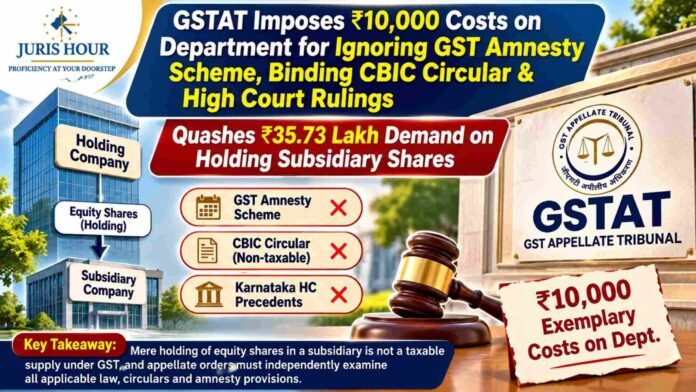
The Bengaluru State Bench of the Goods and Services Tax Appellate Tribunal (GSTAT) has ruled that mere holding of equity shares in a subsidiary company does not constitute a taxable supply of services under GST; also imposed the cost of Rs. 10,000 the First Appellate Authority for ignoring the GST amnesty scheme, binding CBIC circular and Karnataka High Court precedents.
The bench of Srikanth Venkatraman (Judicial Member) and Sudha Koka (Technical Member) set aside a GST demand of ₹35.73 lakh imposed on a company on the allegation that its holding of equity shares in a subsidiary attracted GST under the Reverse Charge Mechanism (RCM).
The bench held that merely holding shares or securities in a subsidiary company cannot be treated as a supply of services under GST.
Buy Now: 210+ GST Judgments E-Magazine – October 2026
The Tribunal also came down heavily on the First Appellate Authority for dismissing the taxpayer’s appeal without properly examining the applicable GST amnesty scheme, the binding CBIC circular and settled judicial precedents of the Karnataka High Court.
The Tribunal imposed exemplary costs of ₹10,000 on the Department, directing payment to the taxpayer within eight weeks. It further granted liberty to the Department to recover the amount from the officer concerned in accordance with applicable conduct and service rules.
The ruling was delivered on November 24, 2026, by the Bengaluru State Bench, Division Bench Court II, comprising Judicial Member Srikanth Venkatraman and Technical Member Sudha Koka.
Background of the Case
The appellant/assessee is a company incorporated on October 23, 2015, and engaged in manufacturing, selling and maintaining ATMs, along with related components, peripherals and software.
During audit proceedings, the GST authorities alleged that the company’s holding of equity shares in a subsidiary company constituted a supply of services liable to GST under the Reverse Charge Mechanism.
Consequently, the adjudicating authority passed an order in FORM GST DRC-07 dated March 29, 2023, confirming a total demand of ₹35,73,000.
The demand comprised:
| Particulars | Amount |
| IGST | ₹18,00,000 |
| Interest | ₹15,93,000 |
| Penalty | ₹1,80,000 |
| Total demand | ₹35,73,000 |
The company challenged the demand, contending that mere ownership or holding of equity shares in a subsidiary cannot be treated as a taxable supply of services under the GST law.
An important development occurred on July 17, 2023, when the Central Board of Indirect Taxes and Customs issued Circular No. 196/08/2023-GST.
The circular clarified that the activity of holding shares or securities of a subsidiary company by a holding company is neither a supply of goods nor a supply of services under GST.
A corresponding State GST circular was also issued on July 21, 2023.
Relying on this clarification, the company submitted an additional representation before the assessing authority on August 1, 2023, requesting that the demand be dropped.
The company also relied upon Section 2(102) of the CGST Act, 2017, which excludes securities from the definition of services.
Its central argument was that shares constitute securities and, therefore, merely holding such shares cannot independently constitute a taxable supply of services under Section 7 of the CGST Act.
Another important issue concerned the limitation period for filing the first appeal.
The 52nd GST Council Meeting, held on October 7, 2023, recommended a special amnesty scheme allowing taxpayers to file appeals against orders passed on or before March 31, 2023, up to January 31, 2024, subject to prescribed conditions.
The recommendation was subsequently implemented through Notification No. 53/2023-Central Tax dated November 2, 2023.
Taking advantage of this special window, the company filed its appeal in FORM GST APL-01 on October 13, 2023, against the adjudication order dated March 29, 2023.
The company contended that its appeal was filed well within the extended period prescribed under the amnesty notification and could not have been rejected by mechanically applying the ordinary limitation provisions under Section 107 of the CGST Act.
The First Appellate Authority, however, dismissed the appeal through Order-in-Appeal No. GST/AP-219/2025-26 dated August 28, 2025, signed on September 3, 2025.
The authority recorded that the appeal had been filed beyond the ordinary limitation period and that no application seeking condonation of delay had been submitted.
It calculated the limitation period under Sections 107(1) and 107(4) of the CGST Act, treating the original order as received on March 29, 2023.
The authority also made a brief observation on the merits, stating:
“The Respondent has already addressed the issue in detail and in light of no additional pleadings and documents, I do not find a reason to interfere with the Impugned Order.”
The Tribunal subsequently noted that the First Appellate Authority had failed to examine the applicability of the special amnesty window, despite the fact that the original order was dated March 29, 2023, and the appeal was filed on October 13, 2023.
The consequential FORM GST APL-04 was issued on December 9, 2025.
Aggrieved by the dismissal, the company approached the GST Appellate Tribunal.
The Tribunal examined whether the First Appellate Authority was justified in rejecting the appeal by relying upon the ordinary limitation provisions without considering the special procedure introduced through Notification No. 53/2023-Central Tax.
The Tribunal observed that the original adjudication order was passed on March 29, 2023, which was before the prescribed cut-off date of March 31, 2023.
Further, the company had filed its appeal on October 13, 2023, whereas the special filing window extended up to January 31, 2024.
Therefore, the appeal was filed within the special amnesty window.
The Tribunal found that the First Appellate Authority had applied the general limitation provisions under Section 107(1) and Section 107(4) without examining the applicable amnesty notification.
It held that the authority’s failure to consider the special statutory mechanism rendered its approach unsustainable.
On the substantive issue, the Tribunal examined Section 2(102) of the CGST/KGST Act, 2017, Circular No. 196/08/2023-GST dated July 17, 2023, and the corresponding State circular.
The Tribunal reiterated that securities, including shares, are excluded from the definition of services under Section 2(102) of the CGST Act.
It further noted that the CBIC circular specifically clarifies that holding shares or securities in a subsidiary company by a holding company does not constitute a supply of goods or services.
Accordingly, in the absence of an independent supply falling within Section 7 of the CGST Act, mere holding of equity shares cannot be subjected to GST.
The Tribunal also emphasised that the departmental authorities were required to consider and follow the binding circular issued under Section 168 of the CGST Act.
The Tribunal noted that the legal position concerning GST liability on mere holding of shares in a subsidiary company had already been examined by the Karnataka High Court in several decisions.
The Tribunal specifically relied upon the following judgments:
1. M/s. Yonex India Private Limited v. Union of India & Others
W.P. No. 2301 of 2023 | Decided on January 18, 2024
The Karnataka High Court examined the taxability of holding shares in a subsidiary company in the context of Circular No. 196/08/2023-GST.
The Court recognised that securities, including shares, are excluded from the definition of services under Section 2(102) of the CGST/KGST Act.
It held that mere holding of shares in a subsidiary company by a holding company cannot, by itself, be treated as a supply of services liable to GST.
2. M/s. Metro Cash and Carry Pvt. Ltd. v. State of Karnataka
W.P. No. 25142 of 2022 | Decided on March 14, 2024
The Karnataka High Court held that merely holding shares in a subsidiary company cannot be classified or construed as a supply of services for GST purposes.
The Court quashed the proceedings initiated on the basis of such shareholding.
3. M/s. A.O. Smith India Water Products Pvt. Ltd. v. State of Karnataka
W.P. No. 7227 of 2023 | Decided on August 20, 2024
The Karnataka High Court reiterated the settled legal position concerning the non-taxability of mere holding of equity shares in group or subsidiary company structures under GST and set aside the defective proceedings.
Relying on these decisions, the Tribunal concluded that the demand raised against the company on account of holding equity shares in its subsidiary could not be sustained.
One of the most significant aspects of the ruling is the Tribunal’s criticism of the manner in which the First Appellate Authority decided the taxpayer’s appeal.
The Tribunal observed that the First Appellate Authority had disposed of the substantive merits through a single-sentence observation without independently examining the statutory provisions, departmental circulars and binding judicial precedents.
The Tribunal particularly noted that the authority had failed to consider:
- The special appeal amnesty window introduced through Notification No. 53/2023-Central Tax.
- Section 2(102) of the CGST Act, which excludes securities from the definition of services.
- CBIC Circular No. 196/08/2023-GST dated July 17, 2023.
- The corresponding State GST circular.
- The Karnataka High Court decisions in Yonex India, Metro Cash and Carry and A.O. Smith India Water Products.
The Tribunal held that treating the respondent’s earlier stand as conclusive without independently evaluating the legal position demonstrated arbitrariness and non-application of mind.
It also referred to the Supreme Court’s decision in Kranti Associates Pvt. Ltd. v. Masood Ahmed Khan, (2010) 9 SCC 496, which emphasises that recording reasons is an essential requirement of quasi-judicial adjudication.
The Tribunal observed that an appellate authority cannot dispose of substantive issues mechanically without addressing the material facts and legal submissions placed before it.
Taking note of the manner in which the appeal was handled, the Tribunal considered it appropriate to impose exemplary costs on the Department.
The Tribunal exercised its powers under Rules 10, 102 and 120 of the GSTAT (Procedure) Rules, 2025.
Accordingly, exemplary costs of ₹10,000 were imposed on the Department.
The Tribunal directed that the amount be paid to the appellant within eight weeks from the date of the order.
Importantly, the Tribunal also granted liberty to the Department to recover the amount from the officer concerned in accordance with the applicable Conduct and Service Rules.
The appeal filed by the company was allowed, and the entire demand of ₹35,73,000, comprising IGST of ₹18,00,000, interest of ₹15,93,000 and penalty of ₹1,80,000, was set aside with consequential relief in accordance with law.
Exemplary costs of ₹10,000 were imposed on the Department, payable to the appellant within eight weeks, with liberty to recover the amount from the officer concerned in accordance with applicable service rules.
Membership Required to Access Case Details & Order Copy
To view the complete Case Details and Download Order Copy, you must have an active membership. Please subscribe to continue.
Read More: GSTAT Quashes Rs. 77,278 Penalty for E-Way Bill Discrepancy Citing Lack Of Tax Evasion Intention

