
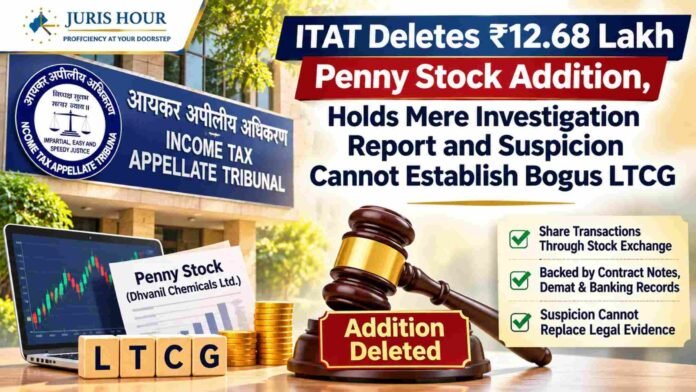
The Income Tax Appellate Tribunal (ITAT), Ahmedabad Bench, has deleted an addition of ₹12,68,189 made under Section 68 of the Income Tax Act, 1961, on account of alleged bogus Long-Term Capital Gains (LTCG) from shares of the company.
The bench of Sanjay Kumar (Judicial Member) and Narendra Prasad Sinha (Accountant Member) has observed that the Assessing Officer (AO) could not treat genuine share transactions as accommodation entries merely on the basis of Investigation Wing information, without conducting independent inquiries or bringing corroborative evidence on record.
Buy Now: Direct tax (Income Tax) Judgments E-Magazine October 2026
The Tribunal emphasised that suspicion, however strong, cannot take the place of legal evidence and that an assessee cannot be held responsible for alleged manipulation by brokers unless a direct link with the alleged accommodation-entry operation is established.
The appellant/assessee had filed its return of income for Assessment Year 2013-14 on 26 March 2013, declaring total income of ₹61,890.
Subsequently, the Assessing Officer received information alleging that the assessee had obtained accommodation entries in the form of bogus Long-Term Capital Gains through transactions in shares of Dhvanil Chemicals Ltd., a company allegedly identified as a penny stock.
Based on the information received, the Assessing Officer reopened the assessment and issued a notice under Section 148 of the Income Tax Act on 30 March 2021.
The assessment was eventually completed under Section 147 read with Section 144B on 31 March 2022.
During the reassessment proceedings, the AO treated the entire sale consideration of ₹12,68,189 arising from the sale of shares of Dhvanil Chemicals Ltd. as unexplained cash credit under Section 68 of the Income Tax Act.
The AO proceeded on the allegation that the transactions involving the said scrip were linked to an alleged accommodation-entry network associated with Sanjay Shah and Jignesh Shah, who were stated to have admitted during a search conducted on 11 September 2018 that transactions in the scrip were being used to provide accommodation entries.
Aggrieved by the assessment order, the assessee approached the Commissioner of Income Tax (Appeals), National Faceless Appeal Centre (NFAC), Delhi.
The CIT(A), vide order dated 13 October 2025, partly allowed the assessee’s appeal and deleted the addition of ₹12,68,189.
The Revenue thereafter challenged the relief granted by the CIT(A) before the ITAT Ahmedabad.
Before the Tribunal, the Departmental Representative argued that the CIT(A) had wrongly deleted the addition made under Section 68.
The Revenue contended that Dhvanil Chemicals Ltd. was identified as a penny stock and that transactions in the company’s shares were allegedly utilised to provide accommodation entries to beneficiaries in the form of bogus LTCG and Short-Term Capital Gains.
The Department further relied upon the alleged admissions made by Sanjay Shah and Jignesh Shah during the search conducted at their premises on 11 September 2018.
Accordingly, the Revenue maintained that the Assessing Officer had correctly treated the sale consideration of ₹12,68,189 as unexplained cash credit and requested the Tribunal to restore the assessment order.
On the other hand, the authorised representative appearing for the assessee submitted that the assessee was a regular investor and trader in shares and that its dealings were not confined to Dhvanil Chemicals Ltd.
It was argued that the purchase and sale transactions were executed through a recognised stockbroker on the stock exchange and that the corresponding consideration was routed entirely through banking channels.
The assessee further pointed out that it had also undertaken transactions in the shares of several other companies, including Power Grid, Engineers India Ltd., Blue Circle Services and Prism Cement.
Additionally, the assessee had extensively dealt in the Futures and Options (F&O) segment, including intraday transactions.
The authorised representative highlighted that the assessee had furnished documentary evidence, including Contract notes evidencing the purchase and sale of shares. Demat account statements reflecting the shareholdings and transactions. Bank statements establishing the movement of funds. Details of share transactions and capital gains disclosed in the return of income.
It was also submitted that the Long-Term Capital Gains as well as Short-Term Capital Gains arising from share transactions had been duly disclosed in the return of income.
Importantly, the assessee argued that the Assessing Officer had not conducted any independent inquiry to establish that the sale proceeds represented accommodation entries.
The assessee was also allegedly not confronted with the material relied upon by the AO to make the addition.
Accordingly, it was contended that the addition was based merely on general information and allegations rather than evidence directly connecting the assessee with the alleged accommodation-entry operation.
After considering the rival submissions and examining the documentary evidence placed on record, the ITAT Ahmedabad found substantial merit in the assessee’s contentions.
The Tribunal observed that the Revenue had not disputed the fact that the assessee purchased and sold shares of Dhvanil Chemicals Ltd., formerly known as Shreya Chemicals Limited, through a recognised broker.
The transactions were duly reflected in the assessee’s demat account.
On examining the demat account, the Tribunal found that the assessee had also dealt in shares of several other companies, including Power Grid, Engineers India Ltd., Blue Circle Services and Prism Cement.
The assessee had also extensively undertaken transactions in the F&O segment.
Thus, the transaction involving Dhvanil Chemicals Ltd. could not be viewed as an isolated investment undertaken solely to generate artificial capital gains.
The Tribunal noted that the assessee had produced contract notes, bank statements and demat account details to substantiate the share transactions.
The sale and purchase transactions were undertaken through recognised stock exchange mechanisms, and the sale transactions were subject to Securities Transaction Tax (STT).
However, the AO failed to bring any evidence on record demonstrating that cash had exchanged hands between the assessee and any alleged accommodation-entry provider.
The Tribunal observed that the sale proceeds were received through banking channels and the shares were delivered in dematerialised form through the clearing mechanism of the stock exchange.
In the absence of evidence establishing any cash exchange or accommodation arrangement, the allegation that the assessee had converted its unaccounted money into bogus LTCG could not be sustained.
One of the most significant aspects of the ruling was the Tribunal’s finding that the Assessing Officer had merely relied upon the findings of the Investigation Wing without conducting any independent investigation.
The Tribunal observed that nothing had been brought on record to establish that the assessee was a beneficiary of the alleged accommodation entries.
Further, no corroborative evidence was available to substantiate the allegations made by the AO.
The documentary evidence furnished by the assessee had neither been disproved nor established to be fabricated.
The Tribunal also observed that even if brokers had indulged in some manipulation, the assessee could not automatically be held liable for the alleged acts of the brokers when the transactions were carried out through banking channels, recorded in the demat account and executed on the stock exchange.
The Tribunal further highlighted that transactions on an online stock exchange platform are executed through an established mechanism where the identity of the seller and purchaser is not ordinarily known to each other.
The shares were delivered in dematerialised form through the stock exchange’s clearing mechanism.
Therefore, unless a specific link was established between the assessee and the alleged group involved in rigging the share prices, the assessee could not be treated as a participant in such activities merely because the scrip had been identified as a penny stock.
The Tribunal found that the Assessing Officer had failed to establish any such connection.
The Tribunal strongly reiterated the settled legal principle that suspicion, however strong, cannot take the character of legal evidence.
It observed that the entire case of the Assessing Officer was based on the presumption that the assessee had introduced its own unaccounted money into the financial system in the guise of bogus LTCG.
However, such a presumption required corroboration through supporting evidence.
For this proposition, the Tribunal relied upon the Supreme Court’s decision in Omar Salay Mohamed Sait v. Commissioner of Income Tax, (1989) 37 ITR 151 (SC), which held that additions cannot be made merely on the basis of surmises, suspicion and conjectures.
The Tribunal also relied upon the decision of the Gujarat High Court in Sanjaykumar Damjibhai Gangani. The High Court considered the issue of alleged bogus LTCG arising from penny stock transactions where the assessee had furnished supporting documentary evidence, including contract notes, demat details and other relevant records.
The High Court held that where the documentary evidence furnished by the assessee had not been adversely disproved, the Assessing Officer could not make an addition under Section 68 merely on the allegation that the assessee was a beneficiary of penny stock transactions.
The High Court also emphasised that the presumption drawn by the Assessing Officer must be supported by evidence establishing that the transactions were non-genuine.
The Tribunal applied the same legal reasoning to the facts of the present case and concluded that the Revenue had failed to establish that the assessee’s transactions in Dhvanil Chemicals Ltd. were bogus.
Considering the facts, documentary evidence and applicable judicial precedents, the ITAT Ahmedabad held that the addition of ₹12,68,189 made under Section 68 on account of alleged unexplained money in the form of accommodation entries was unsustainable.
The Tribunal accordingly upheld the relief granted by the CIT(A) and dismissed the Revenue’s appeal.
The assessee had also filed a cross-objection challenging the validity of reopening the assessment under Section 147 of the Income Tax Act.
However, there was a delay of 61 days in filing the cross-objection.
The Tribunal considered the affidavit submitted by Paresh K Shah, Karta of the HUF, explaining that the delay occurred due to the time taken to obtain the opinion of counsel.
Accepting the explanation furnished by the assessee, the Tribunal condoned the delay.
However, since the Revenue’s appeal had already been dismissed and the addition stood deleted, the Tribunal held that the assessee’s cross-objection had become infructuous.
Consequently, the cross-objection was also dismissed.
The ITAT Ahmedabad dismissed both the Revenue’s appeal and the assessee’s cross-objection.
The addition of ₹12,68,189 under Section 68 relating to alleged bogus LTCG from Dhvanil Chemicals Ltd. consequently remained deleted.
Membership Required to Access Case Details & Order Copy
To view the complete Case Details and Download Order Copy, you must have an active membership. Please subscribe to continue.

