
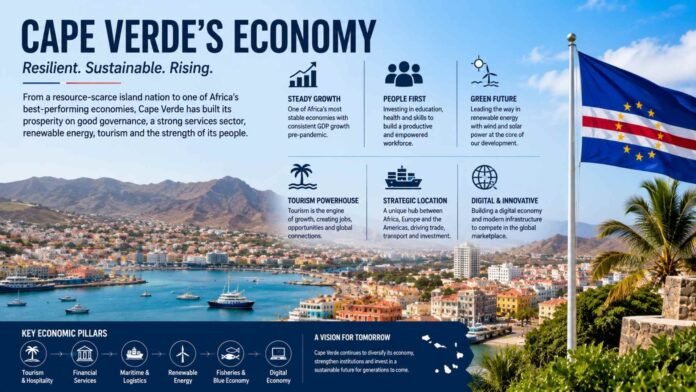
As Cape Verde captures global attention with its inspiring performances at the FIFA World Cup 2026, curiosity about the small Atlantic island nation extends far beyond football. Home to fewer than a million people and blessed with limited natural resources, Cape Verde has quietly built one of Africa’s most resilient and well-governed economies. Driven by tourism, services, renewable energy, and strong democratic institutions rather than oil or minerals, the country has become a compelling example of how sound governance and strategic planning can transform a resource-constrained nation into a rising global success story.
Despite its limited natural resources, small population, and geographic isolation in the Atlantic Ocean, Cape Verde (Cabo Verde) has emerged as one of Africa’s most stable and resilient economies. The island nation has transformed itself from a drought-prone, aid-dependent country into a middle-income economy driven by tourism, services, renewable energy, and strong governance.
Its economic journey demonstrates how strategic policymaking, political stability, and investment in human capital can compensate for the absence of abundant natural resources.
From Independence to Economic Transformation
Cape Verde gained independence from Portugal in 1975. At the time, the country faced enormous challenges, including recurring droughts, food insecurity, limited agricultural land, and almost no mineral wealth.
Recognizing these constraints early, successive governments shifted their focus toward developing a service-based economy rather than relying on agriculture or extractive industries. Investments in education, public administration, transport infrastructure, and democratic institutions laid the foundation for long-term economic growth.
Today, Cape Verde consistently ranks among Africa’s best-performing countries in governance, political stability, and ease of doing business.
Tourism: The Engine of Growth
Tourism has become the backbone of Cape Verde’s economy.
With volcanic landscapes, white-sand beaches, year-round sunshine, and a strategic location between Europe, Africa, and the Americas, the country has developed into a popular holiday destination, particularly for visitors from Portugal, the United Kingdom, Germany, Italy, France, and Spain.
Before the COVID-19 pandemic, tourism contributed approximately one-fourth of the country’s Gross Domestic Product (GDP), while supporting thousands of jobs across hotels, restaurants, transport services, entertainment, and retail businesses.
The islands of Sal and Boa Vista have emerged as international tourism hubs, attracting millions of visitors over the past decade.
The government’s focus has gradually shifted from mass tourism to sustainable tourism, emphasizing environmental conservation, local employment, and higher-value visitor experiences.
A Service-Oriented Economy
Unlike many African economies that rely heavily on oil, mining, or agriculture, Cape Verde derives most of its national income from services.
Key sectors include:
- Tourism and hospitality
- Financial services
- Maritime transport
- Telecommunications
- Public administration
- Digital business services
The country has positioned itself as an emerging digital economy by expanding broadband connectivity, encouraging technology startups, and modernizing public services.
Digital government initiatives have significantly improved transparency and administrative efficiency, attracting foreign investors seeking a stable business environment.
The Importance of the Blue Economy
Surrounded by the Atlantic Ocean, Cape Verde considers the ocean its greatest economic asset.
The government has increasingly promoted the “Blue Economy,” which includes:
- Sustainable fisheries
- Maritime logistics
- Port development
- Marine conservation
- Ocean-based renewable energy
- Aquaculture
Its location along major international shipping routes provides opportunities to become an important logistics and maritime services hub connecting Africa, Europe, and the Americas.
Renewable Energy Ambitions
Cape Verde imports nearly all of its fossil fuels, making energy security a national priority.
To reduce dependence on imported oil, the country has invested heavily in renewable energy projects, particularly:
- Wind power
- Solar energy
- Battery storage systems
Several islands now generate a significant share of their electricity from renewable sources, and the government aims to move toward a much higher renewable energy mix over the coming years.
This transition is expected to reduce electricity costs, improve energy independence, and strengthen climate resilience.
Diaspora: An Economic Lifeline
One of Cape Verde’s unique economic strengths lies outside its borders.
The Cape Verdean diaspora—spread across Portugal, the United States, France, the Netherlands, Luxembourg, and several African countries—plays a major role in supporting the domestic economy.
Money sent home by overseas citizens contributes significantly to household incomes, education, healthcare, housing, and small business investment.
These remittances also help stabilize foreign exchange reserves and reduce poverty.
Beyond financial support, the diaspora contributes expertise, entrepreneurship, and international business networks.
Agriculture Remains Limited
Agriculture accounts for only a small share of the national economy due to:
- Scarce freshwater resources
- Frequent droughts
- Rocky volcanic terrain
- Limited arable land
Domestic food production cannot meet national demand, making Cape Verde heavily dependent on food imports.
Climate change has further increased pressure on water resources, prompting investments in desalination plants, efficient irrigation systems, and climate-smart farming practices.
Fisheries Offer Untapped Potential
Cape Verde possesses one of the largest Exclusive Economic Zones (EEZs) in Africa.
The surrounding Atlantic waters are rich in tuna and other commercially valuable fish species.
Although fisheries currently contribute modestly to GDP, experts believe improved processing facilities, cold storage infrastructure, and export logistics could significantly increase the sector’s contribution while ensuring sustainable marine resource management.
Trade and Foreign Investment
Cape Verde maintains strong economic ties with Europe, particularly Portugal and the European Union.
Foreign investment has primarily flowed into:
- Hotels and tourism
- Real estate
- Renewable energy
- Financial services
- Infrastructure
The country’s stable democracy, transparent institutions, and predictable legal framework have helped distinguish it from many regional peers.
Its currency, the Cape Verdean Escudo (CVE), is pegged to the euro, providing exchange-rate stability that encourages international investment and trade.
Economic Challenges
Despite impressive progress, Cape Verde continues to face structural vulnerabilities.
Heavy Dependence on Tourism
Global shocks such as the COVID-19 pandemic demonstrated how quickly tourism revenues can collapse, affecting employment and government finances.
Climate Change
Rising sea levels, stronger storms, prolonged droughts, and water scarcity pose long-term risks to agriculture, infrastructure, and coastal tourism.
Import Dependence
The country imports most of its:
- Food
- Fuel
- Manufactured goods
- Construction materials
This exposes the economy to international price fluctuations and supply chain disruptions.
Small Domestic Market
With a population of around 600,000 people, domestic demand remains limited, requiring businesses to look toward exports and international markets for growth.
Emerging Opportunities
Cape Verde’s long-term economic strategy focuses on diversification.
Key opportunities include:
- Expanding digital services and remote work industries
- Developing green hydrogen and renewable energy exports
- Strengthening maritime logistics
- Promoting sustainable fisheries
- Building a regional aviation hub
- Encouraging technology startups
- Enhancing climate-resilient infrastructure
International development institutions increasingly view Cape Verde as a model for small island developing states seeking sustainable growth despite environmental constraints.
Why Cape Verde Stands Out
Cape Verde’s greatest economic resource is not oil, gas, or minerals—it is governance.
The country’s commitment to democracy, sound fiscal management, education, and international cooperation has enabled it to outperform many resource-rich nations on several development indicators.
Its experience highlights an important lesson for developing economies: strategic planning, institutional strength, and investment in people can create lasting prosperity even in the absence of abundant natural resources.
As the nation pursues greater economic diversification and climate resilience, Cape Verde is positioning itself as one of Africa’s most promising examples of sustainable island development—where innovation and stability are becoming its most valuable exports.
Read More: Warren Buffett’s 11-Word Warning Returns as Stock Markets Rally: What Every Investor Should Know

