
As retail participation in India’s bond market continues to rise through online bond platforms and debt mutual funds, investors are increasingly exploring fixed-income securities for stable and predictable returns. However, one of the most common mistakes among first-time bond buyers is assuming that a bond’s coupon rate and bond yield mean the same thing.
In reality, these two concepts measure different aspects of a bond’s return. Understanding the distinction can help investors evaluate whether a bond is genuinely offering value or merely appears attractive because of its stated interest rate.
Buy Now: June 2026 Ultimate Legal & Taxation Combo
Coupon Rate: The Interest Rate Fixed at Issuance
The coupon rate is the annual interest that the bond issuer promises to pay on the bond’s face value. It is fixed when the bond is issued and generally remains unchanged throughout the tenure of a fixed-rate bond.
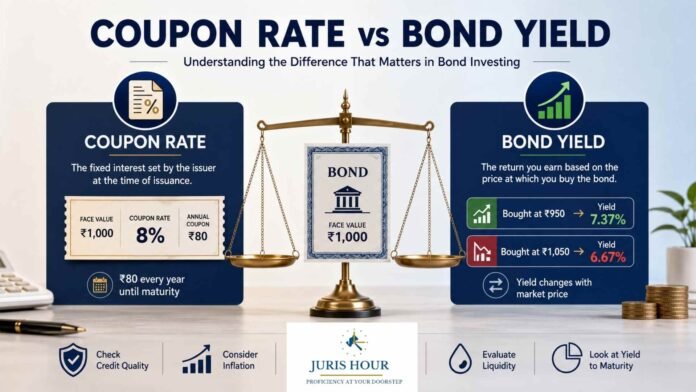
For example, if a company issues a bond with a face value of ₹1,000 and a coupon rate of 8%, investors will receive ₹80 annually until the bond matures, irrespective of fluctuations in the bond’s market price.
Since the coupon payment is contractual, it does not change with interest rate movements or investor demand.
Bond Yield: The Return Based on Your Purchase Price
Unlike the coupon rate, bond yield measures the actual return an investor earns depending on the price at which the bond is purchased.
Bonds are actively traded in the secondary market, where prices move according to interest rates, inflation expectations, issuer credit quality and market demand. As a result, two investors holding the same bond may earn different effective returns if they purchased it at different prices.
The current yield is calculated as:
Current Yield = (Annual Coupon Payment ÷ Current Market Price) × 100
This means the yield changes whenever the bond’s market price changes, while the coupon payment remains constant.
Why Bond Prices and Yields Move in Opposite Directions
One of the fundamental principles of fixed-income investing is the inverse relationship between bond prices and yields.
If market interest rates rise, newly issued bonds begin offering higher coupon rates. Existing bonds with lower coupons become less attractive, causing their prices to decline. As their prices fall, their yields increase.
Conversely, when interest rates decline, existing bonds carrying higher coupon rates become more valuable. Their prices rise, reducing their yields.
This relationship is particularly important because it explains why bond prices fluctuate even though coupon payments remain fixed.
Practical Example
Suppose a bond pays an annual coupon of ₹70.
- If the bond is purchased for ₹1,000, the yield is 7%.
- If market conditions push the bond price down to ₹950, the yield rises to approximately 7.37%.
- If strong demand increases the price to ₹1,050, the yield falls to around 6.67%.
Although the investor receives the same ₹70 every year, the actual return changes because of the purchase price.
Yield to Maturity: The Metric Professional Investors Prefer
Investment professionals rarely rely solely on current yield.
Instead, they evaluate Yield to Maturity (YTM), which estimates the total annualised return an investor is expected to earn if the bond is held until maturity.
YTM considers:
- Annual coupon payments
- Purchase price
- Face value received at maturity
- Capital gain or loss resulting from buying above or below face value
- Remaining time until maturity
Because it captures both income and capital appreciation (or depreciation), YTM provides a far more comprehensive picture of a bond’s expected return.
Beyond Coupon and Yield: Factors Investors Often Overlook
While coupon rate and yield are essential, experts caution that they should not be the only parameters guiding investment decisions.
1. Credit Quality Matters
A higher yield often reflects higher credit risk, not necessarily a better investment. Bonds issued by financially weaker companies generally offer higher yields to compensate investors for the increased possibility of default.
Investors should therefore examine the bond’s credit rating before making a decision.
2. Inflation Can Reduce Real Returns
A bond yielding 7% may appear attractive, but if inflation averages 6%, the investor’s real return is only around 1%.
Evaluating post-inflation returns is especially important for long-term investors.
3. Interest Rate Risk
Longer-duration bonds are generally more sensitive to changes in interest rates.
If rates rise significantly, long-term bond prices tend to decline more sharply than short-term bonds.
4. Liquidity Risk
Not all corporate bonds trade actively in the secondary market. Investors who may need to exit before maturity should consider whether sufficient market liquidity exists.
Who Should Focus on Coupon Rate?
The coupon rate is particularly relevant for investors seeking predictable cash flows, including:
- Retirees relying on regular interest income
- Conservative investors following a buy-and-hold strategy
- Investors purchasing newly issued bonds at face value
For such investors, the fixed coupon provides income certainty throughout the bond’s tenure.
Who Should Focus on Bond Yield?
Yield becomes more important when:
- Purchasing bonds from the secondary market
- Comparing multiple bonds with different market prices
- Evaluating returns against fixed deposits, government securities or debt mutual funds
- Assessing whether the additional return adequately compensates for higher risk
Key Takeaway for Investors
A bond offering a higher coupon rate is not automatically the better investment. Likewise, a higher yield does not always indicate greater value—it may simply reflect increased risk or changing market conditions.
Prudent investors should assess the coupon rate, current yield, Yield to Maturity, credit rating, interest rate outlook, and inflation expectations together before investing.
As India’s bond market continues to deepen and attract more retail participation, understanding these concepts can help investors make informed decisions rather than relying solely on headline interest rates.
Disclaimer
This article is intended solely for informational and educational purposes and should not be construed as investment advice. Investors should evaluate their financial objectives and consult a qualified financial adviser before making investment decisions.
Read More: Pakistan Deputy PM Ishaq Dar Faces Political Heat After Grandson’s Arrest in Lahore Gang Rape Case

