
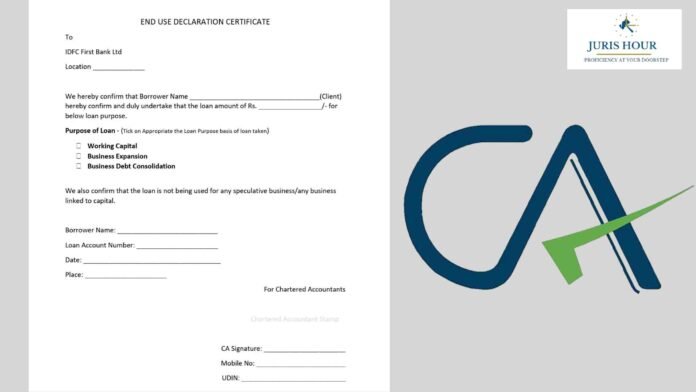
A growing practice among banks of asking Chartered Accountants (CAs) to certify the future end-use of loan funds is drawing sharp criticism from the professional community, with experts warning that such requirements go beyond the scope of professional verification and expose practitioners to undue risk.
Traditionally, CAs provide certifications based on existing financial records, documented transactions, and verifiable facts. However, recent instances indicate that banks are increasingly seeking assurances from CAs on how borrowers will utilize loan funds in the future—a demand many professionals argue is fundamentally flawed.
“Certification Cannot Be Based on Future Intentions”
Chartered Accountants have emphasized that certifying future utilization is not grounded in factual verification. “A CA can only certify what is supported by records and evidence. It is not a matter of fact that any professional can guarantee how funds will be used going forward,” practitioners note.
Under established professional principles, certification must rely on objective data and audit evidence, not on intentions, projections, or anticipated conduct of the borrower. Asking CAs to attest to future actions effectively converts a verification role into a form of assurance that cannot be reasonably provided.
Risk of Misplaced Liability
The concern is not merely academic. By issuing loosely worded certificates that imply assurance over future fund usage, CAs could be exposed to legal and professional liability if borrowers deviate from stated purposes.
Experts argue that such requirements risk shifting accountability away from borrowers and onto independent professionals. “If a borrower misuses funds, the responsibility should lie with the borrower—not with a certifying professional who had no control over future decisions,” one practitioner explained.
Buy Now: Customs Broker’s Digest
Call for Clearer Guidelines
The issue has sparked calls for intervention by regulators and professional bodies such as the Institute of Chartered Accountants of India, urging them to issue clear guidance on the scope and wording of certifications.
Professionals suggest that banks should instead:
- Obtain explicit undertakings or declarations directly from borrowers regarding intended use of funds;
- Restrict CA certifications to verification of past and present financial data;
- Avoid ambiguous language that could be interpreted as guaranteeing future outcomes.
Need for Alignment Between Banks and Professionals
With credit monitoring becoming more stringent, banks’ intent to ensure proper utilization of funds is understandable. However, experts stress that this objective must be balanced with professional standards and legal boundaries.
“There is a need for alignment between banks and the accounting profession to ensure that certifications remain fact-based and do not extend into speculative territory,” stakeholders said.
Until clearer norms are established, CAs are being advised to exercise caution, carefully review the language of certificates, and avoid engagements that require assurance beyond verifiable facts.
Read More: Income Tax Dept. Denies Conducting Search, Terms Allegations of Political Confinement as Baseless

