
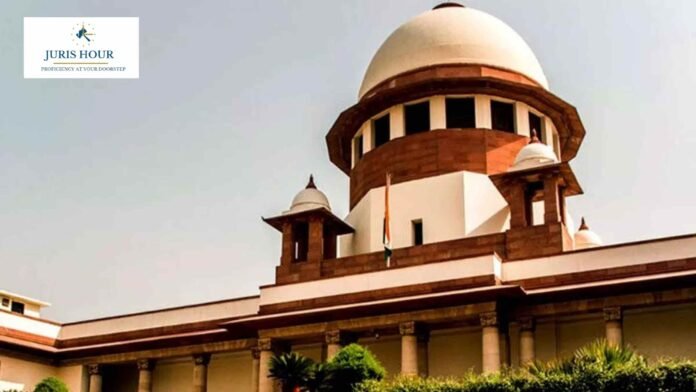
The Supreme Court has acquitted a man convicted in a kidnapping and murder case after finding that the prosecution failed to produce any reliable substantive evidence connecting him with either the crime or the apartment from which the victim’s body was recovered.
A Bench comprising Justice J.B. Pardiwala and Justice K. Vinod Chandran set aside the conviction of the appellant, who had been prosecuted along with five other accused. The Court observed that the investigation was “shoddy” and had proceeded primarily on the basis of confessional statements that could not be relied upon to establish the guilt of the accused.
The prosecution case began with the disappearance of a man who had left his home for Hyderabad. When the family was unable to contact him, his father allegedly received a ransom call demanding that ₹2 lakh be deposited in a bank account.
Buy Now: Supreme Court Judgments E-Compilation – August 2026
The father subsequently lodged a police complaint and deposited ₹1.50 lakh into an account maintained in the name of a woman identified as Geetanjali.
According to the prosecution, an analysis of telephone calls led the investigating officer to accused No. 6. Following his arrest, accused No. 6 allegedly disclosed the location of an apartment where the missing man’s body was found concealed inside a refrigerator. He also purportedly disclosed the involvement of the remaining accused.
Six persons were prosecuted for the kidnapping and murder. One accused died during the trial, while the trial court convicted the remaining five. On appeal, the Telangana High Court acquitted accused Nos. 2, 3, 5 and 6 but upheld the conviction of accused No. 1, who approached the Supreme Court.
The High Court sustained the appellant’s conviction principally on two circumstances. The first was the testimony of a person who claimed to be the watchman of the residential building from which the body was recovered.
The witness stated that the appellant had taken Flat No. 402 on lease and that he had seen the appellant bringing the deceased to the apartment. The second circumstance was the appellant’s alleged failure to explain how the body came to be present inside the apartment purportedly occupied by him.
The High Court treated this failure as an incriminating circumstance under Section 106 of the Indian Evidence Act, 1872, which deals with facts especially within the knowledge of a person.
The Supreme Court, however, found that the very factual foundation necessary to invoke Section 106 had not been established.
Examining the evidence, the Supreme Court noted that no lease agreement was produced to prove that the appellant had rented the apartment.
The person claiming to be the watchman did not state during his examination-in-chief who owned the flat or that he had handed over its keys to the appellant under the owner’s instructions. The prosecution also failed to produce any document establishing that the witness was actually employed as a watchman at the apartment complex.
Although the alleged owner of the flat was examined, he did not produce any ownership documents. His claim that he had entrusted the watchman with the responsibility of letting out the flat was also not specifically corroborated by the watchman.
No resident of the apartment complex was examined to establish the presence of the appellant or the other accused in the building. The visitors’ register was not produced, and the purported watchman could not provide details regarding the occupants of the building’s 17 flats.
The Supreme Court held that the absence of proof regarding the ownership of the flat, the appellant’s tenancy and the watchman’s employment undermined the prosecution’s entire theory.
Consequently, the Court found that the appellant could not be expected to explain the presence of the body in the apartment under Section 106 when the prosecution had itself failed to prove that he occupied the premises.
The same deficiencies also cast serious doubt on the prosecution’s “last-seen” theory that the appellant had taken the deceased into the apartment.
The Court also questioned the identification of the accused by the purported watchman.
The witness admitted that photographs of the suspects had been shown to him before he participated in the test identification parade conducted inside the jail. This substantially weakened the evidentiary value of the identification exercise.
The Supreme Court agreed with the High Court’s conclusion that such an identification could not safely be relied upon, particularly when the witness did not claim to have known the appellant before the alleged incident.
The prosecution relied upon call-detail records to claim that the investigating officer had traced accused No. 6 and uncovered the involvement of the other accused.
However, the service provider’s nodal officer was not examined, and the prosecution did not produce the certificate required under Section 65B of the Evidence Act for admitting electronic evidence.
The Supreme Court consequently held that the prosecution’s claim of having carefully analysed the call records “falls flat”.
Similar deficiencies affected the CCTV footage allegedly showing the accused withdrawing the ransom money from an ATM. The footage was not accompanied by a Section 65B certificate and was also insufficiently clear to identify the persons shown in it.
The amounts recovered from accused Nos. 1 and 6 could, therefore, not be connected with the kidnapping or ransom demand.
The Supreme Court also criticised the failure to investigate the bank account into which the victim’s father had deposited ₹1.50 lakh.
Although the deposit was made into an account maintained in the name of Geetanjali, the account holder was neither properly investigated nor made an accused. The prosecution did not produce the relevant account statement through an authorised bank official to establish the subsequent ATM withdrawals.
The Court found that the failure to pursue this crucial financial trail was another major defect in the investigation.
The prosecution claimed that accused No. 6 led the police to the apartment where the body was concealed. However, no independent witness was examined to prove either the disclosure statement or the discovery allegedly made on its basis.
Moreover, accused No. 6 had already been acquitted. The Supreme Court held that his disclosure statement, even if assumed to have been properly proved, could not by itself incriminate the appellant.
The post-mortem examination established that the victim had died from asphyxia caused by smothering associated with strangulation. It was also established that the body had been found inside a refrigerator in an apartment.
However, the Court said that, apart from proving the homicidal death and recovery of the body, there was “no scrap of evidence, worthy of reliance” connecting any of the accused with the murder or even with the flat.
The Supreme Court noted that the prosecution’s narrative regarding the alleged motive and relationships between the accused was derived almost entirely from their purported confessional statements.
The prosecution alleged that the appellant and another accused had planned to kidnap the deceased because they believed his father was financially capable of paying a ransom. It also projected a story involving alleged intimate relationships among some of the accused and the deceased.
The Court held that nothing independent had been produced to substantiate this narrative. Confessional statements made to the police could not be relied upon to implicate the accused, except to the limited extent permitted by law concerning the discovery of a relevant fact.
“The investigation was shoddy and merely relied on the confessions and the lewd story coming out of the confessions,” the Court observed.
Finding no legally sustainable basis for the conviction, the Supreme Court allowed the appeal and set aside the High Court’s judgment insofar as it had upheld the appellant’s conviction.
The Court noted that it had already directed the appellant’s release. It ordered that, if he had been released, his bail bonds would stand cancelled. If he remained in custody, he was directed to be released immediately unless required in connection with another case.
Membership Required to Access Case Details & Order Copy
To view the complete Case Details and Download Order Copy, you must have an active membership. Please subscribe to continue.
Read More: GST Prohibition Order Automatically Ends After Maximum Extended Period Expires: Bombay High Court

