
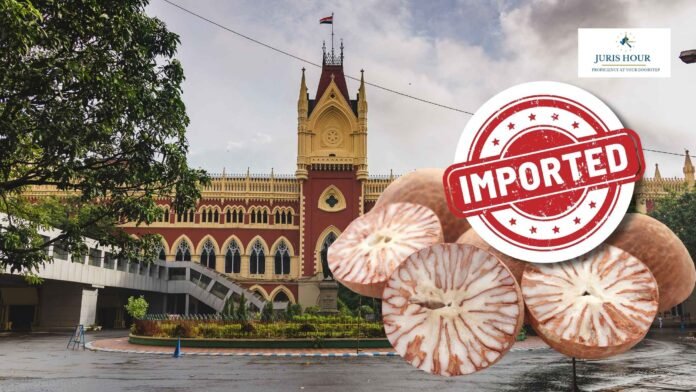
The Calcutta High Court has held that Customs officers can draw samples of imported food products under the Customs Act, 1962 for tariff classification, valuation and investigation of suspected misdeclaration, even though the goods are also subject to the Food Safety and Standards Act, 2006.
A division bench of Justice Rajarshi Bharadwaj and Justice Sudip Deb set aside a single judge’s order which had held that only officers authorised by the Food Safety and Standards Authority of India (FSSAI) could draw samples of imported food articles. The single judge had also quashed laboratory reports concerning a consignment of areca nuts.
Buy Now: 80+ Judgements Indirect Tax – September 2026 E-Magazine
The bench held that the Customs Act and the Food Safety and Standards Act operate in distinct but concurrent fields. Customs authorities can investigate the identity and classification of imported goods, while the FSSAI framework governs statutory food-safety clearance.
The court directed Customs authorities to proceed with the pending show cause notice adjudication in accordance with law. It also vacated directions for fresh sampling, release of the cargo and waiver of demurrage and detention charges.
The case concerned a consignment of foreign-origin areca nuts imported from Indonesia and transshipped to the Inland Container Depot at Durgapur.
The importer filed a bill of entry on September 11, 2025, declaring the goods as “Roasted Areca Nuts” under Customs Tariff Heading 20081991. The consignment comprised three containers weighing approximately 84.48 metric tonnes, with an assessable value of ₹1.12 crore.
The Directorate of Revenue Intelligence (DRI) received intelligence suggesting that dried areca nuts falling under Customs Tariff Heading 080280 had been misdeclared as roasted nuts. According to the department, the alleged misdeclaration was intended to evade customs duties and circumvent minimum import price restrictions.
The DRI issued an alert notice on September 15, 2025, and the consignment was held before the bill of entry was routed to FSSAI’s Food Import Clearance System.
Samples drawn by Customs were sent to the National Food Laboratory in Kolkata. The court recorded that the laboratory reported the samples to be unsafe because of mould, insect infestation and excessive aflatoxin content. Customs seized the containers on October 7, 2025.
Samples were also examined by the Central Revenues Control Laboratory in New Delhi. The division bench recorded that the laboratory reports indicated that the goods were other than roasted areca nuts and were unfit for human consumption. A show cause notice was issued on September 11, 2026.
The importer disputed the allegations of misdeclaration and maintained that the goods were roasted areca nuts. It argued that, because the consignment was a food article, samples could be drawn only by an FSSAI-authorised officer in accordance with the Food Safety and Standards Act and the Food Safety and Standards (Import) Regulations, 2017.
The importer also questioned the testing and retesting procedure, arguing that the Central Revenues Control Laboratory was not a notified referral laboratory under the food-safety law.
On July 15, 2026, a single judge allowed the writ petitions and held that FSSAI-authorised officers were the competent authorities to draw samples from imported food articles. The single judge declared the Customs sampling invalid, quashed the laboratory reports and directed fresh sampling and referral testing.
The DRI and the Commissioner of Customs (Preventive), Kolkata, challenged that decision before the division bench.
The division bench held that the two laws must be read harmoniously. The Customs Act deals with matters including import control, tariff classification, valuation, revenue protection, seizure and investigation of fiscal fraud. The Food Safety and Standards Act is aimed at ensuring that food entering the domestic market is safe.
The court referred to Section 25(1)(iii) of the Food Safety and Standards Act, which prohibits the import of food in contravention of that Act or any other law in force. According to the bench, this provision demonstrates that the two regulatory mechanisms coexist.
The court held that Section 144 of the Customs Act empowers a proper officer to draw samples of imported goods for examination, testing, valuation or other purposes of the Act. The fact that a consignment contains food does not, by itself, remove it from Customs control or prevent sampling for a Customs investigation.
The bench observed that Customs authorities must be able to determine the identity of a commodity when investigating whether goods have been misdeclared or whether import restrictions have been circumvented.
In the present case, the question was whether the consignment consisted of dried areca nuts or processed roasted areca nuts, as declared by the importer. The court held that food-safety legislation could not be used to displace a Customs investigation into tariff classification and alleged fiscal fraud.
At the same time, FSSAI submitted that testing undertaken during a Customs investigation could serve Customs proceedings but could not replace mandatory sampling and testing under the food-safety regime where a formal determination of fitness for human consumption was required. The court distinguished Customs’ enforcement role from FSSAI’s role in statutory clearance for domestic release.
The bench also noted that the bill of entry in this case had not been routed to FSSAI’s Food Import Clearance System. It held that, where a consignment is held under an intelligence-based alert before such routing, FSSAI does not acquire exclusive sampling jurisdiction to the exclusion of Customs officers.
The bench held that adequate weight had not been given to the findings recorded by the National Food Laboratory and the Central Revenues Control Laboratory before their reports were quashed.
It said that objections concerning sampling, testing methodology, chain of custody and the admissibility of reports could be raised and considered during adjudication of the show cause notice under the Customs Act.
The court held that prematurely quashing the sampling proceedings and laboratory reports before statutory adjudication would disrupt the mechanism provided under the Customs Act.
The division bench set aside the single judge’s order to the extent that it treated FSSAI-authorised officers as the sole competent authorities to draw samples for every purpose and quashed the Customs sampling and laboratory reports.

