
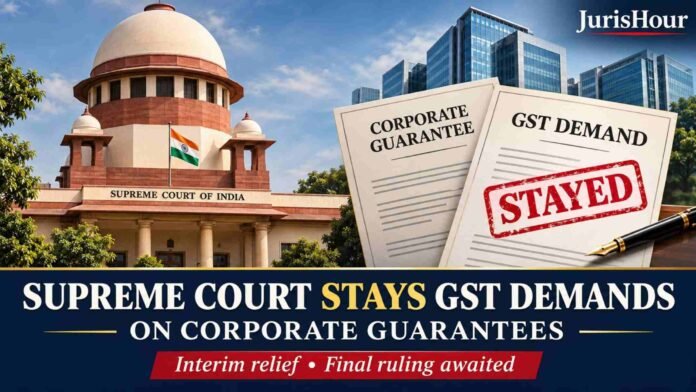
The Supreme Court on November 16, 2026, stayed the impugned tax demands in proceedings concerning GST on corporate guarantees, while issuing notice on petitions challenging the Gujarat High Court’s judgment on the validity and operation of Rule 28(2) of the Central Goods and Services Tax Rules, 2017.
The Bench of Justice Aravind Kumar and Justice Vipul M. Pancholi granted interim protection in petitions against the Union of India and others.
Buy Now: 210+ GST Judgments E-Magazine – October 2026
The proceedings concern significant questions about the taxation of corporate guarantees, including guarantees furnished without consideration, their deemed valuation and demands relating to earlier periods. The Supreme Court’s order grants interim relief against the demands under challenge; it does not finally decide the taxability of corporate guarantees or invalidate Rule 28(2).
The Supreme Court issued notice returnable within four weeks. Advocate-on-Record G. S. Makker accepted and waived notice on behalf of the respondents.
The operative direction states: “There shall be stay of the impugned demand(s) until further orders.”
Senior advocates Mukul Rohatgi, Navin Pahwa and Balbir Singh appeared for the petitioners, along with assisting counsel. Additional Solicitor General N. Venkataraman appeared for the respondents.
The Supreme Court’s brief order contains no substantive findings on the competing interpretations of the GST provisions. Its express interim direction concerns the impugned demands and cannot be treated as a general suspension of GST on all corporate guarantees.
Background: GST on guarantees within corporate groups
The underlying litigation arose from a batch of petitions before the Gujarat High Court challenging the GST treatment of corporate guarantees.
Such arrangements commonly involve a holding company or another group entity guaranteeing borrowing obtained by a related company from a bank or financial institution. The dispute concerned whether furnishing such a guarantee constitutes a taxable supply, particularly where the guarantor receives no commission or other consideration.
The petitioners challenged Rule 28(2), Section 15(4) of the CGST Act and CBIC circulars dated October 27, 2023, and July 11, 2024. They invoked Articles 14, 19(1)(g) and 265 of the Constitution, questioning the levy, its valuation mechanism and its application to guarantees executed before the rule was introduced.
A Division Bench of Justice A. S. Supehia and Justice Vaibhavi D. Nanavati partly allowed the petitions on August 14, 2026. The High Court upheld the statutory framework on several points while granting relief concerning valuation, earlier-period demands and proceedings under Section 74.
What is the dispute over the 1% valuation?
Rule 28(2), introduced on October 26, 2023, provides a specific valuation mechanism for corporate guarantee services within its scope. The disputed mechanism uses 1% of the guaranteed amount or actual consideration, whichever is higher. A subsequent amendment introduced the expression “per annum” with effect from October 26, 2023.
The 1% figure concerns the deemed value of the service on which GST is calculated. It is not itself a 1% GST rate on the guaranteed loan.
The petitioners argued that a valuation rule could not independently create a taxable supply. They also contended that a mandatory benchmark could produce arbitrary results where the actual guarantee commission was lower.
The High Court recorded that actual charges or commissions in the matters before it ranged from 0.25% to 0.3%. It examined the consequences of requiring taxpayers to adopt a 1% value despite a lower actual charge, particularly where guarantees continued over several years.
High Court upheld the rule but read down “whichever is higher”
The High Court declined to invalidate Rule 28(2) in its entirety. It also upheld Section 15(4), which enables prescribed valuation where the value cannot be determined under Section 15(1).
The court upheld GST on corporate guarantees furnished without consideration. However, it found the mandatory “whichever is higher” requirement arbitrary because it denied the guarantor the option of valuation based on actual commission or charges.
It consequently read down that expression while preserving the rule. The High Court reasoned that administrative concerns about possible valuation disputes could not, by themselves, justify an inflexible mechanism producing arbitrary consequences.
This distinction is central to the litigation: the High Court did not strike down the entire corporate guarantee valuation rule or accept a blanket exemption for guarantees supplied without consideration.
Earlier guarantees and the October 26, 2023 cut-off
The High Court also examined the application of the mechanism to guarantees executed before October 26, 2023, including guarantees originating before GST was introduced.
It held that imposing GST using the 1% per annum valuation for periods before the introduction of Rule 28(2) was harsh and unfair. Such an approach, it reasoned, imposed an unexpected financial burden on arrangements made under the prevailing legal framework.
Its conclusion protected the earlier period while recognising liability from October 26, 2023, where guarantees continued beyond that date.
Accordingly, the judgment did not treat execution of a guarantee before October 26, 2023, as sufficient to exclude all subsequent liability for the remaining life of that guarantee.
Section 74 proceedings quashed over absence of deliberate suppression
A separate part of the High Court’s ruling addressed the Revenue’s invocation of Section 74, concerning demands involving fraud, wilful misstatement or suppression of facts to evade tax.
The High Court observed that the dispute involved competing interpretations of the governing provisions. It found no intention to evade tax, or fraud, collusion, misconduct or suppression of facts, in the circumstances considered.
Relying on principles discussed in Uniworth Textiles Ltd. v. Commissioner of Central Excise, the court emphasised the need to establish deliberate conduct rather than treating mere failure to declare as sufficient proof of wilful suppression.
It also noted that, in one matter, the Revenue had issued a notice in August 2024 concerning a guarantee executed in February 2012. It held the invocation of Section 74 arbitrary and affected by non-application of mind, and quashed the impugned action.
At the same time, the High Court clarified that legal complexity does not, by itself, provide immunity from tax liability. The separate question was whether the conditions for alleging deliberate evasion had been established.
Refunds and circulars
The High Court directed refund of excess GST deposited, if any, while permitting adjustment if the parties so desired.
It also set aside the challenged circular clarifications to the extent they conflicted with its findings and allowed the Revenue to issue fresh circulars or administrative instructions consistent with the judgment. Its directions were to be implemented within three months.
On September 11, 2026, the High Court corrected a sentence in paragraph 118 dealing with the discrimination challenge. The correction clarified that Rule 28(2) could not be declared ultra vires on that ground. The remainder of the judgment was unchanged.
Membership Required to Access Case Details & Order Copy
To view the complete Case Details and Download Order Copy, you must have an active membership. Please subscribe to continue.
Read More: 70:30 GST Formula Can’t Be Compulsorily Applied To Pre-2019 Solar EPC Supplies: Supreme Court

