
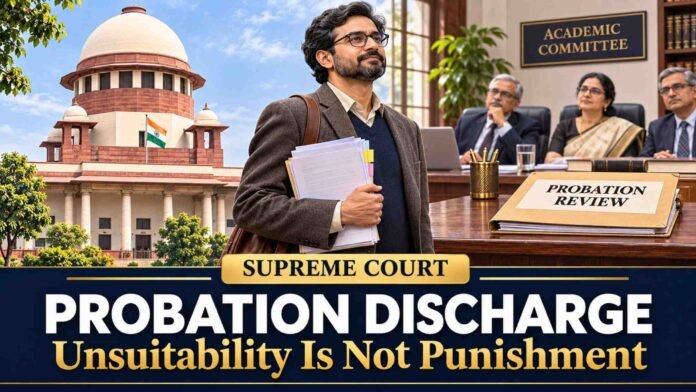
The Supreme Court has held that discharging a probationary employee following a bona fide assessment of suitability does not amount to punishment merely because complaints or adverse material prompted the employer to consider whether the employee should be retained.
A Bench of Justice Dipankar Datta and Justice Sheel Nagu upheld the Indian Institute of Science, Bangalore’s decision to discontinue the services of an Associate Professor during his extended probation. The Court found no material establishing that a specific allegation of misconduct had been investigated and proved against him or that such a finding formed the foundation of his termination.
Buy Now: 90+ Supreme Court Judgments E-Magazine – October 2026
Genuine Suitability Assessment Must Be Distinguished From Disguised Punishment
The Court explained that the decisive consideration is the substance of the employer’s action. Courts must determine whether termination resulted from a genuine assessment of suitability or imposed punishment for a specific act without an inquiry.
Where the decision concerns suitability, it may stand as termination simpliciter. Where it is punitive, the employer must comply with due process.
The Bench clarified that this would require an inquiry under Article 311(2) of the Constitution where that provision applies. In other cases, the applicable service rules and principles of natural justice govern the inquiry.
Background Of The Dispute
The case arose from the appointment of Dr. G. Srinivasan as an Associate Professor at IISc’s Centre for Earth Science, a project backed by the Ministry of Earth Sciences.
His appointment contemplated an initial contractual engagement of five years, including one year of probation. His continuation depended on an assessment of performance by the competent authority.
He joined the Institute on April 15, 2011. Following meetings held in May and June 2012, a Committee of Professors recommended extending his probation by another year. The Institute accepted that recommendation on June 27, 2012.
A subsequently constituted committee assessed his performance on March 26, 2013, and recommended discontinuing his services. Through an office memorandum dated April 10, 2013, the Institute terminated his services with effect from May 9, 2013, after one month’s notice.
A Single Judge of the Karnataka High Court dismissed his challenge. The Division Bench also declined to interfere, leading to the Supreme Court appeal.
Professor Alleged Termination Was Punitive And Influenced By Bias
The appellant argued that the termination memorandum, although neutral in its wording, was punitive in substance. He alleged that adverse findings had been recorded behind his back without notice or a hearing.
He also alleged that the Centre’s Chairman, who participated in the committee, had influenced the assessment because of earlier disagreements.
Separately, he questioned the extension of probation and challenged Regulation 13.5, which permitted termination by written notice without assigning reasons. He contended that his appeal against the extension had remained undecided when his services were terminated.
The Institute maintained that the decision followed an overall assessment of suitability during probation. It argued that such an assessment could include conduct and that the discharge neither imposed punishment nor attached stigma.
Probation Allows Employers To Assess Actual Suitability
Referring to Ajit Singh v. State of Punjab, the Supreme Court explained that probation enables an employer to observe an employee’s work, ability, efficiency, sincerity and competence before deciding whether to retain the employee.
The period provides an opportunity to assess whether the employee’s actual performance supports the impression formed during recruitment.
However, the Court also emphasised that discharge cannot depend on the appointing authority’s whims. Deliberation must precede the decision, and the authority may form its opinion from the available records.
Courts Can Look Behind An Order Within Limited Bounds
The Bench explained that courts should not routinely examine the background file of a discharge for unsuitability to undertake their own assessment of the employee.
Nevertheless, where the circumstances warrant scrutiny, courts may look behind the termination order to ascertain its true nature.
The purpose of this exercise is to determine whether unsuitability was the genuine ground or merely a cloak for punitive action founded on specific misconduct. It does not permit courts to reassess whether the probationer deserved retention.
Complaints Alone Do Not Establish Punitive Termination
The Court stressed that the distinction between “motive” and “foundation” cannot be applied mechanically.
A complaint may trigger an assessment of suitability without becoming a finding of guilt on which termination rests. Conversely, an apparently neutral order may be punitive where its substantive basis is a concluded finding of misconduct.
The record must therefore be examined as a whole. A grievance, complaint or adverse perception, without more, does not establish that the employer imposed punishment.
‘Unsuitable’ Or ‘Unsatisfactory’ Does Not Automatically Mean Stigma
The Bench clarified that a decision to discharge a probationer necessarily implies some assessment of unsuitability. Even expressly describing performance as unsatisfactory or the employee as unsuitable does not, by itself, make the order stigmatic.
Stigma requires something beyond a conclusion that the employee is unsuitable for the job.
The Court identified three sequential questions: whether the order itself contains an adverse imputation; whether, despite neutral wording, its underlying foundation is a finding of misconduct rather than an assessment of suitability; and whether that foundation carries civil consequences likely to affect future employment prospects.
For an order neutral on its face, affirmative answers to both the second and third questions are necessary for stigma to gain traction.
Absence Of A Formal Inquiry Is Not The Only Test
Discussing Pavanendra Narayan Verma, the Court reiterated the relevance of examining whether a full-scale formal inquiry into misconduct culminated in a finding of guilt.
However, it clarified that this is one judicially evolved test and is not exhaustive. It must be considered alongside the stigma test and the object of the inquiry.
The absence of a formal disciplinary inquiry therefore does not eliminate the need to examine the substance of the employer’s decision.
IISc Regulations Permitted Extension And One Month’s Notice
The Supreme Court examined Regulations 13.3 and 13.5 governing the appointment.
Regulation 13.3 permitted an initial contractual appointment of up to five years, including one year of probation. It also expressly authorised the appointing authority to extend probation from time to time or waive it where necessary.
Regulation 13.5 permitted termination through written notice without assigning reasons. During probation, the prescribed notice period was one month.
The Court found no breach of these regulations. It also rejected the challenge to Regulation 13.5, holding that the appellant had not demonstrated arbitrariness or disproportionately harsh operation. A probationer could not insist that reasons must be assigned in every case of discharge.
No Proven Misconduct Formed The Foundation Here
Applying these principles, the Court found no material showing that a specific allegation of misconduct had been investigated and proved against the appellant or that such a finding founded the termination.
The memorandum did not attribute misconduct or moral turpitude to him. The Institute’s decision followed an assessment of suitability during probation and did not constitute punishment disguised as simple termination.
The allegations concerning bias and the fairness of the process did not persuade the Bench that the discharge rested on a specific charge of misconduct or was intended to punish him.
Challenge To Extended Probation Also Fails
The Court also declined relief against the extension of probation.
Although the appellant stated that he had appealed against the extension, he continued to discharge his duties during the extended period. He had not approached a court seeking an expedited decision on that appeal.
Considering the subsequent discharge and the delayed presentation of the special leave petition, the Bench held that no relief was warranted on this ground.
Appeal Dismissed; Court Avoids Unnecessary Adverse Observations
The Supreme Court dismissed the appeal and upheld the concurrent findings of the Karnataka High Court. The parties were directed to bear their own costs.
The Bench observed that the five-year contractual period had practically expired when the special leave petition was presented in 2016. The dispute therefore principally concerned the appellant’s honour and reputation rather than reinstatement.
Membership Required to Access Case Details & Order Copy
To view the complete Case Details and Download Order Copy, you must have an active membership. Please subscribe to continue.

