
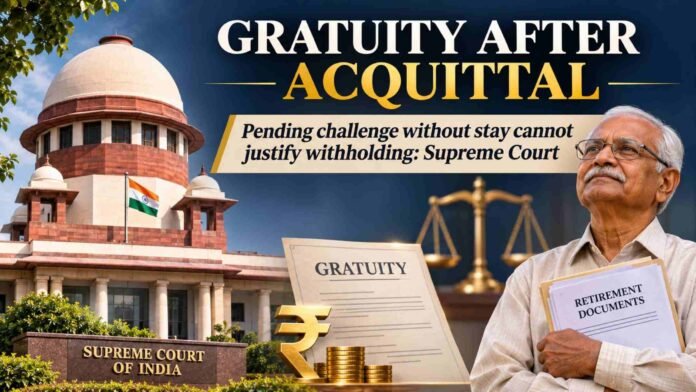
The Supreme Court has upheld the release of gratuity with applicable interest to two retired Delhi Development Authority (DDA) employees, holding that the mere pendency of the State’s application seeking leave to appeal against their acquittal, without any stay on the trial court’s judgment, could not justify withholding their retirement dues.
A Bench of Justice Prashant Kumar Mishra and Justice Shree Chandrashekhar dismissed the DDA’s appeals against a Delhi High Court judgment affirming relief granted by the Central Administrative Tribunal (CAT).
Buy Now: 90+ Supreme Court Judgments E-Magazine – October 2026
The bench upheld the condition that the employees furnish undertakings to repay the amounts with interest if the judicial proceedings ultimately concluded against them.
The dispute concerned Rajender Kumar Sharma and Satendra Pal, who entered DDA service in 1984. Sharma initially joined as a Lower Division Clerk and was subsequently appointed Assistant Field Investigator. Pal joined as Assistant Field Investigator.
On May 18, 2001, the Anti-Corruption Branch of the Delhi government registered FIR No. 29 of 2001 against certain officials of the DDA, Municipal Corporation of Delhi, and Slum and Jhuggi-Jhopri Department, including the two employees.
The prosecution alleged that officials conducting a joint survey to determine slum dwellers’ eligibility for relocation and alternative plots had colluded with property dealers to include fictitious beneficiaries for wrongful gain.
The case invoked Section 13(1)(d) of the Prevention of Corruption Act, 1988, read with Sections 420, 468, 471 and 120-B of the Indian Penal Code, 1860. Sanction for prosecution was granted by the DDA Vice-Chairman on April 8, 2004.
On February 28, 2017, the Special Judge dealing with Prevention of Corruption Act and Anti-Corruption Branch cases in Delhi convicted four co-accused in Criminal Case No. 111/2008.
The two employees and seven others were acquitted, while one accused was discharged for want of sanction.
The State subsequently filed Criminal Leave Petition No. 481/2017 before the Delhi High Court under Section 378 of the Code of Criminal Procedure, 1973, seeking permission to appeal against the acquittal.
On August 24, 2017, the High Court issued notice on the petition and the accompanying application for condonation of delay.
Both employees were provisionally promoted to Research Assistant (Group B). Sharma retired on September 30, 2021, while Pal retired on December 31, 2018.
However, citing the pending criminal leave petition, the DDA withheld gratuity of ₹18,52,224 and ₹15,43,113, respectively.
The authority relied on Rule 69(1)(c) of the Central Civil Services (Pension) Rules, 1972, which bars payment of gratuity until departmental or judicial proceedings conclude and final orders are issued.
The rule also contains a proviso permitting payment where departmental proceedings instituted under Rule 16 of the Central Civil Services (Classification, Control and Appeal) Rules, 1965, concern specified minor penalties under Rule 11.
The central issue was whether an unstayed challenge to an acquittal justified continuing to withhold gratuity under this provision.
In 2023, the employees sought release of their gratuity, relying on relief already granted to a co-accused subject to an undertaking. The DDA rejected their representations, prompting them to approach the CAT.
By separate orders dated January 15, 2026, the CAT directed release of gratuity with applicable interest.
Each employee was required to undertake to refund the amount received, together with interest, if the judicial proceedings ultimately concluded against him and in favour of the authority.
The Tribunal relied on the Delhi High Court’s decision in Kishan Lal Taneja v. Government of NCT Delhi and Others, which concerned a co-accused acquitted by the same trial court judgment.
The DDA challenged the CAT’s directions before the Delhi High Court. On March 25, 2026, the High Court dismissed its writ petitions, following the earlier decision. The authority then approached the Supreme Court.
Rejecting the DDA’s challenge, the Supreme Court held that the reasoning adopted in Kishan Lal Taneja applied equally to the two employees, who had been honourably acquitted following the same full-fledged trial.
The Bench endorsed the conclusion that the pending Section 378 application, particularly one remaining pending since 2017 without a stay on the trial court’s judgment, could not justify withholding their terminal dues.
Explaining the continuing effect of the acquittal, the Court observed,“An Appellate Court may or may not disturb the same, but until then, the acquittal continues to hold the field.”
The Court also rejected the DDA’s contention that Kishan Lal Taneja was per incuriam. It noted that similarly situated persons had secured relief on the strength of that decision, including in Rajinder Khurana v. Government NCT of Delhi and Another and Laxmi Narain v. Government of NCT of Delhi and Others.
The DDA relied on Bikram Chand Rana v. Himachal Pradesh Road Transport Corporation, 2026 INSC 326.
The Supreme Court distinguished that ruling because the employee’s criminal trial remained pending in that case, although departmental proceedings had concluded.
The observations in that decision concerning possible future recovery arose in the context of an amount that could not otherwise be released because of the express statutory bar under Rule 69(1)(c).
In the present case, however, the criminal trial had concluded with a final order of acquittal. The Court held that gratuity had consequently become payable.
The possibility of the acquittal being disturbed in appellate proceedings did not displace its existing legal effect.
The Bench explained that the refund undertaking balanced the protection of public funds with the retired employees’ entitlement to enjoy benefits earned over decades of service.
It observed that superannuated employees, necessarily of advanced age, should not be required to await the uncertain conclusion of appellate proceedings for years.
Such prolonged waiting could render pensionary benefits illusory, particularly where the delay in the State’s challenge was not attributable to the employees.
The Court found that the conditions imposed by the CAT and the High Court adequately safeguarded the DDA’s financial interests.
The Supreme Court dismissed both appeals. The directions to release gratuity with applicable interest, subject to refund undertakings, therefore remained intact.
Membership Required to Access Case Details & Order Copy
To view the complete Case Details and Download Order Copy, you must have an active membership. Please subscribe to continue.

