
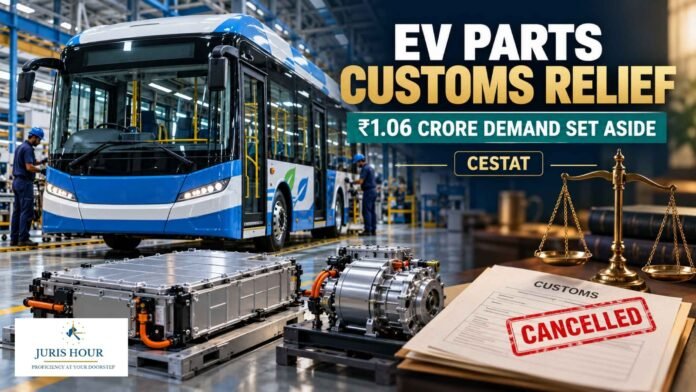
The Customs, Excise and Service Tax Appellate Tribunal (CESTAT), New Delhi, has held that customs duty exemption on imported electric vehicle components cannot be denied merely because the importer engaged a related company to manufacture electric buses, when the components were used for the intended purpose and remained within the importer’s factory premises.
The bench of Dr. Rachna Gupta (Officiating President) and Hemambika R. Priya (Technical Member) set aside an order confirming differential customs duty of ₹1,06,69,156, along with interest and a penalty. The Bench found substantial compliance with the exemption notification and the Customs (Import of Goods at Concessional Rate of Duty) Rules, 2017, commonly known as the IGCR Rules.
Buy Now: 80+ Judgements Indirect Tax – September 2026 E-Magazine
The appellant/assessee was engaged in manufacturing electrically operated vehicles, including electric buses. Its parent company, PMI Coaches Private Limited, which held more than 50% of its shares, carried out bus body fabrication.
The importer procured components such as lithium-ion battery packs, motors, motor controllers, AC/DC converters, electric compressors and braking systems at concessional or nil customs duty rates under serial numbers 528 and 528A of Notification No. 50/2017-Customs dated June 30, 2017.
The exemption was subject to Condition No. 9, which required compliance with the IGCR Rules, 2017.
The dispute concerned components imported under a Bill of Entry dated August 30, 2019, for executing an order from the Himachal Road Transport Corporation for 20 electric buses.
Under a memorandum of understanding dated October 1, 2019, PMI Coaches undertook fabrication and manufacture of the buses using the imported components and other materials supplied by assessee. The importer maintained that manufacturing took place under its supervision and control at shared manufacturing premises at Plot No. 26, Industrial Area, Dharuhera, Haryana.
The completed buses were returned to assessee and subsequently supplied to the transport corporation.
The Customs Department alleged that the importer had sold the components to PMI Coaches rather than supplied them for job work. It relied on tax invoices, payment of GST and statements recorded during the investigation.
According to the department, the two companies were separate legal entities with independent registrations. It argued that the invoiced transactions transferred ownership of the imported components and amounted to clearance of the goods “as such” into the domestic market.
The department also contended that manufacturing was not undertaken at the importer’s registered premises and that the alleged sale had not been disclosed to the jurisdictional Customs authorities.
A show cause notice dated July 29, 2021, consequently proposed denial of the exemption.
The Principal Commissioner of Customs (Preventive), New Delhi, confirmed the differential duty demand under Section 28(4) of the Customs Act, 1962, read with Rule 8 of the IGCR Rules. The order also directed recovery of interest under Section 28AA, appropriated ₹25 lakh already deposited and imposed a penalty under Section 114A.
The assessee submitted that the notification required the imported components to be used in manufacturing electrically operated vehicles. It argued that the notification did not require the importer to personally carry out every manufacturing operation.
The company maintained that its arrangement with PMI Coaches was one of contract manufacturing, supported by the memorandum of understanding, and that issuing GST invoices did not change the underlying nature of the transaction.
It further submitted that the components had not physically left the shared manufacturing premises and were neither unutilised nor defective. On that basis, it disputed the department’s reliance on the provisions governing domestic clearance of unutilised or defective imported goods.
The importer also challenged invocation of the extended limitation period, arguing that it had furnished the prescribed intimations, executed a continuity bond and filed returns, and that the dispute concerned interpretation of the exemption conditions.
The Tribunal noted that the importer had submitted intimations to the jurisdictional Customs authorities, furnished a bond with surety or security and regularly filed returns.
It also found that the assessee and PMI Coaches shared the same manufacturing premises and had entered into an agreement for fabrication of the electric buses.
The decisive consideration was that the imported components were used to manufacture electric buses subsequently supplied to the Himachal Road Transport Corporation. There was no allegation that the components had been used for a purpose different from the one for which they were imported.
The Bench treated the arrangement under which the goods were shown as sold to the job worker as a business arrangement and a procedural lapse in the circumstances of the case.
Its reasoning focused on actual use of the imported components and compliance with the substantive purpose of the exemption, rather than the form of documentation alone.
The Tribunal discussed earlier decisions recognising that an importer can fulfil an end-use condition by utilising another entity’s manufacturing facilities.
These included FDC Limited, Tamil Trading Corporation, Godrej Consumer Products Limited and Intas Pharmaceuticals Limited. The decisions supported the proposition that manufacturing through a job worker does not necessarily defeat an exemption where the imported goods are used for the specified purpose.
The Bench also noted that the 2021 amendments to the IGCR framework expressly provided for sending imported goods to job workers, recognising the business practice.
The Tribunal observed that procedural lapses can be condoned where substantial compliance is established and the substantive outcome remains unaffected.
In this case, the imported components were used in manufacturing the electric buses and did not leave the importer’s factory premises. The Bench therefore held that there was substantial compliance with Notification No. 50/2017-Customs and Condition No. 9, and that customs duty could not be demanded.
Membership Required to Access Case Details & Order Copy
To view the complete Case Details and Download Order Copy, you must have an active membership. Please subscribe to continue.
Read More: Luxury Watches Worth ₹52.54 Lakh Seized at IGI Airport

