
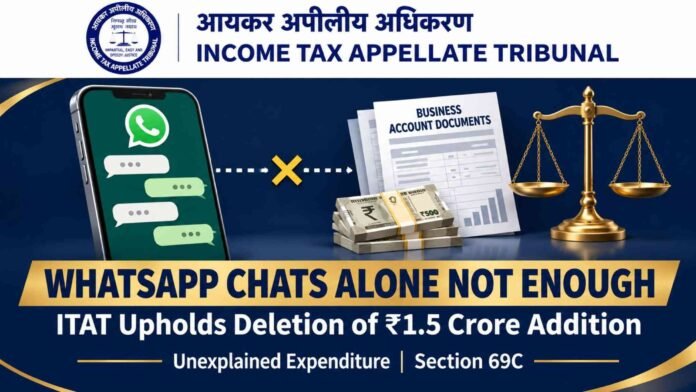
The Ahmedabad Bench of the Income Tax Appellate Tribunal (ITAT) has upheld the deletion of a ₹1.5 crore addition under Section 69C of the Income-tax Act, 1961, holding that third-party WhatsApp communications and an alleged sequence of cash payment followed by a bank transfer did not adequately establish that the taxpayer had received cash or claimed bogus expenditure.
The Bench of Sanjay Kumar (Judicial Member) and Narendra Prasad Sinha (Accountant Member) found that the Assessing Officer had failed to establish the identity of the alleged cash recipient, his connection with the company, or the actual delivery of cash to the company or its representative.
Buy Now: Direct tax (Income Tax) Judgments E-Magazine October 2026
The company filed its income tax return declaring total income of ₹14,56,80,130. Its case was subsequently selected for scrutiny through the Computer Assisted Scrutiny Selection system.
The dispute arose from a search conducted in the Miraj Group on February 21, 2023. The tax authorities relied on WhatsApp communications recovered from the mobile phone of Amit Sharma, a director of Miraj Entertainment Limited (MEL), and a statement recorded from Sanjay Singh under Section 132(4).
According to the assessment narrative, arrangements had been made for cash of ₹2 crore, of which ₹1.5 crore was allegedly delivered in Ahmedabad in connection with the taxpayer. A photograph of a ₹10 currency note was reportedly used as a token for the cash delivery.
Sanjay Singh stated that ₹1.5 crore had been delivered to a person named Ajay. The Revenue alleged that the taxpayer subsequently transferred the corresponding amount to MEL through banking channels, thereby facilitating an accommodation entry.
The Assessing Officer concluded that the alleged arrangement involved the taxpayer providing an entry of ₹1.5 crore to MEL. The Revenue’s case was that MEL recorded advertisement income, while the taxpayer claimed the corresponding expenditure.
Treating the expenditure as bogus, the Assessing Officer added ₹1.5 crore under Section 69C. The assessment was completed under Section 143(3) on March 31, 2025, determining total income of ₹16,06,80,130.
The Commissioner of Income Tax (Appeals), through the National Faceless Appeal Centre, deleted the addition by an order dated September 17, 2025. The Revenue challenged that decision before the Tribunal, invoking Section 69C read with Section 115BBE in its substantive ground of appeal.
The department argued that the taxpayer had regular dealings with MEL and had transferred ₹1.47 crore to it immediately after the alleged receipt of ₹1.5 crore in cash.
The departmental representative submitted that the difference represented tax deducted at source and argued that TDS had been deducted to give the transaction an appearance of genuineness.
The department maintained that the ₹1.5 crore expense recorded in the taxpayer’s books was bogus and that the Assessing Officer’s addition should be restored.
The taxpayer argued that no evidence of an accommodation entry had been recovered from it and that the connection between Ajay, the alleged recipient of the cash, and the company had never been established.
Its representative submitted that no inquiry had demonstrated that Ajay received the money on the company’s behalf.
The taxpayer also relied on its continuing business relationship with MEL. It stated that transactions with MEL during the relevant year totalled ₹17,89,95,245.76 and that details of purchases and expenses had been furnished during assessment.
According to the taxpayer, the addition rested on presumptions rather than evidence showing either receipt of cash or fictitious expenditure.
The Tribunal specifically noted that the WhatsApp communication contained the narration “1.5 ahmedabad khushi”.
It held that the reference could provide a basis for further inquiry. However, its evidentiary significance had to be assessed alongside the remaining material.
The taxpayer was not a party to the communication, which was exchanged between persons associated with MEL. The Tribunal found that the reference to the taxpayer’s first name did not, without further corroboration, conclusively establish that cash was delivered to the company or someone acting on its behalf.
The ruling therefore turned on the absence of a substantiated connection between the communication and the alleged cash receipt.
The Tribunal identified a central gap in the Revenue’s evidence: the identity and role of the person said to have received the cash.
Although Sanjay Singh referred to delivery to Ajay in Ahmedabad, the material did not establish that Ajay was an employee, agent or authorised representative of the taxpayer.
The Assessing Officer had also not brought on record any inquiry or corroborative material demonstrating receipt of cash by the taxpayer through that person.
Consequently, the essential link between the alleged delivery and the taxpayer remained unsubstantiated.
The Tribunal acknowledged that the proximity and nature of the alleged cash payment and subsequent bank transfer could be relevant circumstances. Nevertheless, those circumstances could not independently establish the alleged accommodation-entry arrangement without adequate corroboration.
It also considered the parties’ regular business dealings. Such dealings did not, by themselves, prove that the disputed transaction was genuine, but they could not be disregarded when evaluating the Revenue’s evidence.
The Tribunal found that the Assessing Officer had not demonstrated through examination of the underlying records, or otherwise, that the specific business transaction or expenditure was fictitious.
Despite the taxpayer furnishing transaction details, the assessment order identified no specific defect in the supporting material establishing that the expenditure was bogus.
The Tribunal further noted that Amit Sharma’s statement had subsequently been retracted.
It clarified that a retraction does not automatically deprive the original statement of evidentiary value. Both the statement and the circumstances in which it was made must be examined with the other material on record.
In this case, even the original statement read together with the WhatsApp communications did not adequately establish receipt of cash by the taxpayer or the non-genuine nature of its expenditure.
The Tribunal also addressed the Assessing Officer’s premise that the taxpayer had facilitated an accommodation entry for MEL.
Even if that premise were accepted, it observed, the nature and amount of income arising to the taxpayer from facilitating the transaction would require separate examination based on relevant evidence.
The entire amount involved in an alleged accommodation-entry transaction could not automatically be treated as the facilitator’s income merely because it was alleged to have routed funds.
The Tribunal did not determine any commission income or prescribe a commission rate. Its decision concerned the sustainability of the particular ₹1.5 crore addition under Section 69C.
The Tribunal emphasised that treating recorded expenditure as unexplained under Section 69C required a factual basis establishing its unexplained nature.
An allegation about the routing of funds could not dispense with that requirement. Here, the Revenue had neither established actual delivery of cash to the taxpayer or its representative nor produced independent material demonstrating that the recorded expenditure was bogus or unexplained.
The Tribunal accordingly held that the addition rested on presumptions drawn from the WhatsApp communication and the alleged transaction sequence without the necessary corroboration.
Upholding the CIT(A)’s order, it dismissed the Revenue’s appeal and sustained the deletion of the ₹1.5 crore addition.
Membership Required to Access Case Details & Order Copy
To view the complete Case Details and Download Order Copy, you must have an active membership. Please subscribe to continue.
Read More: Supreme Court Stays GST Demands on Corporate Guarantees

