
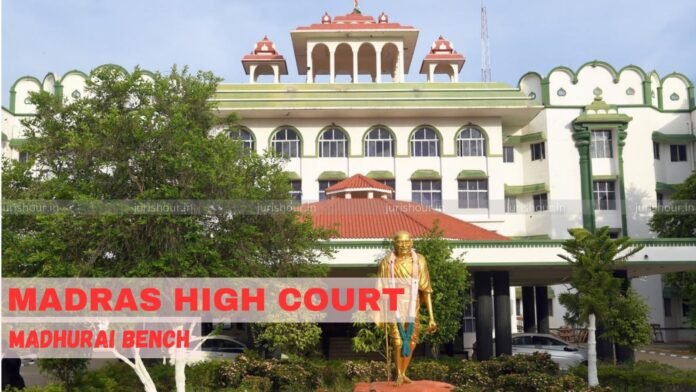
The Madurai Bench of the Madras High Court has refused to quash an FIR alleging a massive Rs. 700 crore property fraud involving an elderly Overseas Citizen of India (OCI) cardholder residing in Singapore, while observing that the allegations relating to fraudulent property transfers, manipulation of income tax returns, siphoning of funds and use of fake records require a thorough investigation.
The bench of Justice B. Pugalendhi quashed the later FIR relating to alleged intimidation and abuse, holding that the subsequent case could divert the main investigation and create an impression of coercion against the accused.
According to the prosecution, the de facto complainant, a septuagenarian Singapore resident holding an OCI card, lost her husband in 2015. Her late husband allegedly owned extensive properties in and around Thanjavur which were embroiled in litigations and SARFAESI proceedings. The complainant alleged that certain individuals approached her claiming they would assist her in managing the disputes and protecting the properties.
The FIR alleged that the accused gained her confidence, obtained her signatures on blank papers, vakalatnamas and power documents under the guise of safeguarding her properties, and later used those documents to execute multiple sale deeds among themselves without her knowledge. The complainant alleged that properties worth nearly ₹700 crore were fraudulently transferred and that valuables and documents were also removed from her residence and lockers.
The petitioners argued before the Court that the dispute was purely civil in nature arising out of property transactions and had been given a criminal colour. They contended that the complainant had admittedly executed power of attorney documents before Sub-Registrars and had also disclosed sale proceeds in her income tax returns for several assessment years while paying capital gains tax.
The accused further argued that the complaint was vague, belated and intended to recover properties and money through criminal proceedings. They maintained that no ingredients of cheating, forgery or criminal conspiracy were made out and that the transactions had taken place between 2017 and 2022, whereas the complaint was lodged only in 2025.
Opposing the plea, the prosecution submitted that preliminary investigation had uncovered nearly 150 registered documents executed between 2017 and 2023 and revealed a systematic scheme to divert the complainant’s assets and money. It was alleged that although sale deeds stated that properties were sold for reinvestment purposes, no reinvestment was actually made in the complainant’s name and the proceeds were siphoned away by the accused.
The prosecution also pointed to suspicious transactions allegedly involving undervaluation of properties, execution of documents when the complainant was outside India, use of fake life certificates and linking of fabricated email IDs and mobile numbers to the complainant’s PAN and bank accounts.
One of the major aspects highlighted before the Court related to the filing of income tax returns. The prosecution claimed that the returns had been filed by the accused themselves in order to create records showing that sale proceeds had been received by the complainant as capital gains, after which the money was allegedly diverted to accounts linked to the accused.
The Court noted that the auditor of the complainant had allegedly stated during investigation that the particulars required for filing the income tax returns between 2018 and 2023 were furnished only by the accused persons. The Court further recorded that OTP-related mobile numbers and email IDs used in the income tax returns allegedly belonged to the accused and not the complainant.
The investigating agency also placed bank account statements before the Court allegedly showing that over ₹4.12 crore had been transferred from the complainant’s accounts to the accused persons. The prosecution additionally alleged siphoning of over ₹8 crore from one bank account and over ₹2 crore from another through misuse of signed cheque books and banking credentials.
After examining the materials, the High Court observed that a prima facie case had been made out warranting further investigation. The Court held that issues such as alleged fraudulent registration of documents when the complainant was abroad, use of fake life certificates, transfer of substantial amounts to the accused, and the filing of income tax returns using the accused persons’ contact details required detailed probe by the investigating agency.
At the same time, the Court acknowledged the defence contention that the complaint may have been triggered by escalation in land prices and directed the investigating agency to examine all aspects fairly.
While dismissing the quashing petitions relating to the main property fraud FIR, the Court directed the District Crime Branch not to harass the accused during investigation and permitted the police to seek documents and information through written communications and registered post. The Court also directed Sub-Registrars, immigration authorities, forensic departments and the Income Tax Department to cooperate with the investigation by furnishing necessary records without delay.
Case Details
Case Title: Revathi Versus The State
Case No.: CRL OP(MD) Nos.7012, 7450 and 8129 of 2026
Date: 30.04.2026
Counsel For Appellant: A.Ramesh, Senior Counsel
Counsel For Respondent: R.Meenakshi Sundaram
Read More: CESTAT Allows Refund of Extra Duty Deposit Paid Through Promoter Loan

