
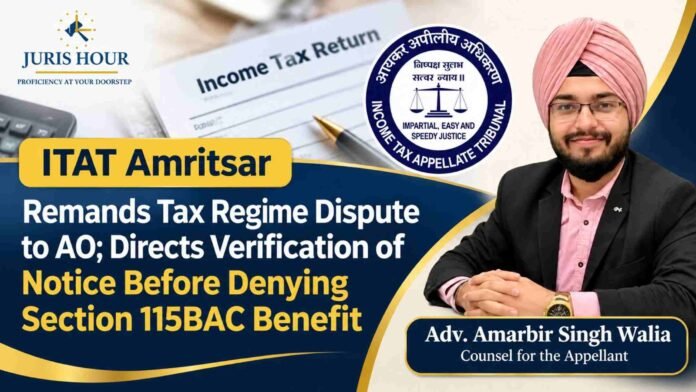
The Income Tax Appellate Tribunal (ITAT), Amritsar Bench, has set aside an appellate order concerning the denial of the benefit of the new tax regime under Section 115BAC of the Income-tax Act, 1961, and restored the matter to the Jurisdictional Assessing Officer (JAO) for fresh examination.
The bench of Ravish Sood (Judicial Member) has observed that where an adjustment is proposed while processing a return under Section 143(1), the statutory requirement of communicating the proposed adjustment to the assessee and providing 30 days to respond must be followed.
Buy Now: Direct tax (Income Tax) Judgments E-Magazine October 2026
The Bench observed that the Assessing Officer must verify whether the proposed adjustment was communicated to the assessee before rejecting the option exercised under Section 115BAC.
The assessee filed his income tax return for AY 2023-24 on July 26, 2023, declaring total income of ₹2,95,96,010 and opting for taxation under Section 115BAC of the Income-tax Act.
However, the Centralised Processing Centre (CPC), through an intimation dated March 11, 2024, rejected the option exercised by the assessee and computed his tax liability under the old tax regime. This resulted in an additional tax liability of ₹88,780.
Amarbir Singh Walia, the counsel for the assessee challenged the adjustment before the Commissioner of Income Tax (Appeals), contending that the requirement of filing Form 10-IE was procedural in nature and that the benefit of the new tax regime should not be denied merely on account of non-filing of the form.
Alternatively, it was argued that if the assessee was to be assessed under the old tax regime, eligible deductions under Chapter VI-A should be allowed.
The CIT(A), however, dismissed the appeal, holding that filing Form 10-IE within the prescribed due date was mandatory for exercising the option under Section 115BAC. The appellate authority also observed that the deductions under Chapter VI-A had not been claimed in the original return.
Before the Tribunal, the assessee explained that he had initially opted for the new tax regime for AY 2021-22 by furnishing Form 10-IE on March 7, 2022. However, the option was rejected because the form was filed after the due date.
It was further submitted that subsequent filings and the manner in which the income-tax e-filing portal reflected the earlier forms created confusion regarding the status of the option exercised for the succeeding assessment years.
The assessee specifically contended that although he had expressly opted for taxation under Section 115BAC in his return for AY 2023-24, the CPC rejected the option without issuing any prior communication or providing an opportunity to explain the position.
It was argued that the action violated the first and second provisos to Section 143(1)(a), which require the proposed adjustment to be communicated to the assessee and provide 30 days to furnish a response before the adjustment is made.
The Tribunal took note of the judgment of the Bombay High Court in Rallis India Limited v. Central Processing Center[2026] 183 taxmann.com 176 (Bom.).
In the said decision, the High Court held that an adjustment under Section 143(1) cannot be made without first communicating the proposed adjustment to the assessee and considering the response furnished within the prescribed period.
The Tribunal observed that the statutory provisions specifically contemplate that the proposed adjustment must be communicated to the assessee, who must be allowed 30 days to respond. If a response is furnished within the prescribed period, the same must be considered before making the adjustment.
The Tribunal found substance in the assessee’s contention that the CPC’s failure to follow this procedure could render the adjustment unsustainable.
Considering the above circumstances, the Tribunal set aside the order passed by the CIT(A) and restored the matter to the file of the Jurisdictional Assessing Officer.
The AO has been directed to verify whether any communication proposing the impugned adjustment was issued to the assessee and to examine the procedural objection in light of Section 143(1)(a) and the Bombay High Court ruling in Rallis India Ltd.
The Tribunal further directed that if the assessee’s income is ultimately held taxable under the old tax regime, the AO must examine his alternative claim for deductions under Chapter VI-A. The assessee will be required to furnish the relevant particulars and supporting evidence for each deduction claimed.
The AO has also been directed to provide a reasonable opportunity of being heard and pass a speaking order dealing with the assessee’s contentions.
Membership Required to Access Case Details & Order Copy
To view the complete Case Details and Download Order Copy, you must have an active membership. Please subscribe to continue.

