
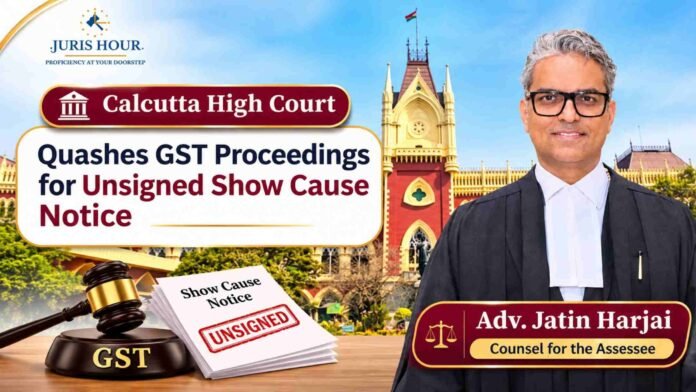
The Calcutta High Court has held that GST proceedings initiated through unsigned and unauthenticated pre-show cause and show cause notices are fundamentally without jurisdiction, quashing the entire proceedings and the consequential adjudication order.
The bench of Justice Sabyasachi Bhattacharyya and Justice Om Narayan Rai, has ruled that the issuance of a validly signed show cause notice is a foundational jurisdictional requirement for initiating adjudication under the GST law.
Buy Now: All 200+ GSTAT Judgements Till November 2026 | Comprehensive E-Magazine
The bench held that where neither the electronic nor the physical copies of the pre-show cause notice and show cause notice carry a valid signature, the very initiation of proceedings stands vitiated.
Mr. Jatin Harjai, the counsel for the appellant contended that the pre-show cause notice and show cause notice did not contain valid digital signatures. Even the electronic copies reflected that the digital signatures were not verified, while the accompanying Form GST DRC-01A indicated an invalid digital signature. The manual copies served upon the appellant were also unsigned or unauthenticated.
Mr. Harjai argued that an unsigned notice is equivalent to no notice in the eyes of law and relied upon the decisions in Commissioner of Income Tax v. Aparna Agency Pvt. Ltd., DBS Tradelink and Advisors Pvt. Ltd. v. State of Maharashtra and Star Raison Landmarks v. Chief Commissioner, State Tax, Commercial Taxes Department.
The appellant also raised other grounds, including alleged block/bunch assessment, absence of any taxable event, non-availability of goods in its custody, and imposition of a penalty almost double the amount specified in the show cause notice.
The department argued that since the notices had been uploaded on the GST portal, they should be deemed to have been validly signed. They also offered to produce the original signed document, if directed by the Court.
However, the Division Bench examined the pre-show cause notice, show cause notice and accompanying DRC-01A form and found that none of them carried a valid digital signature. The physical copies served upon the appellant were also unsigned and/or unauthenticated.
The Court observed that there was nothing on record to establish that any validly signed notice, whether manual or digital, had ever been served upon the appellant at either the pre-show cause or show cause stage.
The High Court emphasised that issuance of a valid notice is the foundational fact upon which GST authorities derive jurisdiction to initiate adjudication proceedings.
It held that the absence of a validly signed notice vitiates the very initiation of proceedings. Where a proceeding is defective at its inception due to the absence of jurisdictional and foundational facts, the entire proceeding becomes invalid in the eyes of law.
The Court further observed that even if the Revenue were to produce a validly signed notice for the first time before the High Court, it would be inappropriate for the Court to assume the jurisdiction of the first authority and thereby deprive the parties of the statutory forums of challenge.
The department relied upon Section 160 of the CGST Act, 2017, which protects proceedings from being invalidated merely on account of mistakes, defects or omissions where they are substantially in conformity with the requirements of the Act.
Rejecting this contention, the Court held that Section 160 cannot be invoked to cure the absence of a validly signed show cause notice.
According to the Court, the defects contemplated under Section 160 relate to factual errors or mistakes of a lesser order and cannot extend to foundational defects that strike at the very root of the jurisdiction to issue a notice.
The Court observed that interpreting Section 160 to cover defects affecting the jurisdictional requirements of a notice would render the statutory provisions providing remedies against such proceedings nugatory.
The Court also examined whether the availability of an alternative statutory remedy would prevent the High Court from exercising jurisdiction under Article 226 of the Constitution.
It held that where the proceedings are fundamentally without jurisdiction due to the absence of validly signed notices, the writ court has ample power to undertake judicial review.
The Court considered it inappropriate to relegate the appellant to another round of statutory appeals when the proceedings themselves were fundamentally defective.
However, the Court clarified that its judgment would not prevent the GST authorities from issuing a fresh, valid notice in accordance with the applicable provisions of law, provided they are otherwise legally entitled to do so.
Membership Required to Access Case Details & Order Copy
To view the complete Case Details and Download Order Copy, you must have an active membership. Please subscribe to continue.
Read More: JURISHOUR | TAX LAW DAILY BULLETIN : 27 November 2026

