
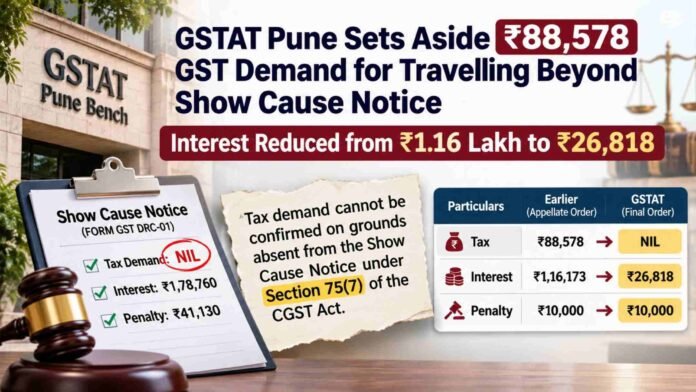
The Goods and Services Tax Appellate Tribunal (GSTAT), Pune Bench, has partly allowed an appeal involving a dispute over alleged short payment of GST for the period July 2017 to March 2018. The Tribunal set aside the State GST demand of ₹88,578, holding that the adjudicating authority had confirmed a tax demand on a ground that was neither specified nor proposed in the Show Cause Notice (SCN), in violation of Section 75(7) of the CGST Act, 2017.
The bench of Shridhar Mahadeo Bhosale (Judicial Member) and Dr. Nirmal Kumar Soren (Technical Member) substantially reduced the interest liability from ₹1,16,173 to ₹26,818 after undertaking a transaction-wise examination of the Electronic Cash Ledger. However, it sustained a penalty of ₹10,000 under Section 73(9) of the CGST Act.
Buy Now: 210+ GST Judgments E-Magazine – October 2026
The dispute originated from a mismatch between the outward tax liability declared in FORM GSTR-1 and the tax reported in FORM GSTR-3B for September 2017.
The taxpayer had declared GST of ₹4,11,291.72 in GSTR-1, comprising CGST of ₹2,05,645.86 and SGST of ₹2,05,645.86, whereas the corresponding GSTR-3B return reflected nil liability.
On November 18, 2017, the taxpayer deposited ₹4,11,290 into the Electronic Cash Ledger, comprising ₹2,05,645 each towards CGST and SGST.
Subsequently, certain amounts from the Electronic Cash Ledger were utilised towards tax liabilities for other periods. On August 12, 2019, the taxpayer also filed FORM GST DRC-03 under Section 73(5), debiting ₹2,05,645 towards CGST, ₹1,17,070 towards SGST and ₹93,750 under the Cess head.
During scrutiny of returns for FY 2017-18 under Section 61, the department issued FORM GST ASMT-10 dated August 3, 2021.
After examining the taxpayer’s explanation, the department recorded that the tax difference of ₹4,11,290 had already been paid. However, the department proceeded to initiate action for recovery of interest and penalty.
The department issued a Show Cause Notice in FORM GST DRC-01 dated June 21, 2022, under Section 73(1) of the CGST Act.
Importantly, the SCN specifically recorded that the taxpayer had already paid the tax amount of ₹4,11,290. Accordingly, the notice proposed interest of ₹1,78,760 and penalty of ₹41,130, while showing the tax demand as NIL under both CGST and SGST.
However, in the subsequent adjudication order dated September 1, 2022, the proper officer determined that the taxpayer had short-paid tax of ₹3 under CGST and ₹88,578 under SGST.
The officer observed that ₹93,750 had been debited under the Cess head instead of SGST and consequently denied credit of that amount towards SGST liability.
The adjudicating authority ultimately confirmed tax of ₹88,581, interest of ₹1,84,090 and penalty of ₹20,000.
In the first appeal, the Deputy Commissioner of State Tax modified the interest liability to ₹1,16,173 and reduced the penalty to ₹10,000, while confirming the SGST demand of ₹88,578.
Aggrieved by the decision, the taxpayer approached GSTAT Pune.
Before the Tribunal, the taxpayer contended that the adjudicating authority had travelled beyond the scope of the SCN.
It was argued that the SCN had categorically acknowledged payment of the entire tax amount and proposed only interest and penalty. The subsequent confirmation of an additional SGST demand of ₹88,578 on account of an alleged wrong-head payment under Cess was therefore impermissible.
Reliance was placed on Section 75(7) of the CGST Act, which provides that the amount of tax, interest and penalty demanded in an order cannot exceed the amount specified in the notice and that no demand can be confirmed on grounds other than those specified in the notice.
The department, on the other hand, argued that the tax liability had been mentioned in the body of the SCN and that omission of the exact amount was merely an inadvertent mistake protected under Section 160 of the CGST Act.
The Tribunal examined the SCN, the adjudication order and the first appellate order and observed that the Show Cause Notice, read as a whole, did not propose any recovery of tax.
The Tribunal noted that the proper officer had specifically recorded in the SCN:
“It is confirmed that taxpayer has already paid tax amount, but it need to impose interest.”
Further, the demand details and summary in FORM GST DRC-01 reflected the tax amount as ₹0.00 under CGST and SGST. The charging paragraph proposed only interest and penalty.
The Tribunal held that the mention of the discrepancy in the summary table or the expression that the short-disclosed amount was recoverable could not be treated as a proposal to recover tax when the notice itself had acknowledged that the tax was already paid.
The Tribunal further observed that the actual basis for confirming the additional SGST demand was entirely different from the ground mentioned in the SCN.
While the SCN dealt with the difference between GSTR-1 and GSTR-3B and recorded that the tax had been paid, the adjudication order confirmed SGST demand on the ground that ₹93,750 had been debited under Cess instead of SGST.
This ground was not specified in the SCN.
The Tribunal held that the confirmation of tax therefore violated both requirements of Section 75(7), namely:
- The demand exceeded the tax amount specified in the SCN, which was NIL.
- The demand was confirmed on a ground that was not specified in the SCN.
The department had sought protection under Section 160(1) of the CGST Act, contending that the omission of the tax amount in the SCN was merely an inadvertent mistake.
Rejecting this contention, the Tribunal observed that Section 160 cannot be invoked to introduce a substantive demand that was never proposed in the original notice.
The Tribunal noted that the SCN did not accidentally omit the tax demand. Rather, after verification, the proper officer had expressly recorded that the tax had already been paid and had proposed only interest and penalty.
The Tribunal held that reading a tax demand into such a notice would not amount to correcting a mistake but would substitute an entirely different case for the one actually made in the notice.
Accordingly, Section 160 could not rescue the demand.
The Tribunal separately examined the interest computation under Section 50(1) of the CGST Act.
The taxpayer contended that interest should be calculated only up to November 18, 2017, when the amount was deposited into the Electronic Cash Ledger.
However, the Tribunal observed that the amount deposited in the Electronic Cash Ledger was subsequently utilised towards liabilities of other tax periods.
The Tribunal found that the SGST balance was utilised on February 20, 2018, and both CGST and SGST balances were subsequently utilised on January 18, 2019.
It also observed that the Electronic Cash Ledger reflected balances of ₹2,10,820 under CGST and ₹1,17,070 under SGST on February 13, 2019.
Since the taxpayer had not placed the complete Electronic Cash Ledger statement on record, the Tribunal proceeded on the ledger figures reproduced in the first appellate order.
The Tribunal held that, for the periods during which the relevant tax liability was neither paid nor covered by the available Electronic Cash Ledger balance, interest remained payable under Section 50(1).
The Tribunal also rejected the taxpayer’s reliance on the proviso to Rule 88B(1), observing that the deposit had been made after the due date for filing the September 2017 return, which was October 20, 2017. Further, the amount was not continuously lying in the Electronic Cash Ledger until its debit for payment of the relevant return.
The Tribunal clarified that it was not deciding the broader question of whether merely depositing an amount into the Electronic Cash Ledger constitutes payment of tax or whether the proviso to Rule 88B(1) applies to periods before its insertion.
Penalty of ₹10,000 Sustained Under Section 73(9)
The Tribunal also examined whether proceedings under Section 73 could have been initiated when the taxpayer had deposited the tax amount before issuance of the SCN.
It observed that Section 73(6) protects a taxpayer from issuance of a notice only where the tax, along with applicable interest under Section 50, has been paid in accordance with Section 73(5).
Since the taxpayer had not paid the applicable interest, Section 73(6) was not attracted.
The Tribunal further held that the penalty of ₹10,000 under Section 73(9) was sustainable.
It observed that the absence of fraud or suppression is consistent with the framework of Section 73 and does not, by itself, provide immunity from the penalty prescribed under that provision.
The Tribunal also noted that the original adjudication order had invoked Section 122, although the SCN had not invoked that provision. However, the first appellate authority had imposed the penalty under Section 73(9), and the department had not challenged the reduced amount of ₹10,000.
Accordingly, the penalty was sustained.
Wrong Payment Under Cess Head: Claim Left Open
The taxpayer had also sought adjustment of ₹93,750 wrongly debited under the Cess head towards SGST liability.
However, since the Tribunal had already set aside the SGST demand on the ground that it travelled beyond the SCN, it refrained from deciding whether the amount paid under Cess could be treated as discharge of SGST liability.
The Tribunal expressly left this issue open, granting liberty to pursue the claim before the appropriate authority in accordance with law.
Final Order of GSTAT Pune
Partly allowing the appeal, the Tribunal modified the Order-in-Appeal dated July 9, 2025, and determined the final liability as follows:
| Particulars | Original Appellate Demand | GSTAT Demand |
| Tax | ₹88,578 | NIL |
| Interest | ₹1,16,173 | ₹26,818 |
| Penalty | ₹10,000 | ₹10,000 |
| Total | ₹2,14,751 | ₹36,818 |
The Tribunal directed the proper officer to adjust the pre-deposit made at the first appellate stage, the pre-deposit of ₹8,859 made before GSTAT, and any further amount paid by the taxpayer against the demand finally determined.
The officer was also directed to communicate the balance payable, if any.
The Tribunal left the claim relating to ₹93,750 debited under Cess open for proceedings before the appropriate authority.
Membership Required to Access Case Details & Order Copy
To view the complete Case Details and Download Order Copy, you must have an active membership. Please subscribe to continue.
Read More: GST Refund Application Changes 2026

