
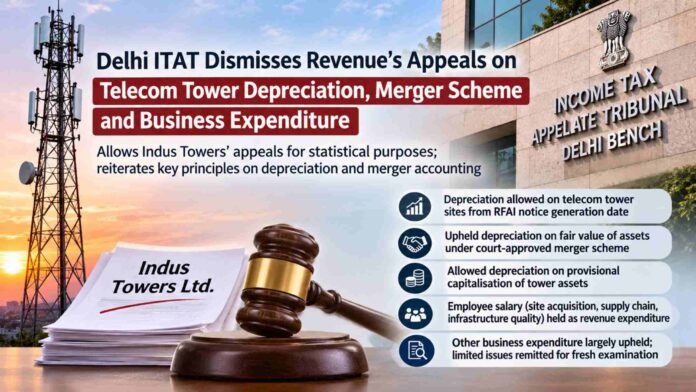
The Delhi Bench of the Income Tax Appellate Tribunal (ITAT) has held that depreciation is allowable from the RFAI notice generation date, upholds fair-value depreciation on assets received under court-approved merger schemes and rejects multiple Revenue challenges.
The bench of Vikas Awasthy (Judicial Member) and Renu Jauhri (Accountant Member) dismissed the department’s appeals and allowed the assessee’s appeals for statistical purposes in a batch of nine appeals involving several contentious tax issues relating to telecom infrastructure assets, depreciation, merger accounting and allowability of business expenditure.
Buy Now: Direct tax (Income Tax) Judgments E-Magazine October 2026
The assessee is engaged in providing passive telecommunications infrastructure services to telecom operators. Its business model involves sharing telecom infrastructure, including tower sites, among different telecom service providers to avoid duplication of infrastructure.
The dispute arose from a series of court-approved schemes of arrangement involving the transfer of Passive Infrastructure Assets (PIAs) from telecom operating companies to tower companies, followed by their merger into the assessee.
The schemes were sanctioned by the High Courts under Sections 391–394 of the Companies Act, 1956.
During assessment proceedings, the Assessing Officer made several additions and disallowances concerning depreciation on transferred infrastructure assets, valuation of assets for MAT purposes, provisional capitalisation, tower-site depreciation, employee expenditure, provisions for expenses, abandoned projects and other business-related deductions.
The CIT(A) granted substantial relief to the assessee, which was challenged by the Revenue before the Tribunal.
One of the principal issues concerned the eligibility of depreciation on Passive Infrastructure Assets transferred under the court-approved demerger and merger arrangements.
The department contended that the assets had been transferred for nil consideration and that the transaction did not qualify as a valid demerger under Section 2(19AA) of the Income Tax Act, 1961. Consequently, it disputed the assessee’s entitlement to depreciation.
The Tribunal observed that the issue was already covered in favour of the assessee by its earlier decisions in the assessee’s own case for preceding assessment years.
The Tribunal relied upon the judicial precedents concerning the binding nature of court-sanctioned schemes of arrangement and the treatment of transfers made under such schemes.
It reiterated that once a scheme has been sanctioned by a competent court, its implementation cannot be challenged by attempting to rewrite the terms of the approved arrangement at a subsequent stage.
Accordingly, the Tribunal upheld the CIT(A)’s order and directed the Assessing Officer to allow depreciation on the Passive Infrastructure Assets.
Another significant issue concerned the adjustment of book depreciation while computing book profits under Section 115JB.
The assessee had recorded Passive Infrastructure Assets at their fair value of approximately ₹16,306 crore pursuant to the court-approved scheme and claimed book depreciation on such assets.
The Assessing Officer treated the recognition of assets at fair value as revaluation and made an upward adjustment of approximately ₹899 crore while computing book profits.
The Tribunal rejected the Revenue’s contention.
Following its earlier decision, the Tribunal observed that recognition of assets at fair value pursuant to a court-approved amalgamation scheme does not automatically amount to revaluation of existing assets.
It noted that the assets had been recognised in accordance with the approved scheme and the applicable accounting treatment. Therefore, depreciation claimed on such fair-value recognition could not be disallowed merely by treating the transaction as a revaluation.
The Tribunal accordingly held that the depreciation was allowable while computing book profits under Section 115JB and rejected the Revenue’s appeal on this issue.
The Revenue also challenged depreciation of ₹39.13 crore claimed on provisional capitalisation of tower assets.
The Assessing Officer had disallowed depreciation on the ground that the provisional capitalisation was based on estimated costs rather than actual expenditure supported by invoices and bills.
The Tribunal noted that the issue had already been examined in the assessee’s own case for earlier assessment years.
It relied upon the findings of the earlier Tribunal order, which had considered the accounting methodology adopted by the assessee and the report of the special auditor.
The Tribunal observed that the Revenue had not controverted the methodology adopted for deriving provisional capitalisation.
Since the corresponding assets were already ready for use, the Tribunal held that depreciation on provisional capitalisation deserved to be allowed.
Accordingly, the Revenue’s challenge was rejected and depreciation of ₹39,13,53,403 was allowed.
A significant ruling emerged on the determination of the date on which telecom tower sites can be considered to have been put to use for claiming depreciation under Section 32.
The assessee claimed depreciation from the date of generation of the Ready for Active Installation (RFAI) notice.
However, the Assessing Officer considered the subsequent RFAI date, generally around 14 days after the notice generation date, as the relevant date for allowing depreciation.
The Tribunal held that the RFAI notice generation date should be considered the date on which the tower site becomes ready for use.
It observed that the concept of use under Section 32 is not restricted to actual physical use and also includes passive use, where an asset is kept ready for use.
The Tribunal held that depreciation on tower sites was allowable from the RFAI notice generation date and rejected the Revenue’s challenge.
The department challenged the deduction of salary expenditure incurred on employees working in the Site Acquisition Team, Supply Chain Management Team and Infrastructure Quality Team.
The Assessing Officer had treated the expenditure as capital in nature on the reasoning that these teams were engaged in setting up new telecom towers and their salaries should therefore form part of the cost of tower assets.
The Tribunal followed its earlier decisions in the assessee’s own case, which had examined the nature and responsibilities of these employees.
It noted that the employees were not exclusively engaged in setting up new tower sites and that a substantial part of their responsibilities related to activities beyond the initial establishment of tower sites.
Accordingly, the Tribunal upheld the allowability of the expenditure as revenue expenditure and rejected the Revenue’s challenge.
The appeals also involved several other issues relating to business expenditure and tax computations, including:
- Write-off of Capital Work-in-Progress relating to abandoned tower projects.
- Provisions for operating expenses, rates and taxes and salary.
- Service Level Agreement (SLA) liabilities and adjustments.
- Asset Retirement Obligation (ARO) and Site Restoration Obligation (SRO).
- Absorbed energy costs not recovered from customers.
- Upfront fees relating to borrowings.
- Interest expenditure and capitalisation under Section 36(1)(iii).
- Reversal of CENVAT credit on written-off fixed assets.
- Penalties and other payments made on behalf of landlords.
The Tribunal applied its earlier decisions in the assessee’s own case to the corresponding issues wherever the facts were identical.
However, in the appeal concerning payments made to municipal authorities, electricity boards and other authorities on behalf of landlords, the Tribunal directed further examination.
It observed that the allowability of such payments would depend upon their actual nature.
For instance, interest or late fees for delayed payment of property taxes could be allowable under Section 37(1), being compensatory in nature. However, payments arising from illegal or unauthorised construction, use or violation of laws and bye-laws would attract the restrictions under Explanation 1 and Explanation 3 to Section 37(1).
Since the lower authorities had not properly examined and bifurcated the expenditure, the Tribunal restored the matter to the Assessing Officer for verification and fresh consideration.
Membership Required to Access Case Details & Order Copy
To view the complete Case Details and Download Order Copy, you must have an active membership. Please subscribe to continue.

