
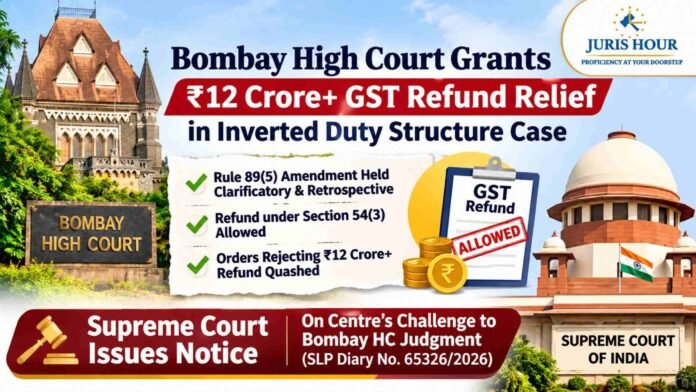
The Bombay High Court has held that the amendment to Rule 89(5) of the CGST Rules, introduced through Notification No. 14/2022, is clarificatory and curative in nature and deserves retrospective application. However, the Union Government has now challenged the judgment before the Supreme Court, which has condoned the delay and issued notice in the matter.
The bench of Justice G.S. Kulkarni and Justice Aarti Sathe, granted relief to assessee in a long-standing dispute concerning the refund of accumulated Input Tax Credit (ITC) arising from an inverted duty structure.
Buy Now: 210+ GST Judgments E-Magazine – October 2026
The dispute concerns refund claims exceeding ₹12 crore filed under Section 54(3) of the CGST Act for the period between 2018 and 2021.
The principal question was whether the amended formula under Rule 89(5) of the CGST Rules could be applied retrospectively to refund claims relating to periods before the amendment.
The petitioner/assessee is a joint venture between China Harbour Engineering Company and Tata Projects Limited, engaged in the construction of Metro Line 4 projects for the Mumbai Metropolitan Region Development Authority (MMRDA).
During the execution of the project, the petitioner was paying GST at the rate of 12% on its outward supplies, whereas its procurement of inputs and input services attracted GST at higher rates of 18% and 28%. This difference in tax rates resulted in substantial accumulation of unutilised ITC.
To recover the accumulated credit, the petitioner filed multiple refund applications under Section 54(3) of the CGST Act for the relevant period. The refund applications were, however, rejected by the adjudicating authority through Orders-in-Original dated 16 March 2023. The appellate authority subsequently upheld the rejection through its order dated 31 October 2023.
Aggrieved by the rejection, the petitioner approached the Bombay High Court by filing Writ Petition No. 2583 of 2025.
The controversy centred on Notification No. 14/2022-Central Tax dated 5 July 2022, which amended Rule 89(5) of the CGST Rules and modified the formula for calculating refunds arising from an inverted duty structure.
The petitioner argued that the amendment was clarificatory and curative in nature, as it sought to remove anomalies in the earlier refund formula. Consequently, the amended formula ought to apply retrospectively to eligible refund claims filed before 5 July 2022, subject to the statutory limitation period.
On the other hand, the Revenue relied upon CBIC Circular No. 181/13/2022-GST dated 10 November 2022 to contend that the amended formula would apply only to refund applications filed on or after 5 July 2022.
The High Court observed that the appellate authority had failed to properly consider the relevant notification, circular and binding judicial precedents while deciding the petitioner’s appeal.
The Bombay High Court placed significant reliance on the Gujarat High Court’s decision in Ascent Meditech Ltd. v. Union of India, wherein the amendment to Rule 89(5) was held to be curative in nature and applicable retrospectively.
The Court noted that the Supreme Court had dismissed the Union Government’s challenge to the decision in Ascent Meditech Ltd. on 28 March 2025. The subsequent review petition was also dismissed on 2 December 2025.
The High Court further referred to the Gujarat High Court’s decision in Tirth Agro Technology Pvt. Ltd., which had followed the same legal position and granted relief in similar circumstances. The Supreme Court had declined to interfere with that decision as well.
Accordingly, the Bombay High Court held that the legal position concerning the retrospective application of the amended formula had attained finality in the context of the precedents relied upon. It found that the appellate authority’s approach in denying the benefit of the amended formula was unsustainable.
Allowing the writ petition, the Division Bench quashed and set aside the Orders-in-Original dated 16 March 2023 and the appellate order dated 31 October 2023.
The Court held that the petitioner was entitled to a refund under Section 54(3) of the CGST Act, representing the difference in GST rates arising from the inverted duty structure. It directed that the refund claims be granted by applying the corrected formula under Rule 89(5) of the CGST Rules.
The Court accordingly made the Rule absolute and allowed the petition without any order as to costs.
In a subsequent development, the Union Government has challenged the Bombay High Court’s judgment before the Supreme Court of India by filing a Special Leave Petition (Civil) Diary No. 65326/2026.
After hearing the Additional Solicitor General, Mr. Raghvendra P. Shankar, appearing for the Union Government, the Supreme Court passed the following directions:
- Delay in filing the Special Leave Petition was condoned.
- Notice was issued, returnable in four weeks.
- Dasti service, in addition, was permitted.
The Supreme Court has therefore initiated proceedings on the Union Government’s challenge to the Bombay High Court judgment. Importantly, the order dated 27 November 2026 does not decide the merits of the retrospective applicability of the amended Rule 89(5). The challenge remains pending before the Supreme Court.
Membership Required to Access Case Details & Order Copy
To view the complete Case Details and Download Order Copy, you must have an active membership. Please subscribe to continue.

