
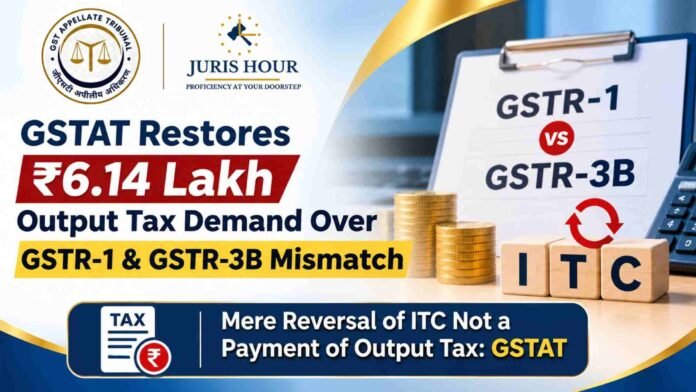
The Goods and Services Tax Appellate Tribunal (GSTAT), Lucknow Bench, has allowed the department’s appeal, holding that mere reversal of Input Tax Credit (ITC) cannot be treated as payment of output tax unless the actual adjustment is established through the prescribed statutory mechanism.
The bench of Narendra Kumar (Judicial Member) and Alok Chopra (Technical Member) has restored an output tax demand of ₹6,14,909.62 arising from a discrepancy between the tax liability declared in GSTR-1 and the tax discharged through GSTR-3B for FY 2017–18.
Buy Now: 210+ GST Judgments E-Magazine – October 2026
The appeal was filed by the department under Section 112(3) of the UPGST Act, 2017, challenging the Order-in-Appeal dated January 16, 2025, whereby the First Appellate Authority had set aside the demand relating to the alleged short payment of output tax.
During scrutiny of returns for FY 2017–18, the Department noticed a mismatch between the outward tax liability declared in GSTR-1 and the tax discharged through GSTR-3B.
The taxpayer had declared an outward tax liability of ₹55,11,540.22 in GSTR-1, whereas the tax discharged through GSTR-3B amounted to only ₹48,96,630.60, resulting in an alleged differential tax liability of ₹6,14,909.62.
The taxpayer explained that outward supplies for September 2017 had been duly reported in GSTR-1 but were inadvertently declared as nil in the corresponding GSTR-3B return. It further contended that the differential liability had subsequently been discharged through reversal of ITC in September 2019 under Table 4(B)(2) of GSTR-3B.
However, the Adjudicating Authority did not accept the explanation and, through an order dated December 29, 2023, confirmed a total demand of ₹18,32,148, comprising tax of ₹8,59,567, interest of ₹8,78,877 and penalty of ₹93,704.
The First Appellate Authority partly allowed the taxpayer’s appeal and set aside the demand concerning the GSTR-1 and GSTR-3B mismatch, accepting the contention that the subsequent ITC reversal was sufficient to discharge the differential liability. Aggrieved by this relief, the Revenue approached the GSTAT.
The Department contended that reversal of ITC and payment of output tax are two distinct statutory operations. Merely reducing the available ITC through reversal does not automatically establish that the outstanding output tax liability has been discharged.
Relying upon Section 49 of the CGST Act, 2017, read with Rules 85 and 86 of the CGST Rules, 2017, the Revenue argued that tax liability can be treated as discharged only when the amount payable is duly adjusted through the prescribed statutory mechanism, with corresponding credit in the Electronic Liability Register.
The Department also highlighted a significant discrepancy in the tax-head-wise reversal. While the differential liability included an IGST component of ₹2,280.44, the taxpayer’s claimed ITC reversal was reflected only under CGST and SGST heads.
Accordingly, the Revenue sought restoration of the demand of ₹6,14,909.62 along with applicable interest and penalty.
The Tribunal examined the returns, show cause notice in Form GST DRC-01, adjudication order in Form GST DRC-07 and the impugned appellate order.
The Tribunal observed that the taxpayer’s explanation regarding the inadvertent filing of a nil GSTR-3B return for September 2017 did not, by itself, establish that the corresponding output tax liability had subsequently been discharged.
It further noted that the taxpayer claimed ITC reversal of ₹6,16,505, comprising ₹3,72,826 under CGST and ₹2,43,679 under SGST. However, the alleged short-paid liability included CGST of ₹3,06,314.59, SGST of ₹3,06,314.59 and IGST of ₹2,280.44.
Thus, the claimed reversal did not correspond with the differential liability either in terms of the aggregate amount or the respective tax heads.
The Tribunal observed that the claim of ITC reversal required proper verification with reference to GSTR-3B returns, the Electronic Credit Ledger, Form GSTR-9C and the Electronic Liability Register.
It held that the First Appellate Authority had erred in equating credit reduction with payment of tax without examining the relevant statutory records, including the Electronic Liability Register, Credit Ledger and Form GST DRC-03.
The Tribunal also recorded that notices of hearing had been issued to the taxpayer on September 9, September 21, October 28 and November 13, 2026.
Despite repeated opportunities, neither the taxpayer nor any authorised representative appeared before the Tribunal, sought adjournment or filed written submissions.
Consequently, the Tribunal proceeded to hear the Departmental Representative and decided the matter on the basis of the pleadings and material available on record.
Membership Required to Access Case Details & Order Copy
To view the complete Case Details and Download Order Copy, you must have an active membership. Please subscribe to continue.

