
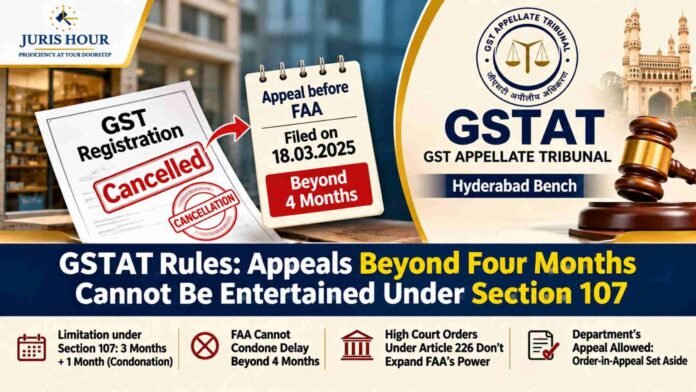
The Goods and Service Tax Appellate Tribunal (GSTAT) Hyderabad, has held that the First Appellate Authority has no jurisdiction to condone delay beyond the statutory period of three months plus one additional month under Section 107 of the CGST Act, 2017.
The bench of sets aside the order allowing restoration of cancelled GST registration, observing that High Court orders passed under Article 226 cannot confer additional condonation powers upon statutory appellate authorities and categorically held that the First Appellate Authority (FAA) cannot entertain an appeal filed beyond the aggregate period of four months, comprising the prescribed three-month period and the additional one-month period available for condonation of delay.
Buy Now: 210+ GST Judgments E-Magazine – October 2026
The bench allowed the Department’s appeal and set aside the order passed by the First Appellate Authority, which had permitted consideration of a delayed appeal against cancellation of GST registration by relying upon certain orders of the Telangana High Court.
The Tribunal clarified that while the High Court can exercise its extraordinary constitutional jurisdiction under Article 226 of the Constitution to grant relief in appropriate cases, such discretionary powers cannot be borrowed or exercised by statutory appellate authorities.
The appellant/assessee was registered under the GST law on September 15, 2022, with GSTIN. The taxpayer had obtained registration with the intention of commencing business in electrical works contract services.
However, the taxpayer failed to furnish its GSTR-3B returns for a continuous period exceeding six months.
Consequently, the Department issued a Show Cause Notice dated February 6, 2024, proposing cancellation of the GST registration on account of continuous non-filing of returns.
Thereafter, the Superintendent of Central Tax, Kukatpally Range, passed Order cancelling the GST registration with effect from February 5, 2024, under Section 29(2)(c) of the CGST Act, 2017, read with Rules 21 and 22(3) of the CGST Rules, 2017.
Importantly, the taxpayer did not file an application for revocation of cancellation under Section 30 of the CGST Act read with Rule 23 of the CGST Rules, either within the prescribed period of 90 days or within the further extended period permissible under the proviso to Rule 23(1).
Instead, the taxpayer approached the First Appellate Authority by filing an appeal on March 18, 2025, challenging the cancellation order dated May 17, 2024.
Before the First Appellate Authority, the taxpayer explained that the delay in filing the appeal occurred due to circumstances affecting the management and functioning of the business.
It was submitted that the managing partner was facing health-related issues, because of which the business activities and compliance obligations could not be attended to properly.
The taxpayer further contended that it had subsequently filed the pending GSTR-3B returns up to February 2024. There was a lack of proper support from the previous tax consultant. Initially, the taxpayer had considered discontinuing the business. These circumstances contributed to the delay in approaching the appellate authority.
The taxpayer sought condonation of delay and relied upon the Telangana High Court’s decision in M/s. Southern Enterprises v. Appellate Joint Commissioner ST, W.P. No. 2471 of 2023.
It also relied upon the decision in M/s. Chenna Krishnama Charyulu Karampudi v. Additional Commissioner (Appeals-I), reported in (2023) 5 Centax 49 (Telangana).
The Joint Commissioner of Central Tax (Appeals-II), Hyderabad, considered the taxpayer’s appeal and acknowledged that the appeal had been filed beyond the statutory period prescribed under Section 107 of the CGST Act.
The First Appellate Authority specifically recorded that the appeal was time-barred, having been filed much beyond the four-month period contemplated under Section 107(4).
However, relying upon the Telangana High Court decisions in Southern Enterprises and Chenna Krishnama Charyulu Karampudi, the FAA proceeded to examine the matter.
The FAA held that the taxpayer’s request for revocation of cancellation of registration with retrospective effect deserved consideration, subject to verification by the proper officer regarding payment of all outstanding dues.
Accordingly, the taxpayer’s appeal was allowed through Order-in-Appeal No. HYD-GST-MD-AP2-45-2025-26 dated May 28, 2025.
Aggrieved by the decision of the First Appellate Authority, the Department examined the order under Section 112(3) of the CGST Act.
The Principal Commissioner of Central Tax, Medchal CGST Commissionerate, through Review Order No. 76/2025-26-GST (OIA) dated March 30, 2026, directed the Assistant Commissioner of Central Tax, Kukatpally Division, to file an appeal before the GST Appellate Tribunal.
Accordingly, the Department filed an appeal before GSTAT Hyderabad on May 28, 2026, under Section 112(3) read with Section 112(4) of the CGST Act.
The Department primarily challenged the jurisdiction of the First Appellate Authority to entertain an appeal filed beyond the maximum condonable period prescribed under Section 107.
The Department argued that the First Appellate Authority, being a statutory authority, could exercise only those powers expressly conferred by the CGST Act and could not extend the limitation period beyond the statutory outer limit.
The GSTAT Hyderabad Bench, comprising Hon’ble A.P. Ravi, Member (Judicial), and Hon’ble Duvvuri Krishna Srinivas, Member (Technical), framed the following questions for determination:
1. Whether the First Appellate Authority had the power to entertain and allow an appeal filed on March 18, 2025, against the cancellation order dated May 17, 2024, beyond the period of three months under Section 107(1) and the further period of one month under Section 107(4) of the CGST Act.
2. Whether the Telangana High Court’s orders in Southern Enterprises and Chenna Krishnama Charyulu Karampudi, passed in writ jurisdiction, conferred any such power upon the First Appellate Authority.
3. Whether the GST Appellate Tribunal itself could condone the delay which the First Appellate Authority had no power to condone and thereby sustain the impugned order.
4. Whether the Department’s appeal was maintainable in view of the Tribunal’s earlier decision in the batch of appeals in APL/2/HYD/2026 and connected matters.
The Tribunal examined the provisions of Section 107(1) and Section 107(4) of the CGST Act.
Section 107(1) provides that any person aggrieved by a decision or order passed by an adjudicating authority may file an appeal before the Appellate Authority within three months from the date on which the decision or order is communicated.
Section 107(4) empowers the Appellate Authority to allow an appeal to be presented within a further period of one month if it is satisfied that the appellant was prevented by sufficient cause from presenting the appeal within the prescribed period.
The Tribunal explained that these provisions establish a clear statutory framework that the ordinary limitation period for filing an appeal is three months. The First Appellate Authority may condone delay for a further period of one month upon being satisfied about the existence of sufficient cause. The total permissible period is therefore four months. Beyond the aggregate period of four months, the statute does not confer any power upon the First Appellate Authority to entertain the appeal.
The Tribunal observed that the cancellation order was dated May 17, 2024.
The ordinary three-month limitation period expired in August 2024, while the additional one-month condonable period expired in September 2024.
However, the taxpayer filed the appeal only on March 18, 2025, approximately ten months after the cancellation order and around six months beyond the statutory outer limit.
The Tribunal further noted that the taxpayer had not pleaded before the First Appellate Authority that the cancellation order had been communicated on any later date. The FAA itself had computed the limitation period from May 17, 2024.
Consequently, the Tribunal held that the First Appellate Authority had no jurisdiction to entertain the appeal.
The Tribunal placed significant reliance upon the Supreme Court’s decisions in the following cases:
A. Singh Enterprises v. Commissioner of Central Excise, Jamshedpur
Reported in (2008) 3 SCC 70; 2008 (221) E.L.T. 163 (S.C.).
The Tribunal relied upon this judgment, wherein the Supreme Court interpreted the limitation provisions under Section 35 of the Central Excise Act, 1944.
The Supreme Court held that where the statute prescribes a specific period for filing an appeal and permits condonation only for an additional specified period, the appellate authority cannot condone delay beyond that period.
The Tribunal observed that the relevant provision under the Central Excise Act is pari materia with Section 107(4) of the CGST Act.
Accordingly, the principle laid down in Singh Enterprises was considered directly applicable.
B. Commissioner of Customs and Central Excise v. Hongo India (P) Ltd.
Reported in (2009) 5 SCC 791.
The Tribunal referred to the Supreme Court’s observation that where the statute provides a specific limitation regime without permitting condonation beyond the prescribed period, the general provisions of Section 5 of the Limitation Act, 1963, stand excluded.
The Tribunal emphasised that statutory limitation provisions must be respected and cannot be extended merely by adopting a liberal interpretation.
C. Assistant Commissioner (CT), LTU, Kakinada v. Glaxo Smith Kline Consumer Health Care Ltd.
Reported in (2020) 19 SCC 681.
The Tribunal referred to this decision while examining whether it could independently condone the delay in filing the first appeal.
The Supreme Court had reiterated the principle that where a statute prescribes an outer limitation period, such limitation cannot be extended by invoking powers beyond those permitted by law.
3. Reliance on Telangana High Court Orders Under Article 226 Cannot Expand FAA’s Statutory Powers
One of the significant aspects of the ruling concerns the distinction between the constitutional powers of a High Court and the statutory powers of an appellate authority.
The First Appellate Authority had relied upon the decisions of the Telangana High Court in:
- M/s. Southern Enterprises v. Appellate Joint Commissioner ST, W.P. No. 2471 of 2023.
- M/s. Chenna Krishnama Charyulu Karampudi v. Additional Commissioner (Appeals-I), (2023) 5 Centax 49 (Telangana).
The Department argued that these judgments did not lay down any general proposition of law empowering the First Appellate Authority to condone delay beyond the statutory period.
The GSTAT examined the observations made by the Telangana High Court in Chenna Krishnama Charyulu Karampudi.
The High Court had observed that although the lower appellate authority might be correct in holding that delay beyond the additional one-month period could not be condoned, the taxpayer could be adversely affected, particularly because the GST Appellate Tribunal had not then been constituted.
The GSTAT clarified that the High Court had granted relief by exercising its extraordinary jurisdiction under Article 226 of the Constitution, considering the peculiar facts and circumstances of that particular case.
The High Court had not declared that Section 107(4) conferred upon the First Appellate Authority any additional power to condone delay beyond one month.
The Tribunal explained that two distinct situations must be recognised:
First: Where a High Court interprets a statutory provision and declares the law, such declaration is binding upon the authorities and tribunals within its territorial jurisdiction.
Second: Where a High Court condones delay or moulds relief by exercising its discretionary constitutional jurisdiction under Article 226, such relief is an exercise of power vested in the High Court.
The Tribunal observed that such constitutional powers cannot be transferred to or exercised by a statutory authority.
It further held that the First Appellate Authority could not borrow the constitutional powers exercised by the High Court in proceedings involving other taxpayers, particularly when no specific direction had been issued by the High Court in the present taxpayer’s case.
Accordingly, the Tribunal held that the decisions relied upon by the FAA did not confer any additional jurisdiction upon it to entertain the delayed appeal.
4. Tribunal Cannot Exercise Powers That Were Not Available to the First Appellate Authority
The Tribunal also examined whether it could itself condone the delay and sustain the order passed by the First Appellate Authority.
It rejected such a possibility.
According to the Tribunal, the central question before it was whether the First Appellate Authority had jurisdiction to entertain the taxpayer’s original appeal.
While examining this issue, the Tribunal explained that it could not exercise greater powers than those available to the First Appellate Authority under the statute.
The Tribunal observed that if it were to uphold the impugned order by condoning a delay that the statute makes uncondonable, it would effectively be doing indirectly what the First Appellate Authority could not do directly.
The Tribunal also referred to the Supreme Court’s decision in Assistant Commissioner (CT), LTU, Kakinada v. Glaxo Smith Kline Consumer Health Care Ltd., wherein the Supreme Court had approved the principle that statutory limitation cannot be extended by invoking even extraordinary powers beyond the permissible statutory framework.
The GSTAT held that when the delay beyond the statutory outer limit cannot be condoned even by invoking the plenary powers of the Supreme Court under Article 142, a statutory Tribunal cannot assume such power.
The Tribunal further observed that an order passed by an authority on an appeal which it had no jurisdiction to entertain is coram non judice, meaning an order passed by an authority lacking jurisdiction.
Such a jurisdictional defect goes to the root of the matter and cannot be cured in further appellate proceedings.
5. Department’s Appeal Held Maintainable Despite Earlier GSTAT Decision
The Tribunal also considered whether the Department’s appeal was maintainable in light of its earlier Common Order Nos. 04 to 19/COURT-II/HYD/2026 dated September 18, 2026, passed in the batch of appeals in APL/2/HYD/2026 and connected matters.
In those earlier cases, the Tribunal had held that although the First Appellate Authority had exceeded the statutory limitation period, the Department’s appeals were not maintainable because the Department had already implemented the appellate orders.
The Tribunal noted that the Department had restored the GST registrations of those taxpayers, who had subsequently resumed their businesses.
The registrations had been acted upon, and genuine transactions had taken place during the intervening period. Consequently, setting aside those orders could have affected the input tax credit availed by recipients of such transactions.
However, the Tribunal found that the factual position in the present case was entirely different.
It noted that:
- Dhakshitha Electricals had not approached the proper officer pursuant to the order passed by the First Appellate Authority.
- The cancellation of GST registration had not been revoked.
- The Department had not implemented the impugned order.
- No business had been carried on under a restored registration.
- No input tax credit availed by recipients was affected.
Therefore, the Tribunal held that the Department was not precluded from challenging the impugned order.
The earlier decision was distinguished on the basis of the subsequent conduct of the Department and the absence of implementation of the appellate order in the present case.
6. Tribunal Leaves the Question of Rule 23 Compliance Open
The Department had also raised a ground concerning the taxpayer’s failure to file an application for revocation of cancellation under Rule 23 of the CGST Rules, 2017, within the prescribed period.
However, after holding that the First Appellate Authority had no jurisdiction to entertain the delayed appeal, the Tribunal refrained from examining this additional ground.
It expressly left the question open and clarified that it was not expressing any opinion on the merits of the original cancellation order.
This distinction is important because the Tribunal’s decision rests on the issue of limitation and jurisdiction rather than an independent determination of the substantive grounds for cancellation of registration.
Final Decision of GSTAT Hyderabad
After considering the submissions, statutory provisions and judicial precedents, the GSTAT Hyderabad Bench concluded that:
1. The First Appellate Authority had no power to entertain the appeal filed by Dhakshitha Electricals on March 18, 2025, against the cancellation order dated May 17, 2024, as the appeal was filed beyond the aggregate four-month period prescribed under Sections 107(1) and 107(4) of the CGST Act.
2. The Telangana High Court’s orders relied upon by the First Appellate Authority, having been passed in the exercise of jurisdiction under Article 226 of the Constitution, did not confer any additional power upon the statutory appellate authority to condone the delay.
3. The GST Appellate Tribunal could not condone a delay which the First Appellate Authority itself had no statutory power to condone.
4. Since the cancellation of registration had not been revoked and the impugned order had not been acted upon, the Department’s appeal was maintainable.
Accordingly, the Tribunal allowed the Department’s appeal and set aside the Order-in-Appeal passed by the First Appellate Authority.
Membership Required to Access Case Details & Order Copy
To view the complete Case Details and Download Order Copy, you must have an active membership. Please subscribe to continue.
Read More: Second SCN For GST Registration Cancellation Barred by Res Judicata: GSTAT

