
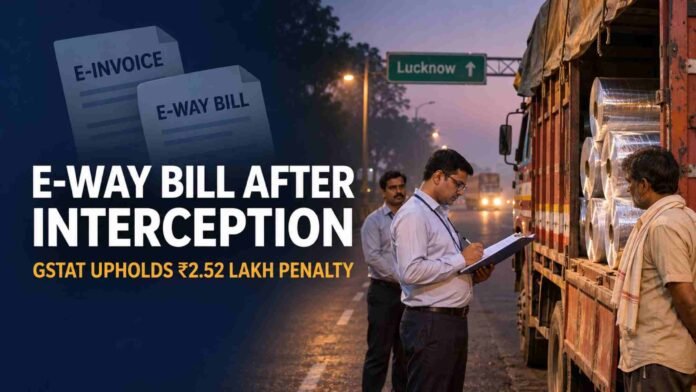
The Goods and Services Tax Appellate Tribunal (GSTAT), Lucknow, has upheld a ₹2,52,216 penalty under Section 129(3) of the Uttar Pradesh Goods and Services Tax Act, 2017, after a trader generated the mandatory e-invoice and e-way bill several hours after its vehicle was intercepted.
The bench of Santosh Kumar Srivastava (Judicial Member) and Arvind Kumar (Technical Member) found two independent breaches. The trader had failed to obtain an Invoice Reference Number (IRN) for a supply covered by mandatory e-invoicing and had dispatched the consignment without the e-way bill required for the journey.
Buy Now: All 200+ GSTAT Judgements Till November 2026 | Comprehensive E-Magazine
The bench found that the trader dispatched goods with only a manual invoice and produced no contemporaneous evidence to support its claim of a GST portal glitch and held that generating the documents later could not retrospectively validate the movement of goods in the circumstances of the case.
A State Tax Mobile Squad intercepted the vehicle near Sarojini Nagar on Kanpur Road, Lucknow, at about 4:03 a.m. on September 10, 2024. The truck was carrying 2,520 kg of paper aluminium foil lamination rolls, valued at ₹8,26,660 inclusive of tax, from Kanpur Dehat to Lucknow. The driver produced a manually prepared tax invoice.
The e-invoice acknowledgement was generated at 6:15 p.m., more than 14 hours after interception. The e-way bill followed at 10:42 p.m., nearly 19 hours after the truck was stopped. The supplier furnished both documents during the detention proceedings.
The proper officer imposed the penalty on September 11, 2024, after the supplier claimed ownership of the goods. The amount comprised ₹1,26,108 each under the central and state GST heads. The first appellate authority upheld the penalty on March 29, 2025.
The bench found that the supplier was covered by Rule 48(4), read with Notification No. 10/2023–Central Tax, which extended mandatory e-invoicing to the notified class of taxpayers with aggregate turnover exceeding ₹5 crore from August 1, 2023. Rule 48(4) required the supplier to upload the prescribed invoice particulars and obtain an IRN. Under Rule 48(5), an invoice issued outside that process by a taxpayer covered by the mandate is treated as invalid for those purposes.
The consignment also exceeded the ₹50,000 threshold for the e-way bill requirement under Rule 138. The tribunal held that the later IRN and e-way bill established when the documents were generated and left the two failures at dispatch uncured. It also referred to Rule 138A, which governs the documents and particulars to be carried during transport.
The trader attributed the omission to inadvertent human error and cited technical difficulties in generating the e-way bill. It argued that both parties were GST-registered, the rolls were specially branded for the buyer and the description, quantity, weight and value matched the manual invoice. In its view, these facts showed a genuine transaction and an absence of intent to evade tax.
The tribunal found no contemporaneous portal error report, failure acknowledgement, grievance reference, screenshot or other reliable material showing an unsuccessful attempt to generate the e-way bill before dispatch. It said that matching goods and invoice particulars could establish the identity of the consignment while the electronic documentation requirements still applied.
The bench distinguished Falguni Steels, where the Allahabad High Court considered technical difficulties, local traffic restrictions during the Kumbh Mela and the generation of one e-way bill before detention. It also distinguished Shyam Sel and Power, where the purchasing dealer had cancelled an e-way bill that had already been generated. Here, both prescribed documents were generated only after interception, and the trader’s technical explanation lacked supporting evidence.
The tribunal relied on Jhansi Enterprises and Akhilesh Traders for the principle that missing transport documents may give rise to a rebuttable presumption of intent to evade tax. It found that the circumstances of this interception indicated such intent and that the trader had failed to provide credible material explaining the missing documents. The bench also treated the Supreme Court’s dismissal of the special leave petition in Satyam Shivam Papers in light of that case’s particular facts.
The tribunal rejected the argument under Section 75(6) that the penalty order lacked reasons. It found that the officer had examined the manual invoice, the interception and document-generation times, and the trader’s explanation. The bench dismissed the appeal and sustained both the original penalty order and the first appellate order.
Membership Required to Access Case Details & Order Copy
To view the complete Case Details and Download Order Copy, you must have an active membership. Please subscribe to continue.
Read More: One E-Way Bill for 2 Invoices of Same Consignment Doesn’t Justify GST Penalty: GSTAT

