
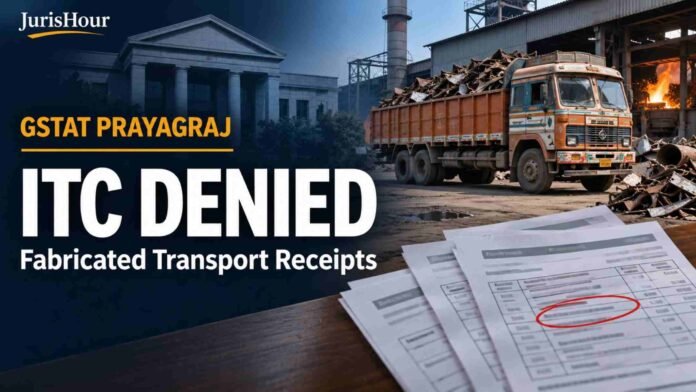
The Goods and Services Tax Appellate Tribunal (GSTAT), Prayagraj, has upheld a demand of ₹4,16,849.40 against an iron-goods manufacturer after finding that the transport receipts it produced to support two input tax credit (ITC) claims had been fabricated. The bench held that the invoices, e-way bills, accounting records and GST returns on file did not establish actual receipt of the goods in the circumstances of the case.
The bench of Mahtab Ahmad (Judicial Member) and Ashish Varma (Technical Member) upheld the invocation of Section 74 of the CGST and SGST Acts, finding that the show-cause notice and the adjudication order alleged collusion, use of invoices without actual supply and an intention to evade tax.
Buy Now: All 200+ GSTAT Judgements Till November 2026 | Comprehensive E-Magazine
The dispute concerned two purchases that the assessee said it made from Ganesh Enterprises, Kanpur, on 2 and 6 June 2018. The invoices had a combined taxable value of ₹7,82,375 and carried ₹1,40,827.50 in CGST and SGST. The invoices appeared in the assessee’s GSTR-2A, and it availed and utilised the credit through its GSTR-3B.
The department examined the transactions after a 2022 inspection found the supplier absent from its registered business premises. The proper officer issued a notice in Form GST DRC-01 on 16 June 2022 and confirmed the demand on 2 June 2023. The first appellate authority upheld that order on 30 January 2024.
The assessee argued that the supplier held an active GST registration when the purchases took place and had surrendered it in November 2020, well before the inspection. It cited tax invoices, e-way bills, its books of account and payments through banking channels. The Tribunal recorded that the supplier had disclosed the sales in its returns and discharged its tax liability.
Section 16(2)(b) requires receipt of the goods or services for which ITC is claimed. The assessee produced two goods receipts, also known as bilties, and two weighbridge slips for the first time before the Tribunal, without seeking permission to introduce them as additional evidence. The bench examined the documents and found signs of alteration in the transport receipts.
One receipt was the consignee’s copy and the other was the consignor’s copy, although the assessee was the consignee in both transactions. The bench found that the last digit on one receipt appeared to have been changed from zero to eight. On the other receipt, the description, weight and rate appeared to have been written over erased entries, and the truck number was missing. Both receipts left the owner and driver fields blank.
The bench found the receipts fabricated and concluded that the goods had not been delivered to the assessee. It said the weighbridge slips could at most show that goods had been weighed at the destination. With the transport receipts discredited, the slips did not establish that the goods covered by the disputed invoices had travelled from Kanpur to the assessee in Fatehpur.
The Tribunal distinguished the Allahabad High Court rulings in Khurja Scrap Trading Company, Singhal Iron Tradersand Saniya Traders. It considered the supplier’s later cancellation and the timing of the inspection, and based its conclusion on the evidence concerning delivery, including the fabricated transport receipts.
The bench acknowledged that neither the DRC-01 notice nor the adjudication order expressly used the statutory phrase “fraud, wilful misstatement or suppression of facts to evade tax”. Both documents, however, alleged that the assesee had colluded with the supplier and used invoices for goods it had not received to claim credit and evade tax. The Tribunal held that these allegations satisfied the substantive requirements of Section 74.
The bench also relied on Section 160(1), which protects a notice or adjudication from invalidity arising solely from a mistake, defect or omission where the proceeding conforms in substance and effect to the Act. It confirmed the original and appellate orders, leaving in place ₹1,40,827.50 in tax, ₹1,35,194.40 in interest and ₹1,40,827.50 in penalty. The bench made no order as to costs.
Membership Required to Access Case Details & Order Copy
To view the complete Case Details and Download Order Copy, you must have an active membership. Please subscribe to continue.
Read More: Rs. 82 Lakh Export Refund Must Await Decision on Disputed ITC: GSTAT

