
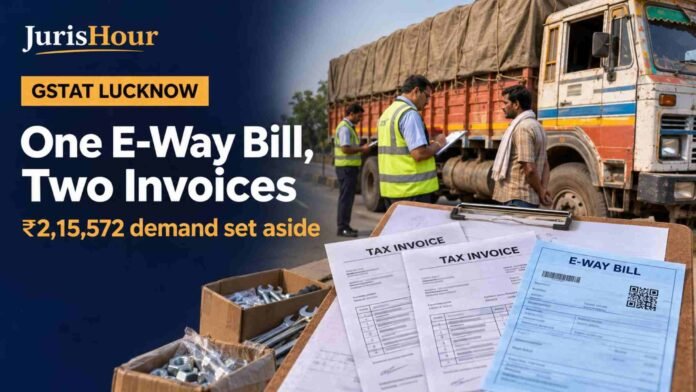
The Goods and Services Tax Appellate Tribunal (GSTAT), Lucknow bench, has dismissed the Uttar Pradesh State Tax Department’s appeal against the cancellation of a ₹2,15,572 demand on a hardware consignment transported under two tax invoices and a single e-way bill. The tribunal held that using one e-way bill for the two invoices was a procedural lapse in the circumstances of the case.
The bench of Santosh Kumar Srivastava (Judicial Member) and Arvind Kumar (Technical Member) found that both invoices, a valid e-way bill and the transport receipt accompanied the goods. The mobile squad identified no discrepancy in the description, weight or quantity of the goods, and the department produced no evidence of concealment or an attempt to evade tax.
Buy Now: All 200+ GSTAT Judgements Till November 2026 | Comprehensive E-Magazine
The bench upheld the cancellation of ₹2,15,572 in tax and penalty under Section 129 after finding that the hardware shipment matched its documents and the supplier had reported the sale and paid IGST.
A mobile squad intercepted a vehicle at Barajor carrying hardware from New Delhi to Bodh Gaya, Bihar. Sona Enterprises had issued invoices 598 and 599, both dated February 7, 2020, for goods supplied to the same buyer. The goods travelled together in one vehicle under a single transport receipt and one e-way bill.
The officer took the view that Rule 138 required a separate e-way bill for each invoice. The squad detained the goods and vehicle through Form GST MOV-06 and issued a notice in Form GST MOV-07. The officer valued the goods at ₹5,98,811 and proposed ₹1,07,786 in IGST and an equal penalty. The owner deposited the amount, and the proper officer confirmed the demand on February 10, 2020, under Section 129(3) of the Uttar Pradesh GST Act, 2017.
On May 5, 2020, the first appellate authority set aside the demand. It accepted the supplier’s explanation that the second invoice continued the first because the list of items exceeded the space available on the manual invoice. It also found that the supplier had accounted for the transaction and charged IGST. The department then appealed to the tribunal.
The department argued that Section 129 provides an independent mechanism to detain goods transported in breach of GST law and that the first appellate authority had wrongly required proof of intent to evade tax. It maintained that limited space in a manual invoice book could not override Rule 138 and that using one e-way bill for two invoices did not qualify as a minor discrepancy under the CBIC circular.
The tribunal examined whether the lapse justified detention and the resulting demand on the facts of the shipment. It recorded that the consignor, consignee, destination and vehicle details were undisputed. Both invoices related to the same buyer and consignment, and the goods matched the documents. The supplier had also reported the transaction in GSTR-1 and GSTR-3B and paid the applicable IGST.
The bench relied on the Allahabad High Court’s decisions in Hindustan Herbal Cosmetics and Falguni Steels in assessing whether a procedural discrepancy, without supporting evidence of tax evasion, could sustain the penalty. It also referred to the Supreme Court’s ruling in Hindustan Steel Ltd. v. State of Orissa on the exercise of discretion in imposing penalties.
The tribunal extended the benefit of CBIC Circular No. 64/38/2018-GST to the taxpayer. The circular, issued on September 14, 2018, addresses specified minor discrepancies in documents accompanying goods in transit. The bench found that the sole basis for the demand was the use of one e-way bill for two invoices covering the same consignment. The department produced no evidence to rebut the first appellate authority’s findings on disclosure of the transaction or payment of tax.
The GSTAT dismissed the department’s appeal and upheld the May 5, 2020 appellate order. The original order confirming the tax and penalty remained set aside.
Membership Required to Access Case Details & Order Copy
To view the complete Case Details and Download Order Copy, you must have an active membership. Please subscribe to continue.
Read More: Unexplained Vehicle Number Mismatch in E-Way Bill: GSTAT Upholds Rs. 5 Lakh GST Penalty

