
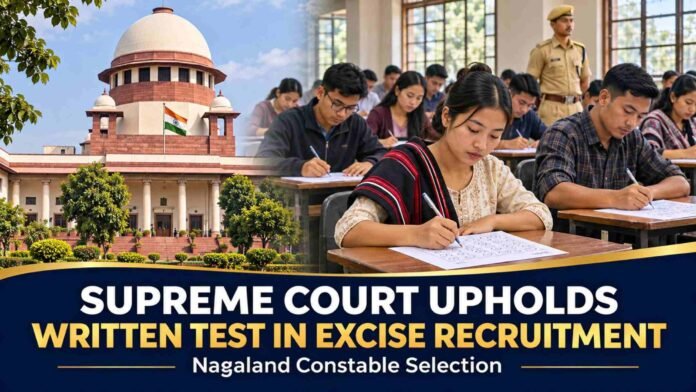
The Supreme Court has upheld the introduction of a written examination after the original advertisement for recruitment of Excise Constables in Nagaland, finding that the examination complied with the governing service rules, applied equally to eligible candidates and caused no demonstrated discrimination or prejudice.
The Bench of Justice Prashant Kumar Mishra and Justice Shree Chandrashekhar dismissed the candidates’ appeal against the Gauhati High Court’s decision sustaining the recruitment process for 46 posts in the Department of Excise and Prohibition.
The Court observed that an objective written examination based on the prescribed Class VIII standard provided a common basis for assessing candidates and reduced disproportionate reliance on the comparatively subjective assessment involved in a viva voce.
Buy Now: 90+ Supreme Court Judgments E-Magazine – October 2026
Original Advertisement Contemplated Physical Test And Viva Voce
The recruitment was governed by the Nagaland Excise Service (Revised) Rules, 1999, framed under the proviso to Article 309 of the Constitution.
An advertisement dated April 7, 2025 invited applications from indigenous inhabitants of Nagaland for 40 Excise Constable posts. The prescribed educational qualification was Class VIII. An addendum dated May 14, 2025 added six vacancies, increasing the total to 46.
According to the appellants, Clause 4 of the advertisement contemplated two selection stages: a physical test and a suitability test/viva voce.
However, on June 4, 2025, the Departmental Recruitment Board issued a corrigendum introducing a written examination and asking candidates to prepare accordingly. The physical test was subsequently conducted between July 14 and July 24, 2025.
A notification dated July 25, 2025 announced the candidates eligible for the written examination and specified its format. The examination would carry 100 marks, contain multiple-choice questions based on the Class VIII standard and have no negative marking. It was scheduled for August 9, 2025.
Candidates Challenged Change After Recruitment Began
The appellants argued that the selection criteria could not be altered after recruitment had commenced. They relied on the 1999 Rules and a memorandum dated July 19, 2016 issued by the Commissioner of Excise and Prohibition.
Their principal contention was that introducing a written examination departed from the procedure specified in the original advertisement.
They also questioned the written examination’s weightage of 100 marks compared with the viva voce’s 12 marks, the latter having been disclosed in response to an RTI query.
The State defended the examination by pointing to the scale of recruitment. It had received 11,521 applications for 46 vacancies. Of these, 5,985 candidates appeared in the physical test and 2,297 cleared it.
The State submitted that an objective written screening examination was necessary to narrow the field and ensure fair assessment at the subsequent stage. It also relied on the appellants’ participation despite their knowledge of the revised procedure, stating that ten of the sixteen appellants had participated in the written examination.
Single Judge Quashed Corrigendum; Division Bench Reversed Decision
A Single Judge of the Gauhati High Court allowed the candidates’ writ petition on October 16, 2025.
The Single Judge reasoned that, although the Government could prescribe an appropriate selection method where the rules were silent, that method had to be specified in the original advertisement and could not be introduced midway through recruitment.
While accepting the validity of the Recruitment Board’s constitution, the Single Judge held that it lacked authority to independently change the selection procedure.
The corrigendum and physical test were consequently quashed. The State was directed to proceed under the original advertisement and the 2016 memorandum, or issue a fresh advertisement if it wished to introduce a written examination.
The State appealed. During the appeal, the Division Bench permitted recruitment to continue subject to the outcome of proceedings, with results not to be declared without the Court’s leave.
On June 23, 2026, the Division Bench set aside the Single Judge’s decision. The candidates then approached the Supreme Court.
Written Examination Fell Within Method Permitted By Rules
The Supreme Court found no reason to interfere with the Division Bench’s judgment.
It noted that Rule 5(i)(a) of the 1999 Rules provides for direct recruitment through “competitive examination/selection”, while Rule 7(1) provides for a Selection Board for direct recruitment to the relevant posts.
Schedule II prescribes direct recruitment for the Group C, non-gazetted post of Excise Constable. Schedule III prescribes Class VIII as the educational qualification.
The Court held that a written examination based on the Class VIII syllabus fell within the competitive examination or selection contemplated by Rule 5(i)(a). Consequently, the recruitment process did not contravene the statutory rules.
The Bench further held that Rule 5(ii), which requires consultation with the Commission when the Government adopts a different method of recruitment, was not attracted. The written examination remained within the recruitment method already permitted by the rules.
Advertisement Empowered Board To Issue Corrections
The Court also considered the powers conferred on the Departmental Recruitment Board by the advertisement itself.
Clause 15 authorised the Board to rectify omissions or commissions through notifications and addenda. Clause 16 vested it with authority to take a final and binding decision in disputes concerning the recruitment process.
The Bench noted that even the Single Judge had accepted that the Board was validly constituted under Rule 7 of the 1999 Rules and had rejected the allegation that its constitution was irregular or prejudicial to the appellants.
These provisions formed part of the circumstances supporting the Court’s decision to uphold the revised procedure.
2016 Memorandum Did Not Bar Written Test
The Supreme Court rejected the appellants’ contention that the 2016 memorandum governed the detailed selection procedure because the statutory rules did not prescribe one.
It accepted the Division Bench’s assessment that the memorandum had neither been confirmed by the Selection Board nor notified by the State Government. It had also not been strictly enforced in previous recruitment exercises.
At its highest, the Court observed, the memorandum prescribed certain minimum physical and medical standards for athletic activities. It did not provide a basis for invalidating the written examination in the circumstances of this recruitment.
Objective Test Reduced Reliance On Subjective Interview Assessment
The Bench rejected the argument that the selection process became arbitrary merely because the written examination was introduced after the original advertisement or because it carried greater weightage than the viva voce.
The Court explained that a written examination based on the already prescribed educational standard allowed candidates to be assessed on a common basis. It also avoided placing disproportionate reliance on the comparatively subjective assessment inherent in an interview.
The decision to introduce the examination had been taken against the backdrop of an exceptionally large number of applicants for 46 posts.
The Court further noted that the corrigendum was widely publicised, including in the local newspapers Nagaland Postand Eastern Mirror.
No Discrimination Or Prejudice Established
The Supreme Court emphasised that all candidates who qualified in the physical test were subjected to the same written examination requirement and afforded an equal opportunity to participate.
The appellants had failed to demonstrate how the procedure operated discriminatorily or caused prejudice to them. Their participation with knowledge of the revised procedure also weighed against their challenge.
The Court’s reasoning therefore rested on the statutory framework, the Board’s authority, publicity of the revised procedure and its uniform application to eligible candidates.
Supreme Court Dismisses Appeal
The State informed the Court that the list of 46 selected candidates had been notified on June 29, 2026. It also objected that the successful candidates had not been impleaded in the appeal.
The appellants responded that publication of the select list did not render their challenge infructuous because appointments had yet to be made. They also pointed out that three acceptance letters were received after the Supreme Court’s July 7, 2026 stay order.
Ultimately, the Supreme Court dismissed the appeal on its assessment of the recruitment rules and procedure, upholding the Division Bench’s June 23, 2026 judgment.
The Bench recognised the discretion available to a competent recruiting authority to devise selection or shortlisting procedures where the applicable rules do not prescribe a detailed method.
Membership Required to Access Case Details & Order Copy
To view the complete Case Details and Download Order Copy, you must have an active membership. Please subscribe to continue.
Read More: Supreme Court Clubs J&K, Haryana Cases With Lal Qila Blast Case, Orders Transfer To Delhi

