
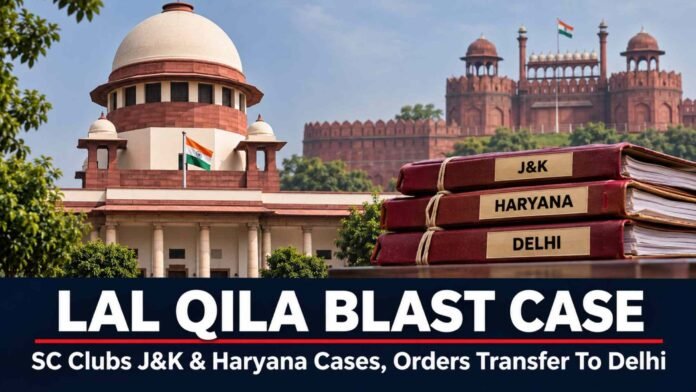
The Supreme Court has directed that two criminal cases registered in Jammu & Kashmir and Haryana be transferred to the Special NIA Court at Patiala House Courts, New Delhi, and clubbed with the Lal Qila blast case. The Court held that the alleged larger conspiracy, common accused persons, overlapping evidence and security concerns justified bringing the proceedings before a single court.
A Bench of Justice Prashant Kumar Mishra and Justice Shree Chandrashekhar observed that separate trials in different States could lead to duplication of evidence, multiplicity of proceedings and conflicting findings. It also considered the security implications of repeatedly moving accused persons between States when several accused remained absconding.
Buy Now: 90+ Supreme Court Judgments E-Magazine – October 2026
Two Cases To Be Transferred To Delhi
The Union sought transfer of the two proceedings and their clubbing with NIA Case No. RC-21/2025/NIA/DLI, titled National Investigation Agency v. Umer Un Nabi and others, referred to in the judgment as the “Lal Qila Blast Case”.
The Jammu & Kashmir proceeding originated in FIR No. 162/2025, registered on October 19, 2025, at Nowgam Police Station, Srinagar, under Section 13 of the Unlawful Activities (Prevention) Act, 1967, and Section 351(2) of the Bharatiya Nyaya Sanhita, 2023.
The judgment records its subsequent re-registration by SIA/CI Kashmir as FIR No. 03/2025, with Case No. 05/2026/SIA/Srinagar. Titled UT of J&K v. Arif Nisar & Ors., the matter was pending before the Additional Sessions Judge, TADA/POTA, Srinagar.
The Haryana proceeding arose from FIR No. 229/2025, registered on November 19, 2025, at Dhauj Police Station, Faridabad. Titled State v. Muzammil & Ors., it invoked Sections 113(3), 152, 196(2), 55 and 61 of the BNS and Section 18 of the UAPA. The judgment described this matter as being under investigation and pending before the Judicial Magistrate First Class, Faridabad.
The principal Lal Qila blast case invoked Sections 103(1), 109(1) and 61(2) of the BNS, Sections 16 and 18 of the UAPA, and Sections 3 and 4 of the Explosive Substances Act, 1908.
Union Alleged Interlinked Incidents And A Larger Conspiracy
Additional Solicitor General Raja Thakare, appearing for the Union, submitted that the three cases concerned interlinked incidents forming part of a larger conspiracy to carry out terrorist attacks at multiple locations in India.
According to the prosecution’s account recorded in the judgment, provocative and inflammatory posters associated with the proscribed organisation Jaish-e-Mohammad had been pasted in Srinagar before the Lal Qila blast. These allegedly challenged India’s unity, integrity, security and sovereignty and advocated the secession of Jammu & Kashmir, leading to the Nowgam FIR.
The Union submitted that investigators identified several accused as medical practitioners, some working at Al-Falah University in Faridabad. Jammu & Kashmir Police arrested Dr. Muzamil Shakeel and Dr. Shaheen Saeed from the university. Disclosures during interrogation allegedly led to recoveries of prohibited weapons, live ammunition and substantial quantities of explosive substances from different locations in Faridabad.
The prosecution further alleged that Umer-un-Nabi escaped in an explosives-laden Hyundai i20 and subsequently carried out the explosion near Red Fort Metro Station on November 10, 2025.
According to the Union, four persons arrested in the Nowgam case were subsequently found to be involved in the Lal Qila blast case and were arrested in that matter through production warrants.
Further explosive recoveries in Faridabad led to the Haryana FIR against Javad Ahmad Siddiqui, Dr. Shaheen Saeed, Dr. Muzamil Shakeel and Maulavi Mohammad Ishtiyak, the judgment records.
These allegations were presented to support the transfer petitions. The Supreme Court’s ruling does not determine the guilt of the accused.
Centre Had Already Entrusted Investigations To NIA
The Court examined Ministry of Home Affairs orders dated December 24, 2025, and January 16, 2026, directing the NIA to take over the Haryana and Jammu & Kashmir cases, respectively.
Issued under Section 6(5) of the NIA Act, both orders treated the matters as connected offences linked to the Lal Qila blast case.
The Bench noted that the orders referred to the involvement of accused persons from the principal NIA case in the other proceedings. A thorough NIA investigation was considered necessary to uncover the alleged larger conspiracy.
The Union argued that common accused persons, common witnesses and overlapping evidence made it expedient in the interests of justice for all three matters to be tried before one Special Court.
Respondents Opposed Clubbing As Premature
The respondents opposed the petitions through senior advocates Shyam Divan and Siddharth Agrawal, and advocates Vrinda Grover and S. Debabrata Reddy. Divan particularly opposed the request for clubbing.
Relying on State (NCT) of Delhi v. Khimji Bhai Jadeja, reported as 2026 SCC OnLine SC 19, the respondents contended that the three cases did not form part of the same transaction.
They argued that clubbing was impermissible or could not be considered at such a premature stage.
Larger Conspiracy And Connectivity Justified Clubbing
The Supreme Court distinguished the judgment relied upon by the respondents. It explained that the cited decision concerned offences committed in the same series of transactions, whereas the NIA’s case rested on a larger conspiracy and connectivity between the three proceedings.
The Bench held that clubbing was permissible in the circumstances presented, particularly given the alleged conspiracy to disturb the country’s peace and security and threaten its unity and sovereignty.
Although the incidents and investigations occurred in different States on different dates, some accused persons, witnesses and evidence could be common. The Court considered these links sufficient, alongside the other circumstances, to direct transfer and clubbing.
The ruling therefore rests on the particular connections placed before the Court rather than establishing that all cases involving similar allegations must automatically be combined.
Court Flags Duplication Of Evidence And Security Risks
The Bench reasoned that separate trials could require repeated presentation of overlapping evidence and create the possibility of conflicting findings by different courts.
Security concerns provided an additional reason for consolidation. Considering the nature and gravity of the alleged offences, the Court noted potential risks to accused persons, witnesses and officials.
With several accused still absconding, repeated movement of accused persons between States would create serious security concerns, the Bench observed.
The Court also referred to its June 4, 2026, order in National Investigation Agency, New Delhi v. Rahul @ Faisal Karim Masud & Ors., Transfer Petition (Criminal) No. 464/2026. In that matter, proceedings arising in West Bengal had been transferred to the Special NIA Court at Patiala House Courts and clubbed with an NIA case.
Transfer Petitions Allowed
Considering the overall circumstances, the Supreme Court allowed the petitions and directed transfer of the Jammu & Kashmir and Haryana proceedings, along with their clubbing with the Lal Qila blast case.
The order concerns the forum and consolidation of the proceedings. The substantive criminal allegations remain to be adjudicated.
Membership Required to Access Case Details & Order Copy
To view the complete Case Details and Download Order Copy, you must have an active membership. Please subscribe to continue.

