
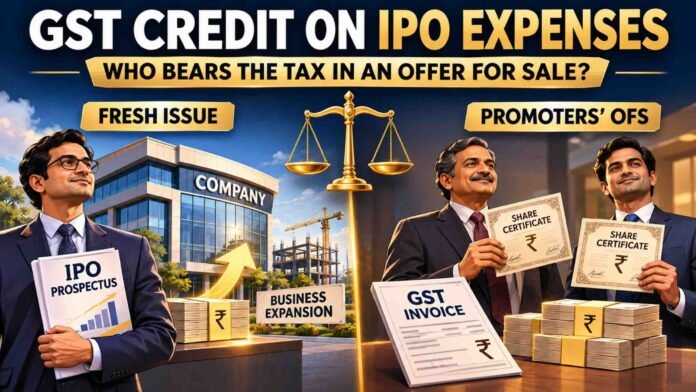
A fresh issue raises capital for the company. An offer for sale pays the selling shareholders. This distinction is central to deciding who can claim GST credit—and who ultimately bears unrecoverable tax on IPO expenses.
An initial public offering may involve substantial expenditure on merchant bankers, legal advisers, auditors, registrars, advertising, underwriting and stock exchange services. Although these expenses appear under one offer, they may serve different transactions.
Some expenses help the company raise fresh capital for its business. Others facilitate promoters or investors selling their existing shares. Treating the entire GST amount as the company’s input tax credit can therefore create a significant exposure.
Credit on fresh-issue expenses is supportable where the services further the company’s business, subject to all statutory conditions and restrictions. Expenses attributable to shareholders’ own sales ordinarily do not qualify for credit in the issuer’s hands merely because it facilitates the offer or pays the invoices.
Buy Now: All 200+ GSTAT Judgements Till November 2026 | Comprehensive E-Magazine
Fresh issue versus offer for sale
| Particulars | Fresh issue | Offer for sale |
| What happens? | Company issues new shares | Existing shareholders sell existing shares |
| Who receives the proceeds? | Company | Selling shareholders |
| Commercial objective | Finance company’s stated business purposes | Provide liquidity or an exit to sellers |
| New equity issued? | Yes | No |
| Company’s ITC position | Supportable subject to business nexus and statutory restrictions | Ordinarily unavailable for seller-attributable expenses |
| Expense responsibility | Company’s attributable expenses | Selling members’ attributable expenses |
| GST on share consideration | No GST on equity securities themselves | No GST on equity securities themselves |
A combined IPO requires identification of company-specific, seller-specific and genuinely shared expenditure.
Shares are outside GST, but services connected with them can be taxable
Section 2(52) of the Central Goods and Services Tax Act, 2017 excludes securities from “goods”. Section 2(101) adopts the securities definition in Section 2(h) of the Securities Contracts (Regulation) Act, 1956. Section 2(102) excludes securities from “services”.
However, the Explanation to Section 2(102) expressly states:
“the expression ‘services’ includes facilitating or arranging transactions in securities”
Thus, the share consideration itself does not attract GST, while services facilitating the transaction can be taxable. Their classification, rate, place of supply and any reverse-charge liability require separate examination. indiacode.nic.in
Section 16: capital raising can further the company’s business
Section 16(1) permits eligible registered persons to claim credit on inward supplies:
“used or intended to be used in the course or furtherance of his business”
The provision does not require every business expense to become a physical component of the goods sold or to produce an immediately identifiable taxable invoice.
Section 2(17)(b) also includes within “business”:
“any activity or transaction in connection with or incidental or ancillary to sub-clause (a)”
Consequently, services used to raise capital for business expansion, working capital or repayment of business borrowings can have a business nexus. But this establishes only the starting point: the remaining conditions under Section 16 and restrictions under Section 17 still apply. indiacode.nic.in
Material provisions governing IPO expense credit
| Provision | What it addresses | Practical relevance |
| Section 2(17) | Business | Includes incidental and ancillary activities |
| Sections 2(52), 2(101), 2(102) | Securities and services | Separate shares from taxable facilitation services |
| Section 2(93) | Recipient | Helps identify the recipient through contractual liability for consideration |
| Section 16(1) | Business use | Core entitlement test |
| Section 16(2)(a) | Prescribed invoice/document | Proper supporting documentation |
| Section 16(2)(aa) | Supplier reporting and communication | Relevant invoice details must be reported and communicated where applicable |
| Section 16(2)(b) | Receipt | Goods or services must be received, including statutory deemed receipt |
| Section 16(2)(ba) | Restrictions communicated under Section 38 | Communicated credit must not be restricted |
| Section 16(2)(c) | Tax payment | Tax charged must have been paid to Government |
| Section 16(2)(d) | Return filing | Claimant must furnish the prescribed return |
| Section 16(2), payment provisos; Rule 37 | Payment within 180 days | Proportionate reversal/payment for unpaid amounts, with applicable interest; RCM exclusion applies |
| Section 16(4) | Claim deadline | Ordinarily 30 November following the financial year or relevant annual return, whichever is earlier |
| Sections 17(1) and 17(2) | Apportionment | Restrict non-business and exempt-use credit |
| Section 17(3) | Securities transactions | Relevant to exempt-supply value for reversal |
| Section 17(5) | Blocked credits | Applies separately to individual expense categories |
| Rules 36 and 46 | Documents and invoices | Prescribed evidence and invoice particulars |
| Rules 42 and 43 | Credit reversal | Inputs/input services and capital goods respectively |
| Chapter V Explanation to CGST Rules | Securities valuation | Prescribes 1% of securities’ sale value for relevant apportionment |
| Sections 2(61), 20; Rule 39 | Input Service Distributor | Relevant to services received for distinct GST registrations |
| Sections 7 and 15; Schedule I; Rules 28 and 33 | Recovery from sellers | Supply, related-person valuation and pure-agent questions |
| Section 103 | Advance rulings | Limits binding effect |
| Section 155 | Burden of proof | Claimant must substantiate eligibility |
| Companies Act Section 28(3) | OFS expenses | Selling members must reimburse attributable expenses |
These provisions operate together; no single invoice description or accounting entry determines eligibility. indiacode.nic.in
Telangana ruling distinguishes fresh-issue expenses from shareholders’ OFS
The Telangana department’s official register records Sai Silks Kalamandir Limited, Application No. A.R.Com/21/2024, dated 18 September 2026. Published reports identify the decision as TS AAR Order No. 10/2026.
The reported holding allows credit on fresh-issue expenses where the net proceeds further the company’s business, while denying the issuer credit on expenditure attributable to shareholders’ OFS because those proceeds do not accrue to the company. tgct.gov.in
| Case detail | Particulars |
| Applicant | Sai Silks Kalamandir Limited |
| Authority | Telangana Authority for Advance Ruling |
| Application | A.R.Com/21/2024 |
| Reported order number | TS AAR No. 10/2026 |
| Date | 18 September 2026 |
| Central distinction | Company’s fresh capital versus selling shareholders’ proceeds |
Verification note: the official register confirms the applicant, application and date. The substantive holding above is attributed to published reports; the original signed order was not obtained in this research.
Under Section 103, an AAR generally binds the applicant and the concerned or jurisdictional officer in respect of that applicant. It is persuasive guidance for other taxpayers, rather than a nationwide binding judgment. indiacode.nic.in
Why paying the invoice does not establish entitlement
Three questions must be examined separately:
- Who contracted for and is legally liable for the service?
- Who received or used it, including any statutory deemed receipt?
- Whose business does the expenditure further?
A company’s payment of a promoter-specific advisory bill does not automatically make that service eligible for company credit.
Similarly, a promoter and the company remain separate legal persons. The fact that the shares being sold are shares in that company does not make the shareholder’s disposal the company’s own capital raising.
The company may obtain commercial benefits from listing. However, that general benefit does not automatically establish entitlement to credit on every expense exclusively attributable to a shareholder’s exit.
Who must bear the promoters’ OFS expenses?
Section 28(3) of the Companies Act, 2013 requires selling members to authorise the company to act on their behalf and provides:
“they shall reimburse the company all expenses incurred by it on this matter”
This is directly relevant where the company initially pays expenses attributable to members’ public sale of shares. In a combined IPO, the company’s own expenses and genuinely shared expenditure still need proper allocation. mca.gov.in
| Question | Position |
| Who discharges GST on an ordinary forward-charge service? | The supplier |
| Who discharges GST where reverse charge applies? | The specified recipient |
| Who can claim ITC? | The eligible registered recipient satisfying the statutory requirements |
| Who should bear seller-attributable OFS expenses? | Selling members, including reimbursement under Section 28(3) |
| Who bears unrecoverable GST commercially? | The party to whom the expense is properly attributable |
| Can an agreement create otherwise unavailable credit? | No |
A contractual indemnity may shift the economic burden of tax, interest or penalties. It does not prevent the authorities from proceeding against the person who made an incorrect credit claim.
How should common IPO expenses be allocated?
Direct attribution should precede allocation of shared expenses.
| Expense | Starting point |
| Advice exclusively concerning fresh capital | Company |
| Advice exclusively concerning a promoter’s disposal | Selling shareholder |
| Shared prospectus, marketing or book-building work | Reasonable documented allocation |
| Company’s continuing listing/compliance services | Independent assessment as company expenditure |
| Catering, gifts or personal expenditure | Separate blocked-credit/non-business examination |
A fresh-issue/OFS proceeds ratio can be reasonable for genuinely common services. A share-number ratio may give the same result where the offer price is identical.
However, there is no universal GST rule requiring that ratio for every IPO expense. Adviser scope, billing records and the offer agreement may support a different allocation.
Commercial allocation between company and sellers also differs from statutory reversal of the claimant’s own common credit under Rules 42 and 43.
The 1% securities rule: a frequent source of error
Section 17(3) includes transactions in securities when determining exempt-supply value for Section 17(2).
The Explanation to Chapter V of the CGST Rules states:
“the value of security shall be taken as one per cent. of the sale value of such security.”
This is a valuation mechanism for apportionment. It does not mean that shares attract GST at 1%, or that only 1% of the GST on securities-sale expenses must be reversed. indiacode.nic.in
Under Rule 42, exclusively exempt-use credit is identified separately. The turnover formula applies to the residual common-credit pool:
D1 = (E ÷ F) × C2
| Symbol | Meaning |
| D1 | Exempt-attributable common credit |
| E | Relevant exempt-supply value |
| F | Total turnover in the State for the relevant period |
| C2 | Residual common credit determined under Rule 42 |
Applicable non-business common-use adjustment is separate.
Fresh issue needs a separate reversal analysis
Fresh allotment creates shares; an OFS transfers existing shares. Whether and how Section 17(3) and the securities sale-value mechanism apply to fresh issuance requires examination beyond the initial business-nexus test.
The issuer may argue that issuing its own equity is capital formation rather than sale of an investment. Nevertheless, the broad expression “transactions in securities” requires a considered position. The reported AAR should not be portrayed as resolving every reversal question.
Nor should promoters’ OFS proceeds automatically become the issuer’s exempt turnover. Identify whose securities transaction—and whose input credit—is being examined.
Can the promoter claim the GST instead?
Denial to the issuer does not transfer credit to the shareholder.
| Seller | Position requiring examination |
| Unregistered individual selling personal investments | No ordinary ITC entitlement |
| Registered individual with another taxable business | Registration does not make personal disposal expenditure creditable |
| Corporate promoter | Direct securities-disposal restrictions apply |
| Corporate seller with taxable operations | Direct costs and common costs require separate treatment |
| Specified bank/financial institution/NBFC | Section 17(4) and applicable Rule 38 mechanism may be relevant |
For an ordinary corporate seller, credit exclusively attributable to securities disposal is generally excluded separately. The 1% turnover valuation does not convert that expenditure into predominantly eligible credit.
Is reimbursement by promoters subject to GST?
“At actual cost” is not, by itself, a GST exemption.
First establish whether the company makes a supply to the selling shareholder. Where it does, classification, consideration and valuation must be examined. Related-person provisions may also become relevant.
Rule 33 permits exclusion of qualifying pure-agent expenditure from the value of a supply, subject to its complete conditions. These include contractual authority, authorised payment, no title to the procured supplies, no own-interest use, actual recovery, separate disclosure and procurement additional to services supplied on own account. cbic-gst.gov.in
For shared IPO services that the company itself uses, the “own interest” condition deserves particular attention.
Section 28(3) reimbursement does not automatically establish Rule 33 compliance. Equally, denial of inward ITC does not automatically establish that reimbursement is a taxable outward supply. Each question requires its own analysis.
Practical examples and illustrations
All figures below are hypothetical. An illustrative 18% rate is assumed; actual tax treatment depends on the service. Allocation examples do not resolve any separate fresh-issue reversal issue.
Illustration 1: Fresh capital for business expansion
A manufacturer raises ₹300 crore through fresh equity for expansion and working capital. Eligible professional fees are ₹4 crore.
| Particulars | Amount |
| Professional fees | ₹4 crore |
| Assumed GST at 18% | ₹72 lakh |
| Gross payment | ₹4.72 crore |
| Potential credit before applicable restrictions/reversals | ₹72 lakh |
| Net expense if fully eligible and credit is usable | ₹4 crore |
The ₹300 crore equity receipt does not itself attract GST. The ₹72 lakh credit depends on the services and compliance conditions.
Illustration 2: Promoters’ pure OFS
Promoters receive ₹500 crore from selling existing shares. Services exclusively attributable to their sale cost ₹3 crore plus GST.
| Particulars | Amount |
| Seller-specific fees | ₹3 crore |
| GST | ₹54 lakh |
| Gross seller-attributable expenditure | ₹3.54 crore |
| Issuer’s ordinary ITC on those costs | Nil |
If the company advances the payment, the seller-attributable settlement should include the unrecoverable GST. Any separate supply or pure-agent treatment must first be established.
A pure OFS can still involve distinct company expenditure with demonstrable own-business use; that expenditure needs independent examination.
Illustration 3: Combined fresh issue and OFS
An IPO contains ₹600 crore fresh issue and ₹400 crore OFS. Assume a 60:40 split reasonably reflects genuinely shared services.
| Category | Fees | GST | Company-attributable GST | Seller-attributable GST |
| Common services | ₹5 crore | ₹90 lakh | ₹54 lakh | ₹36 lakh |
| Fresh-issue-only services | ₹1 crore | ₹18 lakh | ₹18 lakh | Nil |
| Seller-only services | ₹50 lakh | ₹9 lakh | Nil | ₹9 lakh |
| Total | ₹6.50 crore | ₹117 lakh | ₹72 lakh | ₹45 lakh |
The company then applies its own eligibility restrictions to the ₹72 lakh attributable to it.
Applying 60% mechanically to all ₹117 lakh would produce ₹70.20 lakh. That difference demonstrates why exclusive costs must be separated first.
Illustration 4: Securities sale and common credit
A corporate seller has ₹99 crore taxable turnover and ₹100 crore securities-sale consideration in the relevant period. Assume ₹10 lakh residual common credit, no other adjustments and no special financial-institution regime.
| Calculation | Amount |
| Securities sale consideration | ₹100 crore |
| Deemed exempt value at 1% | ₹1 crore |
| Total relevant turnover | ₹100 crore |
| Exempt proportion | 1% |
| Common-credit reversal | ₹10,000 |
If another ₹18 lakh GST relates exclusively to the securities disposal, that credit is separately excluded. The ₹10,000 calculation does not replace that exclusion.
Illustration 5: Adviser paid after 180 days
An otherwise eligible invoice is ₹10 lakh plus ₹1.80 lakh GST. Only half the gross invoice is paid within 180 days.
The credit corresponding to the unpaid half is ₹90,000. Rule 37 requires the corresponding reversal/payment with applicable interest. Re-availment is permitted following the relevant payment, subject to the rule.
Waiting for IPO proceeds does not itself suspend the payment condition. IndiaCode
Particular expenses still require individual scrutiny
| Expense | Key issue |
| Merchant banking and registrar services | Recipient, business purpose and allocation |
| Advocate services | Applicable reverse-charge treatment and credit conditions |
| Overseas advisers | Import-of-service and place-of-supply analysis |
| Advertising and printing | Fresh issue/OFS attribution |
| Food and catering | Section 17(5)(b), including exceptions |
| Gifts/free samples | Section 17(5)(h), where applicable |
| Personal consumption | Section 17(5)(g) and business-use restrictions |
| D&O insurance | Actual cover and purpose; not automatically life/health insurance |
| Construction funded by IPO proceeds | Independent Section 17(5)(c)/(d) analysis |
| Annual listing services | Ordinary business-use and credit restrictions |
| Regulatory fees | Whether GST is actually chargeable, including exemption/RCM questions |
Accounting treatment does not decide entitlement. Charging expenses against securities premium does not, by itself, permit or prohibit credit.
Documentation and demand exposure
The company should preserve engagement letters, prospectus objects, cost-sharing agreements, invoice-level allocation, payment evidence, applicable GSTR-2B reconciliations, utilisation records, reversal workings and seller settlement statements.
Section 155 places the burden on the claimant:
“the burden of proving such claim shall lie on such person.” indiacode.nic.in
Where services are received for distinct GST registrations, the ISD provisions also require examination. Credit should not automatically remain in one GSTIN merely because the registrations belong to the same company.
Wrongful-credit interest under Section 50(3) concerns credit wrongly availed and utilised, read with Rule 88B. Specific reversal provisions require their own interest analysis.
The demand provision also depends on the period: Sections 73/74 address periods up to FY 2023–24, while Section 74A applies from FY 2024–25 onwards. indiacode.nic.in
Frequently asked questions
1. Is GST payable on IPO share proceeds?
No GST is charged on equity securities themselves. Connected professional services can be taxable.
2. Is full credit available on every fresh issue?
No. Business nexus, receipt, documentation, reporting, deadlines, blocked credits and applicable apportionment must all be examined.
3. Can the company claim all credit because it appointed the advisers?
Appointment is relevant evidence, but it does not override the actual supply, use and seller-attributable elements.
4. Is a fresh-issue/OFS ratio compulsory?
No universal GST ratio applies to every expense. Direct attribution should precede allocation of shared costs.
5. Does the 1% rule mean 99% of disposal-related GST is claimable?
No. It values securities turnover for apportionment; it does not override direct exclusion.
6. Can a GST-registered promoter claim the credit?
Registration alone is insufficient. Personal investment disposal and securities-related expenditure remain subject to restrictions.
7. Are reimbursement and pure-agent recovery the same?
No. Pure-agent treatment requires satisfaction of Rule 33, beyond recovery without a mark-up.
8. Does Section 28(3) automatically exempt reimbursement from GST?
No. Company-law reimbursement and GST supply/valuation are separate questions.
9. Can pre-registration IPO service credit be claimed after registration?
Do not assume so. Section 18’s opening-credit provisions are limited and do not generally preserve pre-registration input-service credit. Registration timing should be addressed before invoicing.
10. What if the IPO is abandoned?
Abandonment alone does not automatically negate evidenced intended business use under Section 16(1). Actual services, seller components, credit notes and other restrictions still require review. This is a statutory analysis, not a conclusion attributed to the reported AAR.
11. Does the Telangana AAR bind every issuer?
No. Its binding effect is limited under Section 103; others may use its reasoning persuasively.
12. Who bears the demand if the company wrongly claims promoter-related credit?
The claimant faces the statutory demand. Recovery from promoters depends on applicable legal obligations and enforceable contractual arrangements.
13. Does this analysis cover capital gains tax or STT?
No. Capital gains tax, securities transaction tax and stamp duty are separate levies.
The practical task is to identify whose expense each invoice represents, establish the company’s business use, and separately examine statutory reversals and shareholder recoveries. That approach determines whether GST becomes usable credit or an additional OFS cost borne by the selling shareholders.
Read More: Customs Penalties U/s 112, 114 Doesn’t Bar Special Warehouse Licence: CESTAT

