
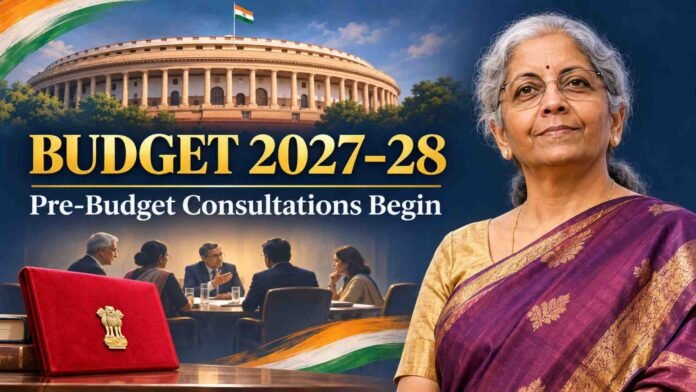
Union Finance Minister Nirmala Sitharaman chaired the first pre-Budget consultation with leading economists in New Delhi on Monday, November 16, beginning discussions ahead of the Union Budget for the financial year 2027-28.
According to the Finance Ministry, the meeting was attended by the Secretary of the Department of Economic Affairs (DEA), the Chief Economic Adviser to the Government of India and senior officials from the department.
The consultation comes as industry bodies put forward proposals for tax relief, lower manufacturing costs and improved access to finance. Among the demands submitted ahead of the Budget are the abolition of long-term capital gains tax on equity investments and a reduction in short-term capital gains tax.
Buy Now: Indirect Tax Judgments E-Compilation – October 2026
Finance Ministry Confirms Meeting With Economists
In a post on X, the Finance Ministry confirmed that Sitharaman chaired the consultation with economists in connection with the forthcoming Union Budget.
The ministry’s announcement identified the senior officials present but did not provide a detailed account of the recommendations made during the meeting. It also did not announce any policy decisions arising from the discussions.
Pre-Budget consultations provide an opportunity for stakeholders to present their assessment of economic conditions and suggest measures for consideration during Budget preparation.
The Union Budget is traditionally presented on February 1. Sitharaman presented the Budget for 2026-27 on February 1 this year.
PHDCCI Calls for Removal of LTCG Tax on Equities
Capital market taxation figures prominently in the proposals submitted by the PHD Chamber of Commerce and Industry (PHDCCI).
On November 10, the chamber urged the government to abolish long-term capital gains (LTCG) tax on equity investments. It also recommended reducing the short-term capital gains (STCG) tax rate to 10% from 20%.
PHDCCI presented its recommendations for the financial year 2027-28 to Sitharaman and senior Finance Ministry officials last week.
Alongside its capital gains tax proposals, the chamber sought a reduction in securities transaction tax (STT). These recommendations form part of its broader push for changes to the tax and investment framework aimed at strengthening India’s capital markets.
The proposals remain industry demands. The information released about Monday’s consultation does not indicate whether the government has accepted them or whether they formed part of the economists’ discussions.
Customs Duty Waiver Sought on Industrial Inputs
PHDCCI has also sought the removal of the 2.5% basic customs duty on imports of liquefied natural gas (LNG), naphtha and heavy petroleum feedstocks.
The chamber argued that reducing the cost of these inputs would help improve the competitiveness of domestic industries.
Its submission also called for measures to ease financing constraints faced by micro, small and medium enterprises (MSMEs). The recommendations bring together concerns over investment, business funding and production costs as manufacturers and smaller enterprises outline their expectations from the Budget.
Growth and Fiscal Discipline Remain Key Background Issues
The previous round of pre-Budget discussions took place amid geopolitical uncertainty and mounting trade pressures, including steep US tariffs on certain shipments.
Those discussions examined the challenge of supporting domestic demand and economic expansion while maintaining fiscal discipline and pursuing deficit-reduction objectives.
Other issues included sustaining GDP growth above 7%, encouraging private investment, attracting foreign investment and responding to changes in foreign portfolio investor flows.
These were themes raised during the earlier consultation process. The Finance Ministry’s announcement of Monday’s meeting did not specify the economic forecasts, fiscal recommendations or tax measures discussed by the participating economists.
External Account Developments Add to Economic Backdrop
Separately, the supplied report cited Reserve Bank of India data showing that India’s current account deficit widened to $7.4 billion in September 2026, against $5.2 billion in the corresponding month a year earlier, primarily because of a higher import bill.
Developments in imports, investment flows and global trade form part of the wider economic backdrop to Budget preparation.
With consultations now underway, the government will consider recommendations from economists and other stakeholders as it prepares its expenditure priorities and revenue proposals for 2027-28. Any decision on the tax changes sought by industry will depend on the government’s final Budget proposals.
Read More: Merely Reproducing SCN Reply Is Not Reasoned Adjudication: CESTAT

