
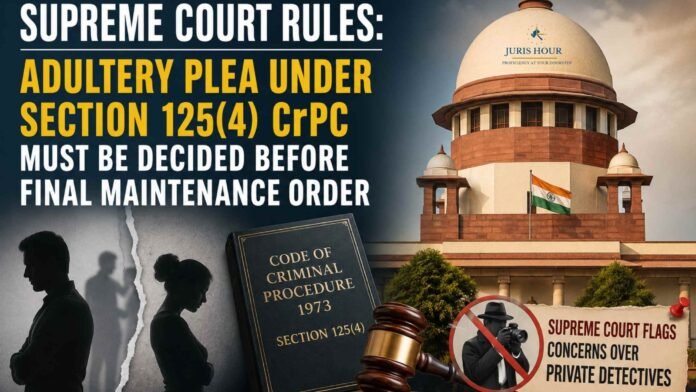
The Supreme Court has held that a husband’s plea alleging that his wife is living in adultery under Section 125(4) cannot be deferred until the final adjudication of the maintenance case. Instead, the issue must be decided after the grant of interim maintenance and before the final determination of maintenance entitlement.
The bench of Justice Sanjay Karol and Justice Vipul M. Pancholi also expressed serious concern over the growing use of private investigators in matrimonial disputes and called upon the Union Government and the Law Commission to examine the need for a regulatory framework governing private detective agencies.
The appellant and respondent were married in July 2014. Matrimonial disputes arose several years later, following which the wife left the matrimonial home in May 2020 along with their minor son. She subsequently initiated proceedings under Section 125 CrPC before the Special Additional Chief Judicial Magistrate, Udaipur, seeking maintenance for herself and the child.
Buy Now: Supreme Court Judgments E-Magazine – 5 Month Combo (2026) (1st February – 30th June 2026)
During the pendency of those proceedings, the husband invoked Section 125(4) CrPC, alleging that his wife was living in an adulterous relationship and therefore stood disqualified from claiming maintenance. To support his allegations, he produced photographs, electronic material and other documents. However, the trial court refused to decide the application at that stage, observing that the authenticity of the electronic evidence could only be examined after a full-fledged trial. The Rajasthan High Court endorsed this view, holding that the allegations constituted disputed questions of fact which could only be determined during final adjudication.
The husband challenged the High Court’s decision before the Supreme Court.
The Supreme Court undertook a detailed analysis of the object and structure of Section 125 CrPC, reiterating that maintenance proceedings are summary in nature and intended to prevent destitution and ensure dignity for spouses, children and parents who are unable to maintain themselves. The Bench noted that maintenance provisions are welfare-oriented and should ordinarily receive a liberal interpretation consistent with their social justice objective.
At the same time, the Court observed that Parliament had consciously incorporated Section 125(4), which expressly disentitles a wife from claiming both interim and final maintenance if she is living in adultery, refuses without sufficient reason to live with her husband, or the parties are living separately by mutual consent. The Court held that these statutory disqualifications cannot be rendered meaningless by postponing their consideration until the end of the proceedings.
Rejecting the approach adopted by the courts below, the Supreme Court ruled that an application under Section 125(4) must be adjudicated before the final maintenance order.
The Bench clarified that the filing of an adultery application does not automatically suspend interim maintenance. Interim maintenance should ordinarily continue while the court examines the allegations. However, where the husband produces clear, cogent and prima facie evidence establishing adultery or another statutory disqualification under Section 125(4), the court may refuse or discontinue interim maintenance after examining such evidence.
The Court illustrated two possible situations. If the allegations are admitted or established on the face of the record, interim maintenance may be denied immediately. Conversely, if the allegations require detailed evidentiary examination, interim maintenance should continue until the Section 125(4) application is conclusively decided.
Applying these principles, the Supreme Court found that the trial court had committed an error by refusing to consider the husband’s application altogether merely because the evidence required examination.
The husband had relied on numerous photographs and electronic records alleging an adulterous relationship. While the wife remained free to dispute the authenticity and admissibility of the material, the Court held that the trial court was duty-bound to assess whether the evidence established a prima facie case warranting denial of maintenance under Section 125(4). Instead, the court incorrectly deferred the issue to the stage of final adjudication, effectively defeating the statutory scheme.
Accordingly, the Supreme Court set aside the Rajasthan High Court’s judgment and remanded the matter to the trial court for fresh consideration of the husband’s application under Section 125(4) on its merits.
Beyond the maintenance dispute, the judgment contains significant observations regarding the increasing reliance on private investigators in matrimonial litigation.
The Court noted that the husband had produced around 237 photographs and 92 videos allegedly depicting the wife’s relationship with another person. This prompted the Bench to raise larger questions concerning who collected such material, whether they had any legal authority to do so, how the data was stored, whether it had been altered using modern technology, and how individual privacy rights were protected.
The Court observed that India presently lacks a comprehensive legal framework governing private detective agencies, despite their growing role in evidence collection. It referred to the Private Detective Agencies (Regulation) Bill, 2007, which proposed licensing, regulation and oversight of such agencies but never became law. The Bench stressed that while private investigations have assumed increasing importance, they must operate within a regulated legal framework balancing investigative needs with privacy and accountability.
The Supreme Court also highlighted that photographs, videos and other electronic records relied upon in maintenance proceedings must satisfy the legal requirements governing admissibility, including compliance with Section 65B of the Indian Evidence Act, 1872 (and its equivalent under the Bharatiya Sakshya Adhiniyam, 2023). The Court reiterated that questions regarding the authenticity, source and integrity of electronic evidence remain crucial before such material can be relied upon by courts.
Recognising the legislative vacuum surrounding private investigators, the Supreme Court directed that copies of the judgment be forwarded to the Secretary, Ministry of Law and Justice, Government of India, and the Chairman of the Law Commission of India for appropriate consideration of a regulatory framework governing private investigation agencies.
Membership Required to Access Case Details & Order Copy
To view the complete Case Details and Download Order Copy, you must have an active membership. Please subscribe to continue.

