
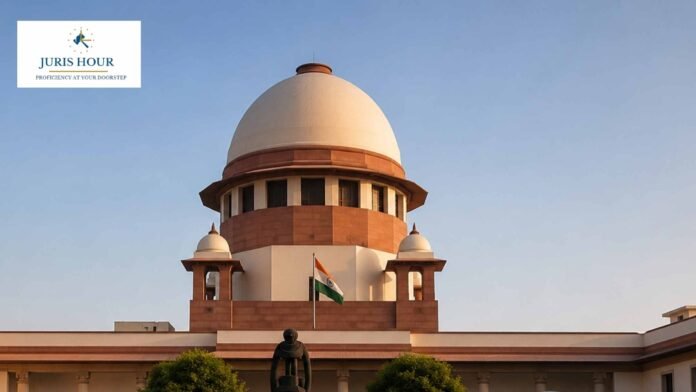
The Supreme Court has held that a purchaser seeking enforcement of an agreement to sell must continuously demonstrate financial readiness and willingness to perform contractual obligations throughout the litigation.
Restoring the Trial Court’s decision, the bench of Justice Prashant Kumar Mishra and Justice N.V. Anjaria refused to enforce a 2004 agreement for the sale of a valuable property in Ooty, while allowing the purchasers to recover the advance amount with interest.
The litigation arose out of an Agreement to Sell executed on 1 April 2004, under which the owner of a prime property situated on Church Hill Road, Udhagamandalam (Ooty), agreed to sell the property for a consideration of ₹2.25 crore. The purchasers claimed to have paid an advance of ₹85 lakh, while the seller disputed the amount, maintaining that only ₹60 lakh had actually been received.
Buy Now: Supreme Court Judgments E-Magazine – 5 Month Combo (2026) (1st February – 30th June 2026)
Alongside the agreement, the seller also executed a General Power of Attorney in favour of the purchaser’s husband, authorising him to deal with the property, execute sale documents, receive consideration and undertake other acts necessary to complete the transaction. The agreement further stipulated that the sale would be completed within 60 days after an ex parte preliminary decree in a pending partition suit was set aside, with the contract expressly providing that time would be of the essence.
The transaction soon became contentious. Several cheques issued towards the sale consideration were dishonoured due to insufficient funds before being replaced through cash payments. During the subsistence of the agreement, the attorney-holder also entered into another agreement to sell the same property to a third party at a lower price, leading to separate litigation.
Subsequently, the seller revoked the Power of Attorney, terminated the agreement alleging breach by the purchasers, and both sides initiated criminal proceedings against each other. The purchasers eventually instituted a suit seeking specific performance of the agreement or, alternatively, refund of the money advanced.
The Trial Court accepted that the purchasers had paid ₹85 lakh and held that the seller was liable to refund the amount with interest. It also created a statutory charge over the property in favour of the purchasers.
However, despite recording findings favourable to the purchasers on several factual issues, the Trial Court declined to grant specific performance. It held that the purchasers had failed to approach the court with clean hands, particularly because one of them had filed a criminal complaint seeking recovery of the advance amount while simultaneously pursuing enforcement of the agreement. The court concluded that such inconsistent conduct disentitled them to the equitable relief of specific performance.
The Madras High Court reversed the Trial Court’s refusal and decreed specific performance. It held that the purchasers had remained ready and willing to perform the contract and relied upon documents showing their efforts to arrange finances, including production of a demand draft of ₹1.40 crore during the appellate proceedings.
The High Court directed the purchasers to deposit the balance sale consideration and ordered execution of the sale deed in their favour.
Allowing the seller’s appeals, a Bench restored the Trial Court’s decree and set aside the High Court’s judgment.
The Supreme Court held that the High Court committed a serious error in concluding that the purchasers had established continuous readiness and willingness merely because they produced a demand draft during the appeal several years after institution of the suit.
The Court observed that a plaintiff seeking specific performance must establish availability of funds and readiness to complete the transaction from the date of the agreement until the passing of the decree. Readiness cannot be demonstrated only at the appellate stage after years of litigation.
The Court found that the evidence did not support the purchasers’ claim that they possessed sufficient financial resources when performance became due.
It noted that two substantial cheques issued towards the sale consideration had been dishonoured because of insufficient funds. The Memorandum of Understanding relied upon to show financial arrangements was neither referred to in the legal notices nor disclosed in the plaint. The subsequent sale of the purchasers’ own properties occurred only in 2006, whereas the suit had been filed in September 2005, demonstrating that funds were not available when the contractual obligations arose.
The Supreme Court therefore held that the purchasers failed to establish the continuous readiness and willingness mandated under Section 16(c) of the Specific Relief Act.
The Court also attached considerable significance to the conduct of the purchasers.
It observed that while seeking specific performance before the civil court, one of the purchasers simultaneously filed a criminal complaint asking the police to trace the seller and recover the advance money. Such conduct, according to the Court, was inconsistent with the stand that the contract remained subsisting and deserved enforcement.
The Bench rejected the High Court’s view that the criminal complaint was merely a “counterblast” to the seller’s earlier complaint. Instead, it held that litigants seeking equitable relief cannot adopt contradictory positions in different proceedings and then expect the court to exercise discretion in their favour.
The Supreme Court further noted that the purchasers had taken mutually inconsistent positions concerning a subsequent agreement executed in favour of a third party.
In one set of proceedings they asserted that contractual rights had been assigned to the third party, whereas in the suit for specific performance they maintained that no assignment had ever taken place and that they alone remained entitled to enforce the original agreement.
The Court held that such contradictory pleadings undermined their bona fides and weighed heavily against grant of equitable relief.
The seller also argued that the suit itself was not maintainable because the purchasers had not sought a declaration that termination of the agreement was invalid.
Rejecting this contention, the Supreme Court relied upon its recent decisions and clarified that where an agreement does not confer any contractual right upon one party to unilaterally terminate the contract, the aggrieved purchaser may treat such termination as repudiation and directly seek specific performance without separately seeking declaratory relief.
The Court additionally observed that more than twenty years had elapsed since execution of the agreement. During this period, one purchaser had died and the seller had reached an advanced age.
Considering the long lapse of time, the equities of the case, and the discretionary nature of the remedy, the Bench concluded that compelling transfer of the property after such a prolonged period would not be just or equitable.
The Supreme Court restored the Trial Court’s decree directing refund of ₹85 lakh with interest while refusing specific performance of the agreement.
It also permitted the purchasers to withdraw the ₹1.40 crore that had earlier been deposited pursuant to the High Court’s directions, together with the accrued interest lying in fixed deposit.
Membership Required to Access Case Details & Order Copy
To view the complete Case Details and Download Order Copy, you must have an active membership. Please subscribe to continue.

