
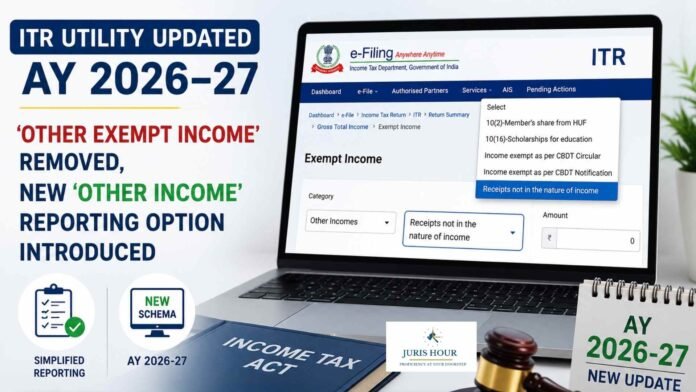
The Income Tax Department has introduced a significant structural change in the Income Tax Return (ITR) utility for Assessment Year (AY) 2026-27, altering the manner in which taxpayers can report exempt and non-taxable receipts.
One of the most noticeable changes is the removal of the ‘Other Exempt Income’ reporting option from the Exempt Income Schedule. The revised utility instead introduces a new reporting field titled “Other Income” under the Exempt Income section, reflecting a shift in the department’s reporting framework. The updated utility and schema for AY 2026-27 were released on 30 June 2026.
The AY 2026-27 ITR utility no longer permits reporting under “Other Exempt Income.” Instead, taxpayers who voluntarily disclose non-taxable capital receipts now have a dedicated option titled “Receipts not in the nature of income,” signalling a more technically accurate reporting framework for amounts that are outside the scope of taxable income.
Buy Now: INCOME TAX E-COMPILATION – JUNE 2026
Earlier Practice: Reporting Capital Receipts Under ‘Other Exempt Income’
In previous ITR utilities, taxpayers had the flexibility to disclose various receipts under the “Other Exempt Income”category, even where such receipts were technically not income at all under the Income-tax Act.
Many professionals voluntarily disclosed transactions such as:
- Sale proceeds of rural agricultural land, which generally do not constitute taxable capital gains.
- Gifts received from specified relatives, which are excluded from taxation under the Act.
- Other capital receipts or non-taxable amounts that were not chargeable to tax.
Although the Income-tax Act did not require such disclosures because these receipts were not regarded as income, many Chartered Accountants and tax professionals preferred reporting them as a precautionary measure to reduce the likelihood of automated scrutiny notices arising from information available in AIS or other reporting systems.
What Has Changed in AY 2026-27?
The revised ITR utility no longer contains the “Other Exempt Income” field.
Instead, taxpayers selecting the “Other Incomes” category under the Exempt Income Schedule are presented with a drop-down containing specific categories such as:
- Section 10(2) – Member’s share from HUF
- Section 10(16) – Scholarships
- Income exempt under CBDT Circular
- Income exempt under CBDT Notification
- Receipts not in the nature of income
The inclusion of “Receipts not in the nature of income” indicates that the department has distinguished between genuinely exempt income under Section 10 and receipts that fall outside the scope of income altogether.
Screenshot Reflects the New Reporting Structure
The updated utility displays the newly added option “Receipts not in the nature of income” in place of the earlier “Other Exempt Income” field.
This category may now be relevant where taxpayers voluntarily choose to disclose non-taxable capital receipts despite there being no statutory requirement to do so.
Does This Mean Disclosure Is Mandatory?
Not necessarily.
Legally, receipts that are not income do not ordinarily require disclosure merely because they are received.
For instance:
- Sale consideration from rural agricultural land, where the land does not qualify as a capital asset.
- Gifts received from specified relatives.
- Certain capital receipts outside the charging provisions of the Income-tax Act.
Such receipts generally remain outside the tax net.
However, many professionals have historically disclosed these transactions voluntarily to maintain consistency with information appearing in AIS, SFT reports, or banking records and to minimise the possibility of automated compliance queries.
The revised utility appears to recognise this distinction by replacing the broader “Other Exempt Income” field with the more technically accurate expression “Receipts not in the nature of income.”
Practical Impact for Tax Professionals
The change is likely to require tax practitioners to revisit their filing approach for clients who receive non-taxable capital receipts.
Professionals who earlier reported gifts from relatives, sale proceeds of rural agricultural land, or similar receipts under “Other Exempt Income” will now need to evaluate whether disclosure is necessary and, if they choose to disclose such receipts voluntarily, whether the newly introduced category “Receipts not in the nature of income” is the appropriate reporting head.
While the amendment does not alter the substantive tax treatment of these receipts, it changes their presentation in the ITR utility and may help distinguish exempt income from amounts that are outside the definition of income itself.
Read More: JURISHOUR | TAX LAW DAILY BULLETIN : 01 July, 2026

