
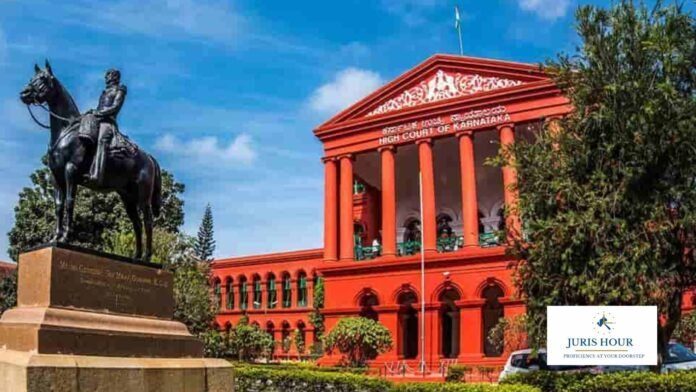
The Karnataka High Court has held that disputes relating to reimbursement of Goods and Services Tax (GST) arising from contractual terms cannot ordinarily be adjudicated in writ proceedings where disputed questions of fact exist.
A Division Bench comprising Chief Justice Vibhu Bakhru and Justice K.S. Hemalekha upheld the order of the Single Judge, which had earlier declined to entertain the contractor’s writ petition seeking reimbursement of GST paid on execution of a Smart City redevelopment project.
The dispute arose out of a tender floated by Davanagere Smart City Limited on November 3, 2018, for redevelopment of the Old City Bus Stand under the Davanagere Smart City Programme.
The contractor emerged as the successful bidder and entered into a work agreement on March 1, 2019. According to the contractor, the project site was handed over in June 2020, and nearly 90% of the work was completed during 2021–2022.
The contractor submitted 23 Running Account (RA) Bills, including the GST component allegedly paid under the CGST Act and the Karnataka SGST Act. While the employer cleared the RA bills, it allegedly did not reimburse the GST component, prompting the contractor to approach the High Court seeking a writ of mandamus directing payment of GST on the bills already raised as well as future bills.
Buy Now: GST Judgements E-Compilation – May 2026
The contractor argued that although the contract was executed after the introduction of GST in July 2017, the tender was based on the Schedule of Rates published in 2016, which did not factor in GST. Consequently, it contended that GST constituted an additional tax burden that ought to be reimbursed separately by the employer.
The State and Davanagere Smart City Limited opposed the petition by relying on the express terms of the contract.
The respondents pointed out that Clause 39 of the agreement clearly stipulated that the contractor’s quoted rates were deemed to be inclusive of all taxes payable for execution of the contract.
They also relied upon Clause 11 of the Instructions to Bidders, which specifically required bidders to include all duties, taxes and other statutory levies while quoting tender prices.
According to the respondents, the contractor’s claim involved interpretation of contractual provisions and factual issues that could not be resolved in writ jurisdiction.
The Division Bench agreed with the Single Judge that the controversy raised multiple disputed questions of law and fact.
The Court observed that the primary issue was whether the respondents were contractually liable to reimburse GST despite clauses stating that quoted rates were inclusive of taxes. Since the contractor disputed the applicability and interpretation of those clauses, the matter required detailed examination of contractual evidence.
The Bench further noted that even assuming the contractor could claim reimbursement of incremental GST, determination of the actual amount payable would require computation after deducting taxes already embedded in the contract rates.
Additionally, the Court observed that the contractor would also have to establish that it had actually paid the GST sought to be reimbursed.
These issues, the Court held, required adjudication on evidence and were not suitable for determination in proceedings under Article 226 of the Constitution.
The High Court also reiterated that the contract contained an arbitration clause providing an alternative dispute resolution mechanism. Since the dispute primarily arose out of contractual obligations and involved disputed factual issues, the contractor was at liberty to invoke arbitration instead of seeking writ relief.
Finding no infirmity in the Single Judge’s reasoning, the Division Bench dismissed the writ appeal.
Membership Required to Access Case Details & Order Copy
To view the complete Case Details and Download Order Copy, you must have an active membership. Please subscribe to continue.

