
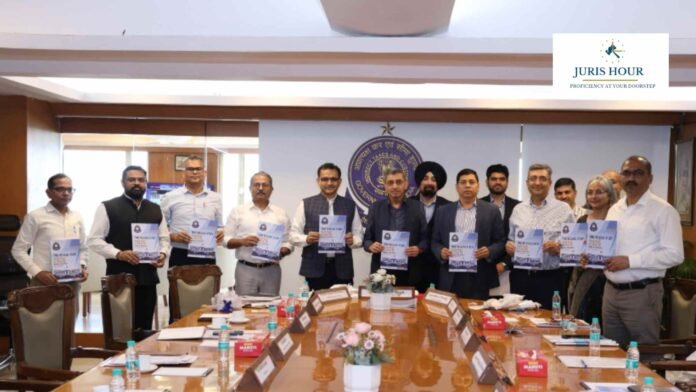
The Jawaharlal Nehru Custom House (JNCH) has recorded a significant improvement in cargo clearance efficiency, reducing the average release time for imported goods to 65 hours and 53 minutes despite handling 16% more Bills of Entry, according to its Time Release Study (TRS) 2026.
The report was released by Mohan Kumar Singh, Member (IT, Taxpayer Services and Technology), Central Board of Indirect Taxes and Customs (CBIC), on August 28, 2026, during his visit to Mumbai Customs Zone-II.
The release ceremony was attended by Vimal Kumar Srivastava, Chief Commissioner of Customs, Mumbai Zone-II, along with senior Customs officials and representatives from the Jawaharlal Nehru Port Authority (JNPA), port terminal operators, Customs brokers, trade associations and other stakeholders involved in cargo clearance operations.
Buy Now: E-Way Bill Judgements From 2020–2026 [Includes Orders of GSTAT]
Import Release Time Falls by Nearly Seven Hours
The TRS 2026 findings show that the Average Release Time (ART) for import consignments declined from 72 hours and 52 minutes in TRS 2025 to 65 hours and 53 minutes in the latest study.
This represents a reduction of approximately 9.6%, or nearly seven hours, over the previous study period. The improvement assumes added significance because JNCH simultaneously witnessed a 16% increase in the number of Bills of Entry processed.
The results indicate that higher cargo volumes did not lead to a corresponding increase in clearance delays. Instead, the Customs House managed to reduce the average time taken to release imported goods while handling a substantially larger number of declarations.
AEO Cargo Cleared Within 48-Hour Benchmark
The study also highlighted a sharp difference between the clearance performance of Authorised Economic Operator (AEO) consignments and non-AEO cargo.
AEO consignments registered an Average Release Time of 40 hours and 40 minutes. This was comfortably within the 48-hour benchmark prescribed under the National Trade Facilitation Action Plan (NTFAP).
By comparison, non-AEO consignments recorded an Average Release Time of 76 hours and 59 minutes. The figures demonstrate the clearance advantages available to businesses participating in the AEO programme, including risk-based facilitation and reduced regulatory intervention.
The gap between AEO and non-AEO release times also underscores the potential benefits for eligible importers that adopt stronger compliance systems and obtain AEO accreditation.
Export Release Time Also Improves
JNCH recorded progress on the export side as well. The overall release time associated with Shipping Bills declined to 195 hours and 49 minutes, compared with 208 hours and 15 minutes in the previous Time Release Study.
The reduction amounts to 12 hours and 26 minutes, indicating an improvement in the overall export cargo cycle.
However, the report reveals that the time directly attributable to Customs processes formed only a small portion of the total export release period. Customs clearance of export consignments took an average of just two hours and 12 minutes.
The balance of the release time was associated with logistics-related activities occurring outside the core Customs clearance process. These may include movement of goods to port terminals, documentation, terminal handling, container aggregation, vessel scheduling and other operational processes involving different stakeholders.
The findings suggest that further reduction in export turnaround time will require coordinated measures across the wider logistics ecosystem, rather than changes limited to Customs procedures alone.
CBIC Member Praises Customs and Trade Stakeholders
Addressing the gathering, Mohan Kumar Singh appreciated the efforts of JNCH officers and participating stakeholders in achieving sustained improvements in cargo clearance timelines.
He reiterated CBIC’s commitment to using evidence-based performance assessments such as Time Release Studies to identify procedural bottlenecks and formulate targeted trade-facilitation measures.
Singh observed that an efficient, technology-enabled and internationally competitive cross-border trading framework would be essential as India works towards the goal of “Viksit Bharat @2047.”
He further emphasised that faster and more predictable cargo clearance would help deepen India’s participation in global value chains and improve the competitiveness of domestic businesses engaged in international trade.
What Is a Time Release Study?
A Time Release Study is a performance-measurement methodology recommended by the World Customs Organization. It measures the time taken by cargo to move through different stages of arrival, regulatory clearance and final release.
The study helps Customs administrations and other border agencies identify the points at which delays occur. The resulting data can then be used to introduce procedural, technological or operational reforms.
Rather than examining Customs activity alone, the TRS evaluates the broader chain of events affecting cargo movement. It can therefore highlight delays caused by documentation, importer or exporter readiness, examination requirements, terminal operations, logistics arrangements and coordination among government agencies.
JNCH has been conducting the study annually, allowing it to compare year-on-year performance and assess whether trade-facilitation initiatives are producing measurable results.
Data Shows Progress Amid Growing Cargo Volumes
The TRS 2026 findings present a positive picture for import cargo clearance at JNCH. A reduction in release time, despite a considerable increase in the number of Bills of Entry, indicates improvement in the capacity of the port and Customs administration to manage rising trade volumes.
The strong performance of AEO consignments further supports the role of compliance-based facilitation programmes in accelerating cargo release.
For exports, the average Customs processing time of two hours and 12 minutes indicates that the major opportunities for further improvement lie in port and logistics operations. Closer coordination among Customs, port authorities, terminal operators, shipping lines, Customs brokers and exporters will consequently remain important for shortening the complete export cycle.
Overall, TRS 2026 reflects continued progress in reducing clearance timelines at one of India’s most important Customs locations, while also identifying areas in which greater stakeholder coordination could further improve the speed and predictability of cross-border trade.

